Decoding the True Cost of Stick-Built Homes
Trying to pin down the real cost of a stick-built home can feel like wrestling with a ghost. You hear numbers thrown around, but what does it all mean for your dream home? Let's get straight to it: the national average to build a brand-new, single-family home currently sits around $323,026.
Of course, that’s just an average. In reality, the final price tag can swing wildly, from a more modest $138,937 all the way up to $531,294 or more. The biggest culprits behind that massive range? Your location, the size of the house, and the level of finishes you decide you just can't live without.
Understanding the True Cost of Your Dream Home
When you first start thinking about building, the "cost per square foot" is the metric everyone latches onto. It’s a decent starting point, for sure, but it's only the first chapter of a much bigger story. Here at South Eastern General Contractors, we've spent over 21+ years of proven results helping people in Fayetteville, Lumberton, and beyond build their legacies. We know a successful project is always built on a foundation of client trust and a realistic budget.
Nationally, you can expect the cost per square foot for a standard stick-built home to land somewhere between $150 and $200. But if you're dreaming of a fully custom design with high-end, luxury finishes, that number can easily soar to $450 per square foot or higher. You can dig into some fascinating details about these national construction trends and what's pushing costs up.
Closer to home, in our communities, the numbers tell a slightly different story. As local leaders in the Fayetteville and Lumberton construction industry, we see unique costs shaped by regional labor rates, material availability, and specific building codes.
Stick Built Home Cost at a Glance: National vs. North Carolina
So, how does our corner of the world stack up against the rest of the country? To give you a better sense of what to expect, we’ve put together a quick comparison. Think of this as a starting point to frame your budget conversations.
| Metric | National Average Range | North Carolina (Fayetteville Area) Estimate |
|---|---|---|
| Cost Per Square Foot | $150 – $250+ | $140 – $225+ |
| Average Total Cost | $300,000 – $500,000+ | $280,000 – $450,000+ |
Actionable Insight: This table gives you a great ballpark figure, but remember that every single project is unique. The final cost isn't just about lumber and labor; it's a complex puzzle of land preparation, design fees, permits, and a thousand other small details that add up.
Building on Trust: Your final cost is more than just materials and labor. It's a combination of land preparation, design choices, permits, and countless other details. As a Native American-owned and HUBZone-certified firm deeply rooted in Fayetteville, we help our clients navigate every line item with confidence, ensuring there are no surprises. We build legacies, not just structures, and that process starts with total transparency and quality.
What's Actually Inside Your Home's Price Tag?
Ever wonder where all the money goes when you build a house? It’s not as simple as just adding up lumber and nails. Think of it like a recipe for a grand feast; you've got your main ingredients, the skilled chefs, and even the cost of the kitchen itself. To really get a handle on the stick built homes cost, you have to look at all the individual pieces that come together.
After two decades of building custom homes here in Fayetteville, Lumberton, and beyond, we at South Eastern General Contractors have learned that the best projects start with total transparency. So, let’s pull back the curtain and break down what you're truly paying for.
At a high level, your total budget is split between a few big players: the land you're building on, all the materials needed, and the crew of skilled people who actually put it all together.
This diagram gives you a quick, big-picture look at how it all shakes out.
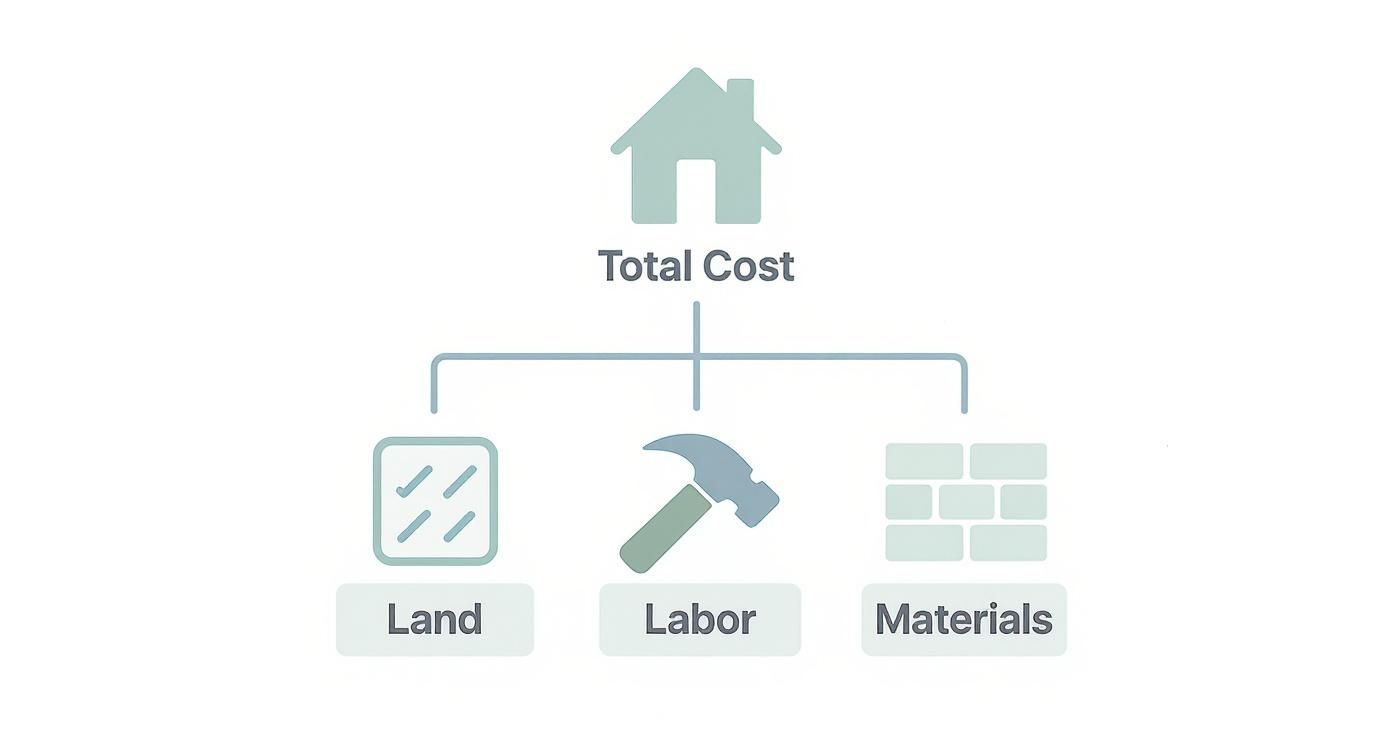
As you can see, the house itself is just part of the story. The land and labor are huge chunks of the final number.
The Big Four Construction Costs
Now, let's zoom in on the actual construction process. This is where we can slice the budget into four main phases—each one a massive step in turning that dream on paper into a place you can call home.
- Land & Site Prep: This is ground zero. Before a single 2×4 is cut, you have to buy your lot, clear it, grade it, and get it ready for building. This part of the budget also covers the crucial step of hooking up utilities like water, sewer, and power. Depending on how far you are from existing lines, this can be a surprisingly big-ticket item.
- Foundation & Framing: We call this the "skeleton" of the house, and for good reason! It’s when your home starts to take physical shape. This includes pouring the concrete foundation and then erecting the massive wood frame that creates your walls, floors, and roof. It’s a huge chunk of your material and labor costs.
- Exterior & Interior Finishes: This is the fun part—where your home gets its personality! On the outside, you’re talking roofing, siding, windows, and doors. Getting detailed roofing cost estimates is a smart move, as it's a major exterior expense. Inside, it's all about drywall, paint, flooring, cabinets, countertops, and light fixtures. Your choices here have a massive impact on the final cost.
- Major Systems (The "Rough-Ins"): These are the guts of your home—the things you don't see but can't live without. We're talking about your entire HVAC system for heating and air, all the plumbing pipes and fixtures, and every inch of electrical wiring. These systems are complex and demand licensed pros, making them a key driver of your budget.
Don’t Get Blindsided by "Soft Costs"
Beyond the concrete and drywall, there's another category of expenses that often catches people off guard: soft costs. These are the behind-the-scenes items that are absolutely essential to getting the project done right.
As an 8(a) and HUBZone-certified builder right here in the Fayetteville area, we’ve managed projects of every size and scope. We’ve seen firsthand how forgetting about soft costs can throw a perfectly good budget into chaos. Our job is to walk you through every single expense so there are no surprises—just a smooth process built on trust and a commitment to quality.
So, what are these sneaky soft costs?
- Architectural & Engineering Fees: The cost of hiring the pros to draw up your blueprints and make sure the whole thing is structurally sound.
- Permits & Inspection Fees: The money you pay to the city or county for the legal permission to build and, eventually, move in.
- Loan Origination & Financing Costs: The fees your lender charges to set up the construction loan.
- Insurance: This includes builder's risk and liability insurance to protect your investment while it’s under construction.
Actionable Insight: Create a separate "Soft Costs" category in your budget spreadsheet from day one. Ask your builder for a detailed list of these items during your initial consultation so you can account for them early and avoid surprises. This knowledge gives you the power to make smart choices, ensuring your new home isn't just beautiful, but built on a solid financial foundation. Check out our guide on the true cost of a custom home builder to dig deeper.
So, What Really Drives the Cost of a New Home?
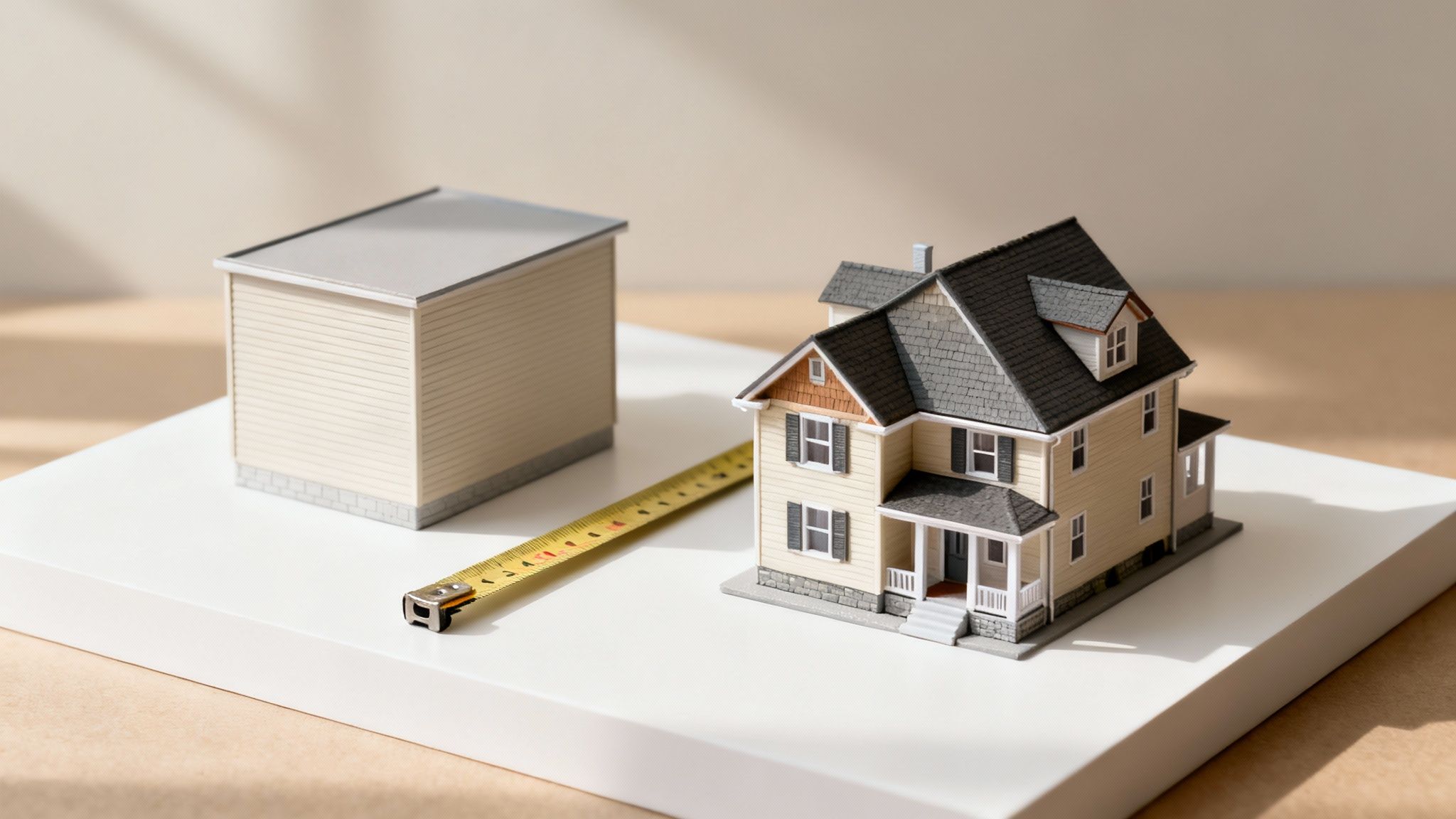
Ever look at two houses with the same square footage and wonder why one costs so much more than the other? The secret isn't just about location, location, location. The real story is told in the blueprint, the materials you choose, and the very ground you build on. Getting a handle on these variables is the first—and most important—step to building a home you love without blowing your budget.
Think of the cost of a stick-built home less like a price tag and more like a recipe. You're the chef, and every ingredient you add or change affects the final dish. Your choices in these key areas will have the biggest ripple effect on the final number.
The Shape of Things: Architectural Complexity
Believe it or not, the shape of your house is a massive cost driver. A simple, rectangular "four-corner" home is the cheapest and most efficient design to frame and roof. It's straightforward.
But the moment you start adding complexity—another corner here, a bump-out there, a charming dormer, or an elaborate roofline with a dozen peaks and valleys—you crank up the cost. It’s not just about using more materials; it’s about the extra time and skill needed from your framing and roofing crews.
A Local Story: We saw this play out on a recent project near Lumberton. The initial design had a complex, multi-gabled roof. Our expert project manager, drawing on years of local experience, worked with the client to simplify the roof design slightly. This small change saved them thousands of dollars in labor and materials without sacrificing an ounce of curb appeal. It all comes down to smart, collaborative planning.
From Builder-Grade to Baller: Materials and Finishes
This is where your personal style meets the bottom line. The difference between standard materials and high-end finishes is a chasm, and your selections will cause some of the biggest swings in your budget.
Just look at a few common decision points:
- Flooring: Basic builder-grade carpet is worlds away, cost-wise, from authentic, site-finished hardwood floors.
- Countertops: You can get functional laminate countertops for a fraction of what you'd spend on premium quartz or a unique slab of natural granite.
- Windows: Standard vinyl windows get the job done affordably. But if you want custom wood-clad or ultra-efficient triple-pane windows, you're making a much larger investment.
- Siding: Vinyl siding is the go-to for budget-conscious builds, while fiber cement or a natural stone veneer will land at the very top of the price scale.
And it doesn't stop there. These choices echo through every part of your home, from the light fixtures and faucets to the kitchen cabinets and interior doors.
As a Native American-owned and HUBZone-certified builder, we’re deeply invested in the Fayetteville and Lumberton communities we serve. Our goal isn't to push the cheapest option; it's to guide you toward materials that deliver the best long-term value. We're here to build legacies, and that starts with making durable, quality choices you'll be proud of for decades.
It All Starts With the Land: Site Conditions
That beautiful piece of land you bought? It’s not just a backdrop for your new home; it's the foundation of your entire project. The condition of your lot can be a huge, and often hidden, cost factor. A perfectly flat, clear, "build-ready" lot is the dream, but it's rarely the reality.
Here are a few land-related curveballs that can add serious money to your budget:
- Slope: A sloped lot means serious dirt work. You'll need more excavation, grading, and possibly a more expensive foundation (like a walk-out basement) to make it work.
- Soil Quality: If the soil is weak or unstable, you might need to bring in an engineer to design a specialized foundation just to keep the house from shifting.
- Trees and Rocks: Clearing a heavily wooded lot is one thing. But if the crew hits bedrock while digging your foundation? That means bringing in heavy equipment (and the bills that come with it).
- Utility Access: How far are you from the main lines? Running new connections for water, sewer, and electricity across a long distance can add tens of thousands to the site prep budget.
With over 21+ years of proven results right here in this region, we’ve seen it all. Our deep local expertise means we can spot these potential landmines early on, helping you make informed decisions about your property and plan your build with total confidence.
Comparing Stick-Built and Modular Homes
When you start digging into how to build a new home, you'll inevitably hit the classic crossroads: stick-built or modular? It's a debate that too often gets boiled down to a simple price-per-square-foot race, but that's like comparing a custom-tailored suit to one off the rack just by looking at the price tag. The real value is so much deeper.
The right choice isn't just about the initial stick built homes cost. It’s about matching the construction style to your vision, your need for flexibility, and your dream of building a true family legacy.
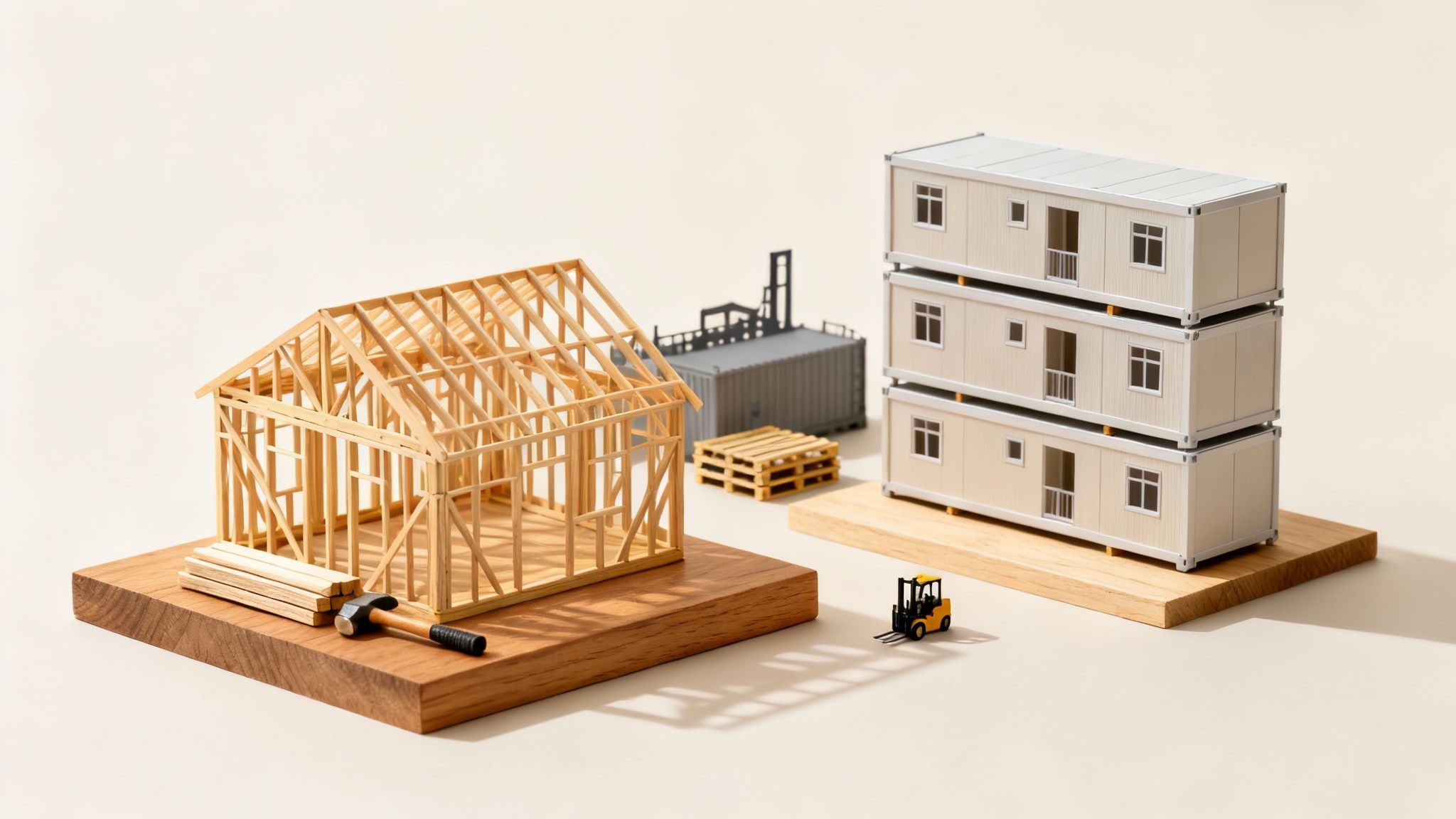
Stick-built homes are what most of us picture when we think of home construction—built from the ground up, piece by piece, right on your land. On the other hand, modular homes are built in large sections (or "modules") inside a factory, then trucked to your property and pieced together like massive, high-tech LEGOs. While the factory approach can sometimes trim the upfront cost and timeline, it comes with trade-offs you absolutely need to weigh.
To help you see the differences at a glance, we've broken down the key features of each method. This table gives you a side-by-side look at what each construction style truly offers.
Feature Comparison Stick Built vs Modular Construction
| Feature | Stick-Built Homes | Modular Homes |
|---|---|---|
| Customization | Virtually unlimited. Every detail can be tailored to your vision. | Flexible but with limits. Designs must fit factory and transport specs. |
| Construction Site | Built entirely on your property from the foundation up. | Modules are built in a factory, then assembled on-site. |
| Timeline | Generally longer and more susceptible to weather delays. | Often faster due to simultaneous factory work and site prep. |
| Financing | Traditional and widely understood by all lenders. | Can sometimes be more complex for lenders unfamiliar with the process. |
| Design Flexibility | Allows for intricate architectural details and unique layouts. | Better for more standardized or simpler floor plans. |
| Resale Value | Often commands a higher appraisal and resale value. | Strong value, but sometimes perceived differently in the market. |
| Foundation | Poured and cured on-site before framing begins. | Often prepared concurrently while modules are built off-site. |
| Builder Interaction | High level of on-site collaboration and decision-making. | More front-loaded design decisions before factory production. |
As you can see, the choice isn't just about cost or speed. It's about control, creativity, and the long-term vision you have for your home. Both methods result in quality houses, but they get there on very different paths.
Customization and Creative Freedom
Here’s where stick-built homes truly shine: the almost ridiculous level of design freedom. Because every single board is cut and every wall is framed right there on your property, you're the master of your domain. Want to nudge a wall six inches to the left for the perfect morning light? Go for it. Dreaming of an eccentric roofline or a one-of-a-kind, winding staircase? A stick-built process is how you make it happen.
Modular homes have come a long way in flexibility, but they're still playing by factory rules. The design has to work within the constraints of what can be built in a box and safely hauled down the highway. This often means sacrificing those truly bespoke, character-defining touches that transform a house into your home. For a much deeper dive, check out our complete guide comparing modular versus stick-built home costs.
Timelines and Financial Realities
Speed is modular's big selling point. Since the modules are built in a climate-controlled factory while your foundation is being prepped, weather delays are a non-issue. This parallel process can absolutely shave weeks, or even months, off the total construction timeline.
But here's a reality check: financing can sometimes be a hiccup. Some lenders just aren't as comfortable with the factory-built process, which can throw a wrench into getting construction loans approved. Stick-built homes follow a path lenders have walked a thousand times, making for a much smoother, more predictable financing journey. With 21+ years of proven results, we at SEGC have built rock-solid relationships with local Fayetteville lenders who know our process and trust our work and our commitment to quality.
Building Legacies, Not Just Structures: As a Native American-owned firm, we believe a home is more than an asset; it’s the foundation for your family’s future. The unparalleled design freedom and proven long-term value of a stick-built home make it the ultimate tool for creating a space that will serve your family for generations to come.
Long-Term Value and Appraisal
At the end of the day, both methods produce solid, durable homes that meet the exact same local building codes. Where they differ is in perception, and in real estate, perception is reality. Stick-built homes consistently hold a slight edge in appraisal and resale value because they're universally recognized as the gold standard for custom building. That lasting value is a huge deal when you're thinking about your home as a long-term investment.
Of course, the cost to build a house isn't the same everywhere—not by a long shot. Seeing these huge regional construction cost differences really drives home how much location matters.
Ultimately, whether you lean stick-built or modular, the key to protecting your investment is partnering with a trusted local builder who knows the ropes and is committed to craftsmanship that will last a lifetime.
Financing Your Custom Built Home
Let's talk about the money side of things. Building a custom home is an incredible journey, but it's a different financial beast than just buying a house that's already standing. A dream home needs a rock-solid financial blueprint, so this is your no-nonsense guide to getting your budget and financing locked in.
First things first: you need a real, detailed budget. We're talking way beyond a simple stick built homes cost per square foot. This means listing out every single cost you can think of, from the architect's first sketch to the very last doorknob. And most importantly, you have to plan for what you can't plan for.
The Power of a Contingency Fund
Here's a truth from the trenches: no matter how meticulously you plan, something unexpected will happen. It’s the nature of construction. Maybe we’ll discover some weird soil issue when we start digging, or the price of that perfect tile you picked out suddenly skyrockets. This is exactly why a contingency fund isn't just a nice-to-have—it's your project's safety net.
We always tell our clients to tuck away 10% to 20% of the total construction cost into a separate contingency fund. Think of it not as "extra" money, but as an essential part of a smart budget. It's what gives you peace of mind and saves you from a full-blown financial panic later.
At SEGC, we believe in being straight with you from day one. That means preparing you for the whole ride, bumps and all. With over 21 years of building right here in the Fayetteville area, we’ve seen time and again how a good contingency fund turns a potential disaster into a minor hiccup, keeping everything moving forward without breaking the bank. Our commitment to client trust means planning for the unexpected together.
Demystifying the Construction Loan
Getting a loan for a new build isn't like your typical mortgage. You’ll most likely be looking at a construction loan, which works more like a line of credit that we, your builder, draw from as we hit major milestones.
It generally unfolds like this:
- Approval: First, you get approved for the whole estimated cost of the project.
- Draws: As we complete a stage—say, getting the foundation poured—the lender sends an inspector to sign off on the work. Then they release the funds to cover that phase.
- Interest-Only Payments: While the house is being built, you're usually just paying interest on the money that's been paid out so far.
- Conversion: Once your home is finished and you have the keys, the construction loan rolls over into a regular, long-term mortgage.
Lenders are a bit more careful with construction loans because, well, there's no house to use as collateral yet. They need to see a tight set of plans, a realistic budget, and a builder they know they can count on. As you think about this major investment, be sure to explore various home financing options to find the loan that works best for you.
Partnering with a Trusted Builder
Who you choose as your builder directly affects your chances of getting financed. Lenders are all about minimizing their risk. When they see you’re partnered with an established, certified company like SEGC, it gives them a huge dose of confidence.
Our status as a Native American-owned, 8(a), and HUBZone-certified firm is a clear signal of stability and reliability. That reputation can make your path to getting a loan a whole lot smoother. For a deeper dive into the financial nuts and bolts, our guide on effective construction cash flow management has some great insights. At the end of the day, we don't just build homes; we build the trust that gets projects funded and dreams off the ground.
It’s More Than a House, It’s Your Legacy
Let's be honest. Tallying up the cost of a stick-built home is more than a spreadsheet exercise. You’re not just buying lumber and labor; you’re choosing a partner to build the backdrop for your life’s biggest moments.
The builder you pick is, without a doubt, the most important decision you'll make in this entire journey. It’s the difference between a nightmare of miscommunications and a smooth, even enjoyable, experience.
Choosing South Eastern General Contractors is an investment in peace of mind. With over 21+ years of proven results, we've built our reputation one relationship at a time. Our entire process is grounded in straight talk and solid integrity, making sure the vision you have in your head is the home you get to walk into.
We're Not Just Building Here, We Live Here
As a Native American-owned and HUBZone-certified company, we’re not just some faceless firm. Our roots in the Fayetteville and Lumberton communities are deep. This is our home, too, and we're personally invested in seeing our neighbors thrive. For us, it’s not just business—it’s about building a stronger community, one family at a time.
Our special certifications, like our 8(a) status, aren't just fancy acronyms. They’re proof of a higher standard of excellence and rock-solid reliability that truly sets us apart. Partnering with SEGC means you’re working with a team known for its financial stability and operational integrity. In the often-chaotic world of construction, that kind of security is priceless.
Building Trust, One Story at a Time
We recently had a family moving to Fayetteville who were, frankly, panicked about building a home from hundreds of miles away. They needed more than a builder; they needed a trusted advocate on the ground, someone to be their eyes and ears.
We made it work by leaning into what we do best: constant communication. Through detailed progress reports, weekly calls, and a genuine spirit of teamwork, we turned a stressful situation into a genuinely exciting one. We listened, offered our guidance when they needed it, and tackled every little challenge together. The final result? A stunning custom home that was everything they dreamed of, finished on time and without any last-minute surprises.
"Choosing SEGC was the best decision we made. They didn't just build us a house; they welcomed us to the community and treated our project like it was their own. The trust we built with them was priceless."
That’s the SEGC difference in a nutshell. We don’t just put up walls; we build legacies. Your home is where your story unfolds, and we consider it a genuine honor to help you write the first chapter.
If you’re ready to stop dreaming and start planning, we're here to listen. Let’s have a real conversation about your vision and how we can bring it to life with the care and quality it deserves.
Answering Your Top Home Construction Cost Questions
When you start digging into the numbers for a new home, the questions come fast and furious. It's totally normal. Let's tackle some of the most common ones we hear from our clients right here in Fayetteville and Lumberton.
Does The "Cost Per Square Foot" Include The Land?
That's a big "no." Think of the cost-per-square-foot figure as the price tag for the house itself—the sticks, bricks, drywall, and everything that makes it a home.
The land you build on is a completely separate (and major) line item. So are things like clearing the trees, grading the lot, running utility lines, and putting in a driveway. You've got to budget for the place before you can budget for the palace.
How Do I Get A Real, No-Nonsense Cost Estimate?
Forget online calculators and ballpark guesses. The only way to get a number you can actually take to the bank is to sit down with a builder who knows the local market inside and out.
A truly accurate estimate requires three key things: your final architectural plans, a detailed list of every single finish you want (we call this a "spec sheet"), and a professional look at your actual build site.
Here at SEGC, with 21+ years of proven results, we provide a solid preliminary estimate to get your planning started. But for that locked-in, fixed-price contract? We need all those final details ironed out. We believe in giving you honest, transparent numbers you can truly build your legacy on. Our commitment to client trust and quality demands it.
What's The Biggest Budgeting Mistake You See People Make?
Oh, this one's easy. People get so focused on the big stuff—the foundation, the frame, the roof—that they completely underestimate the cost of finishes. The "fun stuff" is where budgets go to die.
That beautiful tile, those high-end faucets, the custom lighting… it adds up faster than you can imagine. The second biggest mistake? Not having a healthy contingency fund. We tell every client that a 10-15% contingency isn't just a good idea; it's non-negotiable. It’s your financial shock absorber for the unexpected, from surprise soil issues to a sudden spike in lumber prices. As a trusted, Native American-owned builder, we help our clients build this safety net into their budget from the very beginning. It's all about ensuring a smooth project built on trust and smart planning.
Your home is where your family's story will unfold. At South Eastern General Contractors, we don’t just build houses; we build legacies. If you’re ready to talk about the vision you have for your future, our team is here to help you bring it to life with integrity and craftsmanship you can count on.