

What is Construction Scheduling? Expert Tips & Insights
Think of a construction project like conducting a massive orchestra. You have the percussion section (heavy machinery), the strings (framers and electricians), the woodwinds (plumbers and HVAC techs), and the brass (finishers and painters). Without a conductor holding the sheet music, all you get is noise—a chaotic, expensive mess.
Construction scheduling is that sheet music. It's the master plan that tells every single person on the job site not just what to do, but when to do it, and how their part fits into the grand symphony of the build. It’s far more than a simple calendar; it’s the project’s heartbeat, dictating the rhythm and pace from groundbreaking to ribbon-cutting.
The True Blueprint for Project Success

So, what is construction scheduling when you get right down to it? It’s a living, breathing document that serves as the central nervous system for the entire operation. Forget a static to-do list; this is a dynamic roadmap that guides every decision, coordinates every trade partner, and helps us see around corners to anticipate challenges before they become problems.
This process is where the magic happens. We take a complex set of architectural drawings and a client's vision and break it all down into a logical sequence of manageable, perfectly timed steps. This means identifying every single task, figuring out which ones have to happen first (the dominoes), and then assigning the right people, equipment, and materials to get it all done.
For over 21 years, we at Southeastern General Contractors (SEGC) have been honing this craft, turning complicated plans into the buildings that serve our communities in Fayetteville and Lumberton. As a proudly Native American-owned and HUBZone-certified firm, we don’t see scheduling as just paperwork. We see it as our commitment to building certainty and trust for our clients.
The Core Components of a Construction Schedule
A truly solid schedule is much more than just a list of dates scribbled on a whiteboard. It’s a sophisticated document woven together from several critical elements that ensure a project flows smoothly instead of lurching from one crisis to the next.
Let's break down the essential ingredients that make up a real-world construction schedule. Think of these as the fundamental building blocks we use to map out a project, like a recent commercial build we completed in Fayetteville, where this level of detail was the key to coordinating dozens of subcontractors without a hitch.
The Core Components of a Construction Schedule
| Component | Description | SEGC's Local Example |
|---|---|---|
| Tasks & Durations | Every single activity is listed, from site clearing to final landscaping, each with a realistic time estimate. This isn't guesswork; it's based on our 21+ years of proven results. | For a recent retail project in Lumberton, we allocated 3 days for steel beam erection, factoring in crew size and crane availability. |
| Dependencies | This maps out the "cause and effect" of construction. You can't hang drywall until the electrical and plumbing rough-ins are inspected and approved. | On a community center build, we scheduled the roofing to be completed before the interior hardwood flooring was delivered to prevent water damage. |
| Milestones | These are the major checkpoints that signify real progress. Think "Foundation Poured," "Building Dried-In," or "Permanent Power On." | A key milestone for the Fayetteville library expansion was "Building Watertight," which allowed interior work to accelerate regardless of weather. |
| Resource Allocation | This ensures the right crew, equipment, and materials are assigned to each task at precisely the right moment to avoid costly delays. | Our schedule ensured the concrete delivery was staggered perfectly to match the finishing crew's pace, preventing waste and overtime. |
| The Critical Path | This is the single longest chain of dependent tasks that determines the project's absolute minimum completion time. A delay on this path delays everything. | The critical path for a medical clinic involved the foundation, framing, and roofing sequence. We focused our primary attention here to keep the project on track. |
As you can see, each piece informs the others, creating a complete picture of the project's journey from start to finish. This detailed planning is what separates a smooth, predictable build from a chaotic one.
At SEGC, we believe the schedule is our promise to you. It's the physical representation of the trust you place in us, and it's the tool we use to deliver your project with the precision and integrity it deserves. This is how we build legacies, not just structures.
Why a Schedule Is Your Project’s Bedrock
Let's be blunt: a construction schedule is much more than a piece of paper or a file on your laptop. It's the absolute foundation of a successful build. Trying to run a project without one is like trying to navigate a maze blindfolded—you're basically asking for chaos, budget blowouts, and a dangerously disorganized job site.
Think of a solid schedule as the project's central nervous system. It's the master coordinator, making sure every trade, supplier, and inspector shows up in the right order to prevent bottlenecks and keep the job humming along. It stops the electricians from arriving before the walls are framed or the drywall from being delivered before the roof is on. These aren't just minor mix-ups; they're the kinds of expensive, time-wasting blunders a good schedule is designed to eliminate.

From Chaos to Control
The true magic of construction scheduling is how it transforms a mountain of overwhelming complexity into a clear, step-by-step roadmap. It creates the structure you need for organization, clear communication, and real accountability from the first shovel in the ground to the final walkthrough.
A well-crafted schedule gives a project manager the power to:
- Optimize Resource Allocation: You get the right people and the right equipment on-site precisely when they’re needed. No more crews standing around, and no more wasted rental fees.
- Manage Cash Flow: By linking payments to specific project milestones, you create financial predictability that both clients and subcontractors can rely on.
- Enhance Safety: A good schedule prevents overcrowding and stops different trades from tripping over each other, which instantly makes for a safer, more orderly work environment.
This proactive mindset is how we, as an 8(a) certified firm, steer clear of common industry headaches like supply chain delays and labor shortages. For us, having a reliable timeline isn't just about being efficient; it’s about earning unshakable trust from our clients in communities like Fayetteville and Lumberton.
A schedule provides the necessary framework for consistent and transparent effective project progress reporting. It’s not just a plan; it’s a communication tool that keeps every stakeholder informed, aligned, and confident in the project's direction.
Mitigating Risk in a High-Stakes Industry
The stakes in construction are enormous. We're talking about a global market size projected to rocket past $17 trillion by 2025. In a game this big, even tiny delays can set off a chain reaction of massive financial losses.
On top of that, the industry is fighting a serious labor crunch. In the U.S. alone, there has been an average of 382,000 job openings in construction every single month over the past year. These challenges make iron-clad scheduling more important than ever. It's the only way to strategically deploy the skilled workers you do have without burning them out.
At SEGC, we don't just create schedules; we make commitments. They are the tools we use to demonstrate our reliability and deliver on our promises, building a legacy of excellence one perfectly timed task at a time.
Exploring Key Scheduling Methods and Tools
So, now that we’re all on board with why a schedule is so critical, the big question is: how do you actually build one that works? It’s not just about throwing dates on a calendar and hoping for the best. Real pros use proven methods and powerful tools to create a reliable roadmap for the entire project.
Think of these methods as different kinds of maps. Some give you a simple, big-picture view, while others provide a highly detailed, turn-by-turn route to get you to the finish line. At SEGC, we’ve learned to blend these classic techniques with modern tech on our projects across Fayetteville and Lumberton, making sure we have the perfect approach for whatever the job throws at us.
Gantt Charts: The Visual Project Calendar
The Gantt chart is a classic for a reason—it just plain works. It’s probably the most recognizable tool in the project management world. Picture a visual calendar for your whole project, where every single task is a horizontal bar. The longer the bar, the more time that task is expected to take. Simple, right?
This visual layout makes it incredibly easy to see who’s doing what and when. You can spot overlapping tasks at a glance and get an instant feel for the project’s overall progress. For many jobs, a well-made Gantt chart is all you need to keep the entire team in sync.
The Critical Path Method: A Project’s GPS
If a Gantt chart is your trusty calendar, then the Critical Path Method (CPM) is your project’s high-tech GPS. CPM digs much deeper. It meticulously identifies the single longest chain of dependent tasks that absolutely must be completed on time to hit the project’s finish date.
Any delay to a task on this “critical path” will push back the entire project. It's that simple.
By laser-focusing our management efforts on this specific sequence, we can get ahead of problems before they have a chance to blow up the timeline. This is the heart of how to manage construction projects effectively and a huge reason clients trust our 8(a) and HUBZone-certified firm to deliver.
CPM forces you to think like a strategist, making sure your best resources are aimed squarely at the tasks that matter most.
The image below gives you a sense of just how much data a detailed schedule has to juggle—from the massive number of tasks to key milestones and even built-in buffer days.
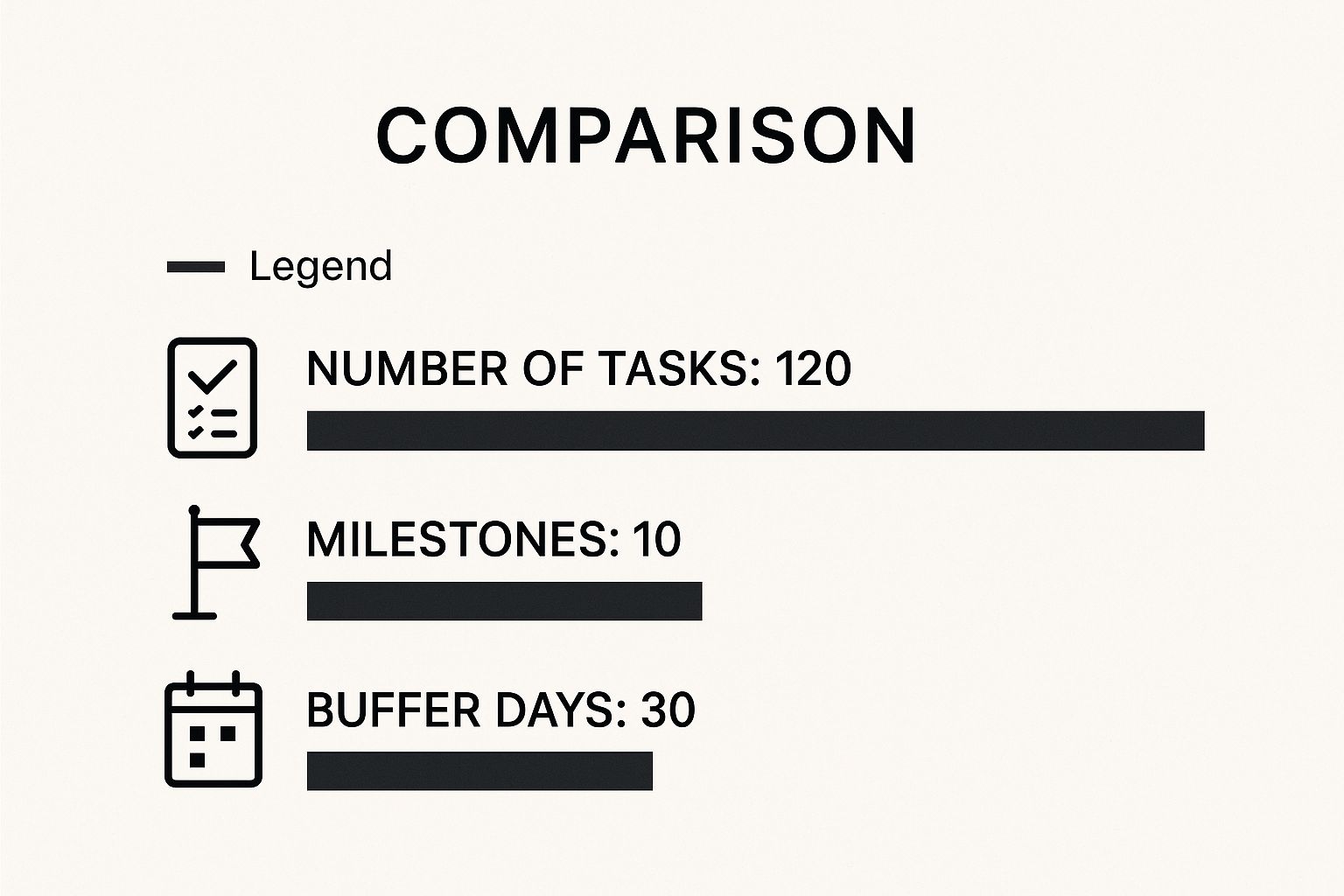
It’s a great visual reminder that even a medium-sized project involves hundreds of moving parts, which is why having a robust scheduling method isn’t just nice—it’s non-negotiable.
Comparing Scheduling Methods: Gantt vs. CPM
Choosing between a Gantt chart and the Critical Path Method often comes down to the project's complexity. One offers a quick visual summary, while the other provides deep analytical power. Here's a quick breakdown to help you see the difference.
| Feature | Gantt Chart | Critical Path Method (CPM) |
|---|---|---|
| Primary Use | Visualizing project timeline and task progress. | Identifying the sequence of tasks that determines the project duration. |
| Best For | Simpler projects, team communication, and progress tracking. | Complex projects with many dependencies and tight deadlines. |
| Key Strength | Easy to understand and create; excellent for a high-level overview. | Highlights critical tasks, manages risk, and optimizes resource allocation. |
| Weakness | Doesn't explicitly show task dependencies or the project's critical path. | Can be complex to set up and requires detailed task information. |
Ultimately, many project managers use both. They'll use CPM for the initial strategic planning and then translate that plan into a Gantt chart that's easier for the whole team to follow day-to-day.
The Evolution to Modern Tools
Construction scheduling has come a long, long way. The process started with hand-drawn charts, then took a massive leap forward with the computerized Critical Path Method developed back in the 1950s. Today, we’re in an entirely new league.
We’re now in an era where tools like Building Information Modeling (BIM) and sophisticated software are the new standard. To keep projects running smoothly, modern construction firms lean on specialized software. For a great deep-dive, you can explore some of the best field service scheduling software options.
These platforms bring everything—scheduling, resource management, and team communication—under one roof. They give us the real-time data needed to make smart decisions on the fly, keeping our 21+ years of proven results going strong on every single job site.
How We Turned a Scheduling Nightmare into a Win in Lumberton
Talk is cheap. Anyone can create a pretty schedule on paper, but the real magic happens when that plan gets punched in the face by reality. And trust me, it always does.
On a recent commercial build right here in Lumberton, NC, we got that punch. The custom-fabricated steel trusses—the absolute backbone of the roof structure—were suddenly hit with a two-week delay. An amateur move would be to panic. A common one would be to start pointing fingers. We did neither.
Instead, we immediately huddled around the schedule. For us, a schedule isn't a fragile promise; it's our most powerful problem-solving tool. It’s a huge part of why clients trust our Native American-owned and 8(a)-certified firm to get the job done, no matter what.
Flipping a Setback on Its Head
Our first question wasn't "Whose fault is this?" It was, "What can we do right now?"
Yes, the steel trusses were on the critical path, which meant the roofing was a no-go. But a complex project is a web of hundreds of tasks, and not all of them depend on the roof. We spotted an opening—a chance to get ahead by juggling the sequence of work. This kind of agile thinking is something you only develop after decades of experience serving communities like Lumberton.
Here’s how we rejiggered the plan:
- Push Up Interior Framing: We immediately jumped on all the non-load-bearing interior walls. This kept our skilled framing crews on-site and productive instead of sitting at home waiting.
- Go Underground: We shifted resources to knock out the underground plumbing and electrical conduit installation, a job we had originally slated for a later phase.
- Pour Interior Slabs: The building's footprint was secure, so we got to work pouring interior concrete slabs in sections that wouldn't interfere with the truss installation later.
The Power of Transparency and Trust
Of course, a pivot like this only works if everyone is on the same page. As a HUBZone-certified business, clear communication isn't just a policy; it's how we operate. We immediately looped in the client and every subcontractor, explaining the delay and walking them through our proactive new game plan. No secrets, no rumors—just a clear path forward.
By treating the schedule like a flexible roadmap instead of a rigid set of commands, we managed to absorb almost the entire two-week delay. When the trusses finally arrived, we were so far ahead on other tasks that the lost time was practically erased.
This real-world story from our own backyard in Lumberton is the perfect illustration of what construction scheduling truly is. It's not about making sure problems never happen—they will. It’s about having a rock-solid system to solve them without missing a beat.
It’s how we’ve built a 21+ year legacy of turning potential disasters into success stories for the communities we are proud to call home.
Lessons Learned: Scheduling Best Practices from 21+ Years in the Field
Knowing the scheduling methods is just the start. Actually using them to bring a project to life, on time and on budget? That's a whole different ball game. After more than 21+ years in the trenches, serving communities from Fayetteville to Lumberton, we've learned a thing or two about what separates a schedule that looks good on paper from one that actually works.
These aren't just textbook tips. These are the hard-won principles that have become the foundation of our client relationships and our reputation as a Native American-owned, 8(a), and HUBZone-certified firm. It’s how we turn a plan into a promise kept.
Get Everyone in the Room from Day One
The single biggest mistake you can make? A project manager locking themselves in an office and creating the schedule alone. That's a recipe for disaster. A schedule created in a silo is just a fantasy.
Real success comes from collaboration. We get everyone—subcontractors, key suppliers, even the client—involved in the scheduling process right from the beginning. This way, we know the timelines are realistic because the people doing the work have signed off on them. It’s how you spot potential conflicts before they cost you time and money, turning a simple document into a shared mission. This is the heart of great construction management.
Your Schedule Is a Living, Breathing Thing
Let's be blunt: a schedule that isn't updated daily is already useless. Construction sites are dynamic. The weather turns, a shipment gets delayed, you uncover something unexpected during excavation. A static, "set-it-and-forget-it" schedule can't handle reality.
We treat our schedules like a pulse monitor for the project. Daily check-ins and constant communication let us make real-time adjustments. We can shift resources, re-sequence tasks, and keep the project moving forward instead of grinding to a halt. This agility is how we absorb the punches and still deliver.
It's all about staying ahead of the problems, not just reacting to them.
Plan for Everything—The Unexpected and the Inevitable
Every experienced pro knows you need to build a little buffer time into your schedule for surprises. But smart planning goes deeper than that. It's also about scheduling the predictable stuff that keeps your project humming along.
Think about your heavy equipment. A well-oiled machine is a reliable one. That's why smart Preventive Maintenance Scheduling for your gear is non-negotiable. An excavator that gets its regular service is an excavator that won't break down the day you need it most.
By weaving these practices into our daily workflow, we do more than just manage a timeline. We build confidence and predictability, which is the cornerstone of the trust that has defined Southeastern General Contractors for over two decades.
Your Construction Scheduling Questions Answered
Alright, we’ve dug into the nuts and bolts of what construction scheduling is and why it matters. But theory is one thing, and the real world is another. Let's tackle some of the most common questions we get from clients and partners, drawing on the practical, hands-on experience we've gained over 21 years in the business.
What Is the Single Biggest Mistake to Avoid?
Easy. The biggest blunder is thinking the schedule is a one-and-done document you create and then file away. A schedule that isn't treated as a living, breathing plan is doomed from the start. When it’s built in a bubble without input from the folks on the ground, it’s just a recipe for blown deadlines and broken trust.
That's why our process at SEGC is built on collaboration. We hammer out our schedules with direct feedback from our key trade partners, our suppliers, and, most importantly, you. Our work in communities like Fayetteville has driven this home: a schedule's real magic is in its flexibility and the honest communication it fuels, not in how rigid it is.
How Does Good Scheduling Impact Worker Safety?
This is a huge one, and it gets overlooked way too often. A rushed, disorganized schedule is a direct threat to everyone on site. It leads to crowded work zones, creates immense pressure to take shortcuts, and causes mass confusion about who is supposed to be where. And on a job site, chaos is the #1 enemy of safety.
A thoughtfully built schedule—like the ones we develop for our HUBZone-certified projects—is a powerful safety tool. It gives each trade the space they need to work safely, without climbing over each other. It also carves out dedicated time for critical safety checks and creates a workflow that’s predictable and logical. For us, scheduling isn't just about being on time and on budget; it's a fundamental part of protecting our most important asset—our people.
Trust is the most important thing we build. It starts with transparent scheduling and clear communication, ensuring you always know where your project stands and that we are protecting your investment at every step.
Can I Use These Scheduling Principles for a Small Project?
You bet. The core ideas behind construction scheduling scale to fit any job, big or small. Whether you’re putting up a brand-new community center or just remodeling a kitchen, the fundamentals don't change: break down the work into tasks, put them in a logical order, figure out how long each will take, and keep an eye on your progress.
For a smaller job, something as simple as a Gantt chart you knock out in a spreadsheet can be an absolute game-changer. This kind of proactive planning is a signature of how we operate at SEGC because it saves headaches, cuts down on stress, and delivers a better final product, no matter the project's size. It's also a great way to figure out the right questions to ask general contractors before you hire anyone.
At the end of the day, a schedule is a communication tool that gives you confidence. It’s proof that your contractor has a clear, actionable plan to bring your vision to life. As a Native American-owned firm, we see this level of detailed planning as the highest form of respect for our clients, their investment, and our craft.
At Southeastern General Contractors, our schedules are more than just timelines; they're our promise to you. For over 21 years, our Native American-owned, 8(a), and HUBZone-certified firm has been building legacies of trust and quality in Fayetteville, Lumberton, and beyond. If you’re looking for a partner who builds with integrity, transparency, and a proven legacy of success, let's talk about what you want to build next.