

A Guide to Commercial Construction Cost Calculators
Embarking on a new commercial construction project is an exciting venture. But before the first shovel hits the dirt, the most pressing question always surfaces: "What is this actually going to cost?" This is where a commercial construction cost calculator can be a valuable first step.
Think of it as your initial, back-of-the-napkin sketch. It provides a ballpark estimate based on broad strokes—like square footage, building type, and general location. It’s a fantastic gut-check to see if your vision aligns with your budget, but let's be clear: it's a starting point, not a guaranteed final price.
Your First Step in Project Budgeting
Starting a commercial build can feel overwhelming, especially when it comes to the budget. With a whirlwind of variables—from raw materials and labor to the complex world of permits—the most common question is usually the simplest: "Where do I even begin?"
This is the perfect moment to use a commercial construction cost calculator.
It isn’t a crystal ball; it won’t spit out a final price guaranteed down to the penny. What it will do is translate the big idea in your head into a rough number. It’s an indispensable tool for early conversations, giving you and your stakeholders a high-level view of the financial scope.
However, a generic online calculator is like a GPS showing only the most direct route. It doesn’t know about the surprise traffic jam, the unexpected road closure, or the scenic detour you might want to take. It gives you a path, but it’s missing the real-world context that makes a journey successful.
The Limits of Automation
An online form can't walk your property. It has no idea about the unique challenges of your specific site, the soil composition in Fayetteville, or the local permitting process in Lumberton. These are the kinds of details that can completely change the final numbers.
This is where boots-on-the-ground experience isn't just nice to have—it's everything. A calculator is going to miss things like:
- Local Material Sourcing: The price and availability of steel, lumber, or concrete can swing wildly depending on regional supply chains.
- Site-Specific Conditions: Is your lot perfectly flat, or does it need thousands of dollars in grading? Are we tapping into existing utilities or running new lines from a half-mile away?
- Regulatory Nuances: Local zoning laws, unexpected environmental hurdles, and specific building codes can add layers of cost and complexity that a simple algorithm just can't predict.
At SEGC, we believe an estimate is the start of a conversation, not the end of one. It’s about building trust by showing you not just the what, but the why behind every number on the page.
The SEGC Difference From Day One
For more than 21+ years, our team at South Eastern General Contractors has been turning abstract estimates into on-budget, on-time realities right here in North Carolina. As a Native American-owned, 8(a), and HUBZone-certified firm, we don't just answer to a corporate office; we answer to our community. We bring a level of local leadership and accountability that automated tools simply can't match.
Our deep roots in towns like Fayetteville and Lumberton mean we aren't just putting up buildings; we're building legacies. When you partner with an experienced general contractor, you gain the clarity and foresight needed to turn that ballpark figure into an ironclad plan. So, bring us your napkin sketch. Let's talk about how to build something that lasts.
So, What's Really Driving the Costs?

A commercial construction cost calculator provides a number, but what’s actually in that number? Think of it like a complex recipe. The final price tag isn't just about the size of the project; it’s about the quality of the materials, the intricacy of the design, the skill of the craftspeople, and the specific site conditions.
Your project's budget is a mix of four main ingredient groups. Understanding these categories is the first real step in turning a generic online guess into a financial plan you can build on.
Hard Costs: The Stuff You Can See and Touch
Hard costs are the tangible, physical pieces of the puzzle. This is everything you can point to on a job site: the steel forming the building’s skeleton, the concrete for the foundation, and the lumber for framing. It also covers the roof, windows, doors, and interior finishes like drywall and flooring.
These are the most obvious expenses. Just as with a recipe, you can choose standard ingredients or premium ones. Opting for high-end, custom finishes will naturally drive up your hard costs, which directly moves the needle on any cost calculator.
Soft Costs: The Recipe, The Permits, and The Expertise
If hard costs are the ingredients, then soft costs are the architectural plans, permits, and professional services required to get started. These are the less visible but absolutely critical expenses that bring a project to life.
This bucket includes a ton of essential services:
- Architectural and Engineering Fees: The experts who design the building and ensure its structural integrity.
- Permits and Inspection Fees: The cost of getting municipal approval, a process our team knows inside and out, especially in Fayetteville and Lumberton.
- Insurance and Legal Fees: The necessary protections for your project, your investment, and every person on site.
- Project Management: The expert coordination needed to keep all moving parts on track—a core part of what we do at SEGC.
These "behind-the-scenes" costs can easily account for 15-30% of the total budget, a significant figure that simple online calculators often overlook. For a deeper dive into the tools that help manage this complexity, check out our guide on the best construction estimating software.
Labor and Site Costs: The Baker and The Kitchen
Your project isn't going to build itself. Labor costs pay for the skilled craftspeople who turn blueprints into a physical structure—the electricians, plumbers, masons, and carpenters. Their expertise is the difference between a building that simply stands and one that stands the test of time.
Then you have the site costs, which involve preparing the land. This includes everything that must happen before a single drop of concrete is poured: demolishing old structures, grading and excavating the land, and hooking up essential utilities like water, sewer, and power.
As one of our Fayetteville project managers often says, "A calculator can't see the bedrock six feet under your lot, but we can. Ignoring site prep is like trying to build on an unstable foundation—the final product will suffer."
"A calculator gives you a number. A true partner gives you a plan. We've built our reputation over 21 years by understanding that the details a calculator misses are often the ones that matter most to our clients' success."
– An SEGC Project Manager
The interplay between these factors is complex. The cost of building in the U.S. is constantly influenced by volatile material prices, labor shortages, and regional variations. While overall inflation might be around 3%, unpredictable tariffs, fuel costs, and supply chain hiccups create a challenging environment. Add the rising demand for skilled tradespeople, and you can see why costs keep climbing. Any good cost calculator needs to adjust for these dynamic economic trends.
As a Native American-owned, 8(a), and HUBZone-certified firm, we don’t just build structures. We build trust by ensuring you understand every ingredient in your project’s recipe.
Why Generic Online Calculators Often Get It Wrong
We've all seen them—the slick, simple commercial construction cost calculators online. You enter a few details like square footage, building type, and a zip code. Voila! A number appears. It seems easy and definitive. But here's the hard truth: it's often dangerously misleading.
A generic calculator gives you a black-and-white snapshot of a full-color, 3D world. It relies on stale, national averages that can't capture the real-time, on-the-ground realities of a local market like Fayetteville or Lumberton, where costs can differ significantly from national trends.
The Make-or-Break Impact of Location and Timing
The single biggest reason a one-size-fits-all calculator fails is its blindness to local context. It has no idea that a particular municipality in our area is famous for its slow permitting process, which can add months of carrying costs. It doesn’t know that skilled welders are in high demand in Fayetteville right now, a detail that can send labor costs soaring.
These blind spots are huge. While modern estimating tools are faster than scribbling on a legal pad, their accuracy is only as good as the data they’re fed.
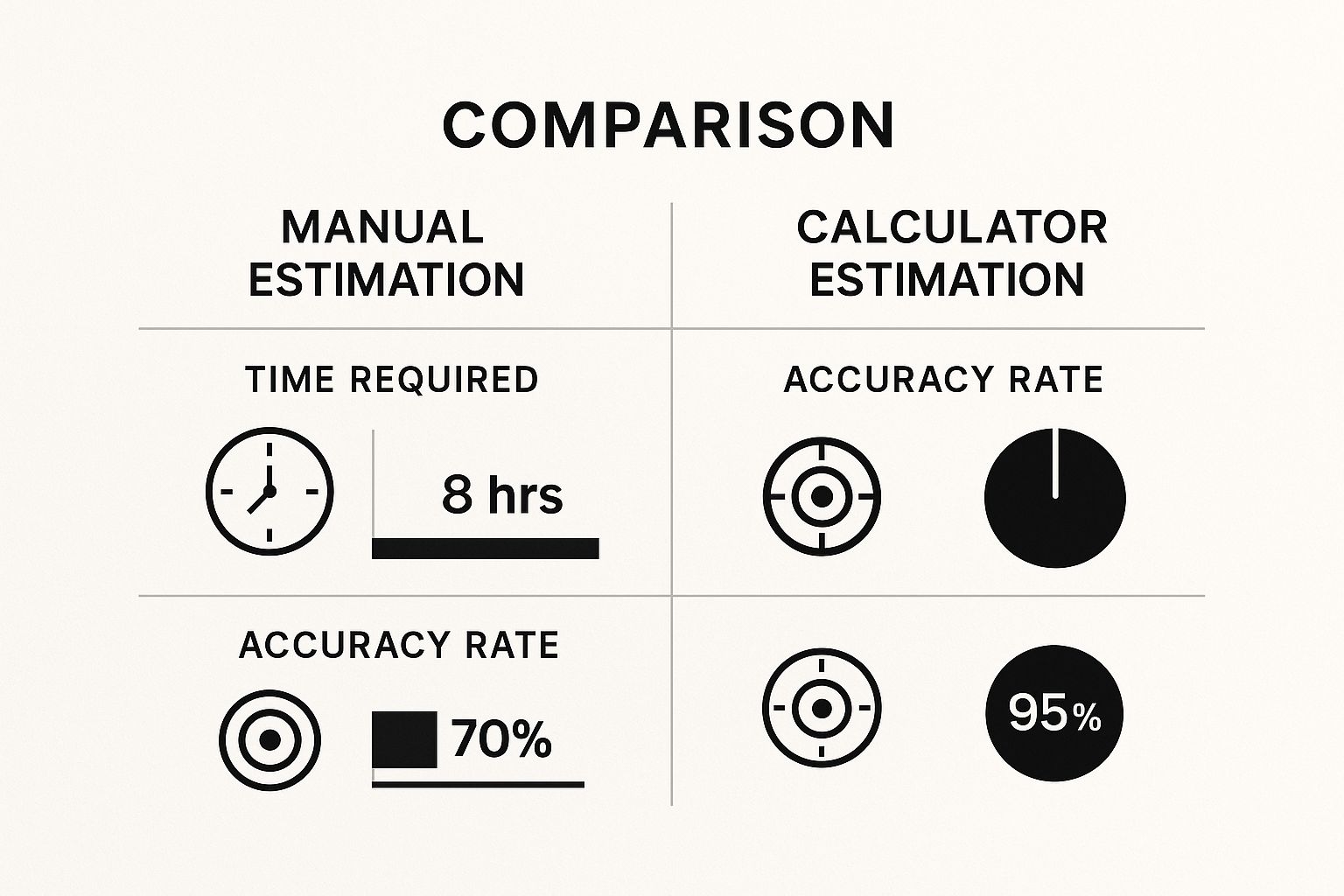
The right tool can be a massive improvement, but its precision hinges on data that reflects what's happening right here, right now—something generic databases can't provide.
Even global forecasts tell this story. Projections for 2025 suggest a worldwide commercial construction cost inflation of around 3.9%. But that number is an average. Europe might see a 2.4% bump, while North America could face something closer to 3.8%, thanks to ongoing skilled labor shortages. It’s a powerful reminder that every project's cost is tied to its specific place on the map and moment in time.
A Story from Our Fayetteville Files: How Local Knowledge Saved Six Figures
This isn't just theory; it’s about real money. A client recently came to us with a number they got from a popular online calculator for a project here in Fayetteville. On paper, the budget looked fantastic. But it was missing the land’s hidden story.
Having built in this area for over 21+ years, our gut told us something was off. We know from experience that the soil in that part of town can be a real headache, with poor load-bearing capacity. We pushed for a geotechnical survey right away, and sure enough, our suspicions were confirmed. The ground needed major remediation before the foundation could be poured.
The online calculator was completely clueless. If the client had moved forward with that number, they would have been blindsided by a massive, six-figure change order that would have torpedoed their budget and schedule.
Our boots-on-the-ground experience turned a potential catastrophe into a manageable plan. We built the soil remediation costs into the initial budget, giving the client an honest, realistic financial picture from day one. That’s the SEGC difference. As your local construction leaders, we see what the algorithms can't.
Key Cost Factors A Calculator Might Miss
An online form can't ask the questions a seasoned pro knows are critical. Here’s a quick look at what a basic tool sees versus what we investigate to build a real-world budget.
| Cost Factor | Basic Calculator Input | SEGC's Comprehensive Analysis |
|---|---|---|
| Site Conditions | Assumes a flat, "perfect" lot. | We investigate soil quality, drainage, topography, and site prep needs. |
| Labor Market | Uses a broad regional average. | We analyze current local labor availability, skill levels, and competing projects. |
| Permitting & Fees | Ignores them completely. | We know the specific municipal processes, timelines, and associated fees. |
| Material Sourcing | Pulls from national price lists. | We tap into our local supply chain relationships for real-time pricing and availability. |
| Building Codes | Doesn't account for recent changes. | We stay current on hyper-local and state-level code amendments. |
This table just scratches the surface, but it illustrates the Grand Canyon-sized gap between a generic guess and a professional estimate.
A huge reason these calculators fall short is their failure to keep up with changing regulations. Staying on top of updates like the latest Scottish Building Regulations is vital, as new requirements can dramatically shift costs—a detail most automated tools will miss. As a Native American-owned, 8(a), and HUBZone-certified firm, our job is to protect your investment with proactive expertise. We build a foundation of trust long before we ever pour one in the ground.
Let's Run the Numbers on a Real-World Project
Alright, enough with the theory. Let's get our hands dirty and see how a commercial construction cost calculator performs in a real-world scenario.
Imagine you're looking to build a new mid-size retail shop—say, 5,000 square feet—right here in Fayetteville, NC. You've found the perfect piece of land and you're eager to figure out what this dream will cost.
You pull up a popular online calculator and enter the key details:
- Building Type: Retail Store
- Square Footage: 5,000 sq. ft.
- Quality Level: Mid-Range
- Location: Fayetteville, NC
The calculator processes the data and returns a number: $1,250,000. That breaks down to $250 per square foot. It feels solid, a real number you can finally wrap your head around. But hold on. This is where the real work—and the real expertise—kicks in. That number isn't the finish line; it’s the starting pistol.
The SEGC Difference: Looking Beyond the Calculator
When a client comes to us with an estimate like that, it’s the beginning of a much deeper conversation. With over 21+ years of building across communities like Fayetteville and Lumberton, our team knows that the most important questions are the ones a calculator can't ask. We call it the "SEGC difference"—the human insight that protects your investment from budget-busting surprises.
For that same retail space, here’s where our team would immediately start digging:
- Soil & Site Conditions: Is the land flat and ready to go, or are we looking at a major earth-moving project? We know that certain pockets of Fayetteville have tricky soil that requires a more robust—and expensive—foundation. That’s a detail that could easily add tens of thousands to the bottom line.
- Utilities & Infrastructure: Where are the water, sewer, and power lines? Tapping into hookups at the property's edge is one thing. Having to trench a quarter-mile to reach the main grid is an entirely different conversation with a much bigger price tag.
- Local Permitting & Stormwater Rules: What are the specific stormwater management codes for that exact parcel? Fayetteville has unique regulations that can dramatically influence site design, sometimes requiring costly retention ponds or specialized drainage systems that a generic calculator would never account for.
These aren't just details; they're the massive, project-defining variables that can make or break your budget.
From a Digital Guess to a Real-Life Success Story
This isn’t just a hypothetical exercise. We had a client in Lumberton walk through our doors with this exact situation. A passionate entrepreneur had an online estimate for their dream retail spot, and while the number looked great on screen, it was missing the full story.
"The online calculator gave me a budget that made me feel confident. But when SEGC walked the property with me, they pointed out potential drainage issues and the cost of upgrading the local utility hookups—things I never would have considered. Their detailed analysis upfront saved us from at least two major change orders that would have been devastating down the road. They built trust before they even broke ground."
– A Valued SEGC Client
This is what we're all about. We don’t just put up walls and roofs; we build relationships grounded in total transparency. By spotting those critical cost factors early, we helped reshape the budget into an honest, ironclad plan that truly aligned with their vision and financial reality.
But don't just take our word for it. Check out our commercial project portfolio and see the proof for yourself. Each project is a story of turning an initial idea into a thriving business right here in our community. As a Native American-owned, 8(a), and HUBZone-certified firm, we’re committed to providing the kind of local leadership and proven results no algorithm can ever replace.
From Digital Guess to Ironclad Budget

Think of a number from a commercial construction cost calculator as a snapshot—a single frame from a much longer movie. An ironclad budget, on the other hand, is the full-length feature film: a detailed, collaborative roadmap built on trust, transparency, and boots-on-the-ground expertise.
The journey from that initial online estimate to a project-ready budget is where a true construction partner earns their stripes. It's time to swap assumptions for verified, actionable data. The calculator did its job; now, the real work begins.
This is the process we live and breathe at SEGC. For over 21+ years, we've walked with clients in Fayetteville, Lumberton, and beyond, turning their initial ideas into legacies built to last for generations.
The Human Touch a Calculator Can’t Replicate
An automated tool is fantastic for a quick look, but its blind spots are huge. A calculator can't walk a job site and feel the grade of the land. It can't navigate the tricky waters of local permitting or foster the relationships with suppliers that lock in the best materials at the right price. That takes human instinct and a genuine stake in your success.
This is especially true for a firm like SEGC. Our Native American-owned, 8(a), and HUBZone certifications aren't just letters on a page. They signify a profound accountability to our community and a promise to deliver excellence, whether we're building a new retail space or a sensitive government facility.
An estimate tells you what a project might cost. A budget, built with an experienced partner, tells you what it will cost and lays out the exact path to get there. It’s the difference between a guess and a guarantee.
This entire transformation is powered by solid project management, making sure every dollar is accounted for and every decision is crystal clear. To really dig into this crucial skill, check out our guide on how to manage construction projects.
Turning Your Idea Into a Concrete Plan
The best projects always start with a straightforward conversation. So, bring us that number you got from an online calculator. Let's sit down and start layering it with the kind of real-world intelligence that only comes from decades of local experience.
We’ll immediately start digging into the critical factors the calculator completely missed:
- Real-World Site Logistics: How do we get trucks in and out? Where will we stage materials? What potential snags could impact the timeline and budget?
- Smart Value Engineering: We’ll hunt for opportunities to get you the same fantastic result using more cost-effective materials or construction methods, all without cutting a single corner on quality.
- Long-Term Operating Costs: The project isn't over when we hand you the keys. We look ahead to things like energy efficiency and maintenance to understand the total cost of ownership.
Managing a project's finances effectively requires more than just a good partner; it also needs the right tech. You can explore some of the best construction project management tools that work hand-in-glove with our hands-on expertise.
At the end of the day, turning an estimate into a budget is really about building trust. It's about us showing you the "why" behind every line item so you feel empowered and confident in every decision. We don't just build structures; we build legacies. Let's get started on yours.
Common Questions About Construction Budgeting
Diving into the dollars and cents of a commercial construction project can feel complex. You have questions, and that's not just okay—it's smart. At SEGC, we believe an educated client is the best partner. We’ve put together the questions we hear most often about project budgets and online cost calculators.
Our goal is simple: provide clear, straightforward answers that cut through the industry jargon. After more than 21+ years building legacies in communities like Fayetteville and Lumberton, we are here to share our expertise and empower you.
How Accurate Are Online Calculators, Really?
This is the million-dollar question. The honest answer? It depends on how you use them. A commercial construction cost calculator is a fantastic Day One tool. It's perfect for a quick gut check, that initial ballpark figure to see if your vision is financially feasible.
Think of it like a weather forecast on your phone. It gives you a great general idea—sunny with a high of 85. But it can't tell you if a freak five-minute downpour will pop up right over your job site. For that level of detail, you need someone on the ground.
That's what a calculator is. It works with broad averages and can't possibly know about the local labor crunch in Fayetteville, the specific soil conditions on your lot, or the quirky permitting process in your town. It will never be 100% accurate because it's missing that critical, on-the-ground intelligence.
What’s the Biggest Mistake People Make with Initial Estimates?
Hands down, the biggest mistake is treating a calculator's estimate as a guaranteed, locked-in price. That initial number is a conversation starter, not a contract. When people seek financing or make commitments based on that number alone, they're setting themselves up for painful budget overruns.
Another common pitfall is forgetting about soft costs. These are the "invisible" but essential expenses: architectural designs, engineering fees, permits, legal reviews, and insurance. They aren't the bricks and mortar, but they can easily consume 20-30% of your total budget—a massive detail most simple calculators ignore.
The most successful projects are born from a healthy dose of skepticism toward initial numbers. Use the estimate to start asking deeper questions, not to stop asking them.
This is where a true partnership with your contractor makes all the difference. An experienced pro doesn't just accept your numbers; they challenge them and then help you build a realistic budget from the ground up. To see why this is so critical, check out our guide on how to choose a general contractor who will be a real advocate for your project's success.
How Do I Account for Unexpected Costs?
Ah, the dreaded "surprise" cost. The best defense is a good offense: plan for them from the very beginning with a contingency fund.
This is a sum of money, usually between 5% to 15% of your total budget, set aside specifically for unforeseen issues. What kind of things?
- Weather Delays: A month of non-stop rain can bring groundwork to a screeching halt.
- Material Price Spikes: A sudden global event can make the price of steel jump overnight.
- Hidden Site Conditions: You start digging and find a massive slab of granite or soil that won't support a foundation.
As a HUBZone and 8(a) certified firm with deep roots in North Carolina, we pride ourselves on being proactive to minimize these surprises. Our deep local knowledge helps us anticipate potential hiccups, but a healthy contingency fund is still the smartest insurance policy you can have.
Can I Save Money by Managing the Project Myself?
It’s an alluring thought: "If I act as my own general contractor, I can save that management fee." In theory, it makes sense. In reality, for most people, it's a recipe for disaster that ends up costing far more in both money and stress.
A professional GC brings more to the table than just scheduling. We have long-standing relationships with vetted subcontractors, which means you get quality work at a fair price. We know how to navigate the maze of permits and inspections that can paralyze a project. Most importantly, our 21+ years of proven results means we have learned how to solve problems before they blow up your budget and timeline.
Think of it this way: you might be able to change your car's oil, but would you try to rebuild the engine? Construction management is a highly specialized skill, and the price of inexperience can be staggering.
How Does Global Data Affect My Local Project?
It might seem strange that events in another country could affect your new building in Lumberton, but in today's connected world, they do. Sophisticated cost databases are crucial for getting the big picture right. For example, the 2025 international construction cost databases pull together detailed data from 101 countries, tracking everything from labor rates to material prices.
This global view helps contractors spot trends and understand price fluctuations caused by supply chain issues or currency swings. It means your local project benefits from a world of data. For a closer look at these datasets, you can discover more insights about international construction costs on compassinternational.net.
By blending this high-level information with our hyper-local expertise, we build budgets that are both globally informed and street-smart. As a Native American-owned firm, we're dedicated to combining the best of modern data with timeless principles of craftsmanship and trust.
Your vision is worth more than a number spit out by a calculator; it deserves a real-world plan. At South Eastern General Contractors, we’ve spent over two decades helping clients across North Carolina turn their ideas into tangible, lasting legacies. Let’s start the conversation about yours.