

How to Plan a Home Addition: Building Your Legacy
So you’re thinking about an addition. That’s fantastic! Expanding your home is one of the most rewarding investments you can make, both for your property value and, more importantly, for your family's daily life. It’s a chance to finally build that space you’ve been dreaming of.
But let's be real—turning a daydream into a structurally sound, beautifully finished part of your home takes more than just a Pinterest board. It requires a solid, thoughtful plan. For over 21 years, our team at South Eastern General Contractors (SEGC) has been walking homeowners in Fayetteville and Lumberton through this very process, turning those "what if" conversations into real, livable spaces. As a Native American-owned, 8(a), and HUBZone certified firm, we don't just build additions; we build trust and lasting value in the communities we call home.
This isn't just a local trend. The global home renovation market hit an estimated $1.99 trillion in 2024, and right here in North America, we're leading the charge with 33.34% of that pie. People everywhere are realizing the value of making their current home work better for them.
Your Dream Addition Starts with a Real Plan
Before you start sketching layouts on a napkin, the most important step is to figure out your "why." What's the real reason you need more space? Every decision, from the floor plan to the faucet finish, will circle back to this fundamental need.
A successful project starts with clarity. Is this about creating a first-floor primary suite so you can comfortably age in place? Or maybe you're desperate for a great room big enough for holiday chaos and movie nights with the whole family. Nailing this down early prevents headaches and budget surprises down the road.
From Vague Idea to Buildable Vision
Let's get the big questions out of the way. This isn't about blueprints yet; it's about getting to the heart of the matter.
- What’s the main problem we’re trying to solve? Are the kids literally climbing the walls because there’s no playroom? Is your "home office" still the kitchen table? Identifying the core issue keeps the project laser-focused.
- How will we be using this space in 5 or 10 years? Today's nursery might need to become a teenager's hangout zone or a guest room later. Thinking ahead ensures your investment serves you well for years to come.
- What are our absolute must-haves? Be honest. Separate the non-negotiables (like an accessible, zero-entry shower) from the "would be nice" wishes (like that heated towel rack). This list becomes your North Star when it's time to talk budget.
Getting these answers straight in your own mind makes it so much easier to communicate your vision to a design-build team. If you're new to all this, it helps to learn the lingo. Our guide on architectural drawing basics is a great place to start demystifying how ideas get translated onto paper.
This simple illustration shows how we move from that initial spark of an idea to the actual construction.
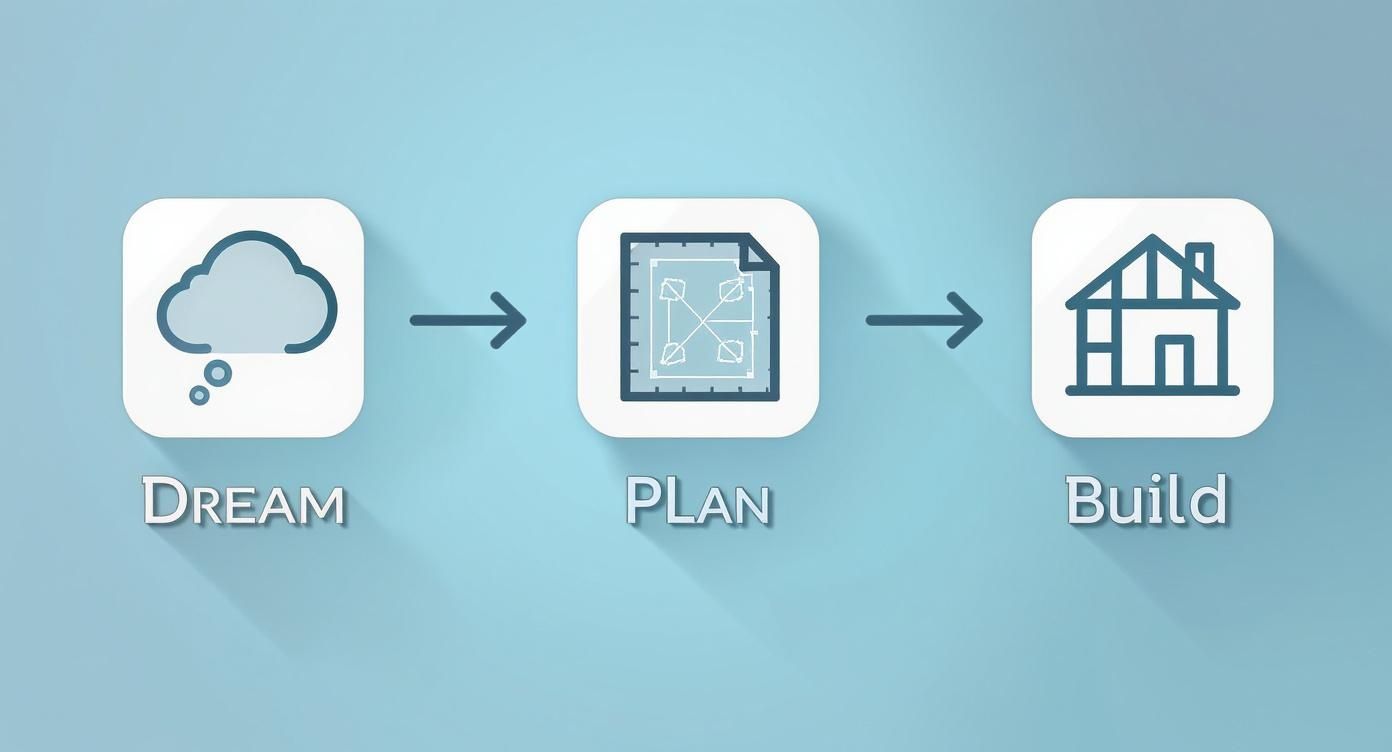
As you can see, that "plan" phase is the critical bridge. It’s where the magic of your dream meets the reality of the build, setting the stage for a smooth, predictable, and ultimately successful project.
Building a Budget That Actually Works
Let's get right to it—the money talk. A home addition lives and dies by its budget. It’s not just about cool designs and picking out paint colors; it’s about crafting a financial plan that’s airtight, honest, and won’t leave you with a case of sticker shock halfway through the project. After more than 21 years of helping families in Fayetteville and Lumberton bring their visions to life, we’ve learned that a solid budget is the foundation of a stress-free build.

This isn’t about plucking a number from the sky. A proper budget is a detailed roadmap that accounts for every nut, bolt, and permit, keeping your investment safe and the project on course.
Understanding the True Costs
So, what does a home addition really cost? National averages can be a decent starting point, pegging the cost somewhere between $125 to $250 per square foot. For a typical project, that puts the total between $21,917 and $83,356. That’s a massive range, right? It all comes down to the complexity, the materials you choose, and local labor rates right here in NC.
But a budget is so much more than lumber and drywall. A truly comprehensive financial plan breaks down into several key areas:
- Pre-Construction Costs: Think of this as the homework phase. It covers architectural or design-build fees, structural engineering reports, land surveys, and all the permit fees for Fayetteville, Lumberton, or your local town.
- Hard Costs: This is the stuff you can touch—the tangible materials and the skilled labor needed to put it all together. This bucket includes the foundation, framing, roofing, electrical, plumbing, insulation, windows, and doors.
- Finishing Costs: Here’s where your personal style shines! This category is all about flooring, paint, cabinets, countertops, light fixtures, and appliances.
- Landscaping and Exterior Work: Don't forget the outside. Your addition is going to disrupt the yard, so you need to budget for repairing siding, fixing walkways, or replanting the garden bed that got trampled.
A great budget sees around corners. We recently worked with a family in Lumberton whose first quote from another builder completely missed the need for a new HVAC zone. We caught it during our detailed planning, building it into the budget from day one. That simple step saved them from a $7,000 "surprise" change order mid-project. That’s the kind of foresight that builds trust and keeps things running smoothly.
To give you a clearer picture, here’s a sample breakdown of how costs are typically allocated. Keep in mind, these percentages can shift based on your specific project.
Sample Home Addition Budget Breakdown
A sample budget illustrating the typical cost allocation for a mid-range home addition project. Percentages can vary based on project scope and location.
| Expense Category | Estimated Percentage of Total Budget | Key Considerations |
|---|---|---|
| Site Prep & Foundation | 10% – 15% | Includes excavation, concrete, and waterproofing. Soil conditions can impact cost. |
| Framing & Exterior | 15% – 20% | Covers lumber, sheathing, roofing, windows, doors, and siding. |
| Major Systems | 10% – 15% | Plumbing, electrical, and HVAC. Upgrading existing systems can add to this. |
| Interior Finishes | 20% – 25% | Drywall, paint, flooring, trim, cabinets, and countertops. This is highly variable. |
| Labor | 20% – 30% | The cost for all the skilled tradespeople involved in your project. |
| Contingency Fund | 10% – 20% | Your safety net for unforeseen issues. Non-negotiable! |
This table is a guide, but a detailed, line-item budget from your contractor is what will truly set your project up for success.
The Power of a Contingency Fund
If there's one thing we've learned, it's to expect the unexpected, especially in older homes. That’s why a contingency fund isn’t just a nice-to-have; it’s an absolute must. Think of it as your project's insurance policy.
We always guide our clients to set aside 10% to 20% of the total construction cost. This isn’t a slush fund for splurging on fancier tile. It’s strictly for legitimate, unforeseen problems—like finding hidden termite damage, discovering your electrical panel is ancient and needs an upgrade to meet code, or hitting a surprise layer of rock during excavation. As a HUBZone-certified contractor, we believe in total transparency, so you’ll always know exactly why and when that fund needs to be tapped.
Financing Your Home Addition
Okay, you have a realistic budget estimate. Now, how do you pay for it? The good news is, you have options.
Financing Options to Consider:
- Home Equity Line of Credit (HELOC): This works like a credit card secured by your home. You can draw funds as you need them, which is perfect for paying contractors in phases.
- Home Equity Loan: You get a single lump sum of cash with a fixed interest rate. This is a solid choice when you have a firm, final cost for the entire project.
- Cash-Out Refinance: You take out a new, larger mortgage, pay off your old one, and pocket the difference in cash. This can be a smart move if you can also lock in a better interest rate.
- Construction Loan: A short-term loan designed specifically for building projects. The bank typically releases the money in stages as work is completed and inspected.
The best path forward really depends on your personal finances and the scale of your project. For a deeper dive into creating your financial plan, check out our guide on how to budget for a home renovation.
Building a budget is really about building confidence. When you know every potential cost is covered, you can stop worrying about the numbers and start getting excited about watching your dream take shape.
Taming the Paperwork: Designs, Zoning, and Permits
Before the first nail is hammered, your new addition has to conquer the world of paper and regulations. This is where your vision gets real—transforming from a dream into a set of buildable, legally approved plans. It might seem like a jungle of red tape, but think of it as laying the foundation for a project that goes off without a hitch.
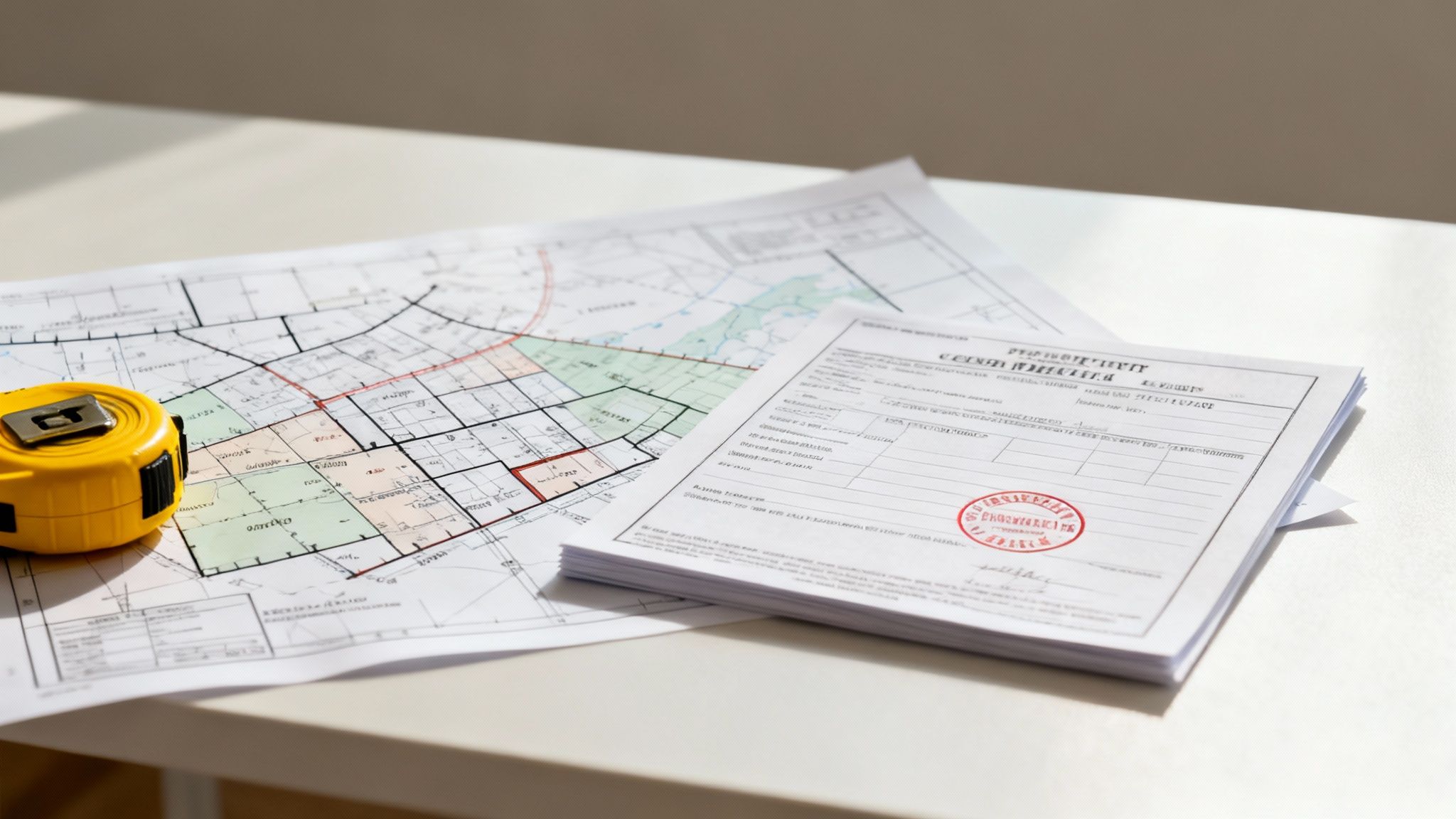
Getting those brilliant ideas out of your head and onto a blueprint is the first major milestone. This is the fun part, where we figure out the flow, the look, and the feel of your new space. It’s a true collaboration.
From Napkin Sketch to Official Blueprint
When it's time to create a design, you've got two main choices: hire an architect first, or go with a design-build firm. An architect will draw up beautiful plans that you can then shop around to different builders. The other option is a design-build company, like SEGC, where the designer and the builder are on the same team from the very beginning.
We find that this all-in-one approach just works better. It keeps the design tethered to the reality of your budget. Our team is designing with real-world construction costs in mind, which saves you from the gut-wrenching experience of falling in love with a design that costs a fortune more than you planned to spend. As a HUBZone-certified firm right here in Fayetteville, we're not just building structures; we're building legacies, and that starts with a plan that’s both inspiring and realistic.
Decoding Local Zoning Laws
Every piece of property in Fayetteville and Lumberton comes with a rulebook—the local zoning ordinances. These aren't just gentle suggestions; they're the law. They tell you what you can build, where on your property you can build it, and how tall it can be. Trying to wing it is a surefire way to hit expensive delays.
Here are a few terms you'll hear a lot:
- Setbacks: This is simply the required empty space between your addition and your property lines (front, back, and sides).
- Lot Coverage: This rule limits how much of your land can be covered by buildings. Your home, your garage, and your new addition all count toward this total.
- Height Restrictions: Pretty straightforward—your addition can't be taller than a specific limit, which is especially important for second-story projects.
Navigating the specifics of the Cumberland and Robeson County planning departments is something we do every day. We recently worked with a Fayetteville family who dreamed of a huge sunroom, but their initial sketch pushed past the rear setback by just three feet. Because we know the local codes inside and out, we were able to tweak the footprint, save their vision, and keep them fully compliant, avoiding weeks of frustrating redesigns.
Getting the Official Green Light: Building Permits
With a zoning-compliant design in hand, the next step is getting the building permits. A permit is your local government's official stamp of approval, certifying that your project is designed to meet critical safety codes.
Almost any home addition will need a general building permit. You’ll also likely need separate permits for the specialized trades, like electrical, plumbing, and mechanical (HVAC) work. For example, if your project involves a kitchen remodel, knowing the specific permit requirements for gas cooktop installations is an absolute must.
The permit package you submit usually includes:
- The full set of architectural and structural drawings.
- A site plan showing exactly where the new structure will sit on your lot.
- The official application forms, along with the required fees.
This is a point in the process where a seasoned local contractor truly earns their keep. We handle the entire submission for you. With over 21+ years in the area, we know the folks at the permit office. We can anticipate their questions and make sure the paperwork is right the first time. The discipline we apply to our complex 8(a) government contracts translates directly here—it's all about a methodical approach that cuts through the bureaucracy.
Ultimately, this whole phase is about doing your homework. It’s about sweating the details before construction starts to protect your investment and clear the way for a build that's as smooth as it is stunning.
Choosing a Contractor You Can Trust
Alright, you’ve got your plans in hand and a budget that makes sense. Now comes the moment of truth—the single biggest decision you’ll make for your home addition: picking the right crew to build it.
This isn't just about hiring a company with a nice truck and a toolbox. You’re looking for a partner, someone who’s going to be in your home, around your family, and responsible for a massive investment. Get this right, and the process can be exciting. Get it wrong, and… well, let's just make sure you get it right.
Don't Settle for Just a License and a Truck
First things first, let's cover the absolute bare minimum. Any contractor you even think about talking to must show you their general contractor's license, proof of general liability insurance, and workers' compensation coverage. No exceptions. This is just the ticket to get in the game.
But the real pros go way beyond that. You need a team that runs on a documented, predictable process for everything. How do they communicate daily progress? What happens when you want to change something? This is where a "change order" comes in—and it should be a crystal-clear document you review and sign, not a surprise number scribbled on a final invoice.
We once stepped in to rescue a project here in Fayetteville where the homeowner was fighting with their builder over thousands of dollars in verbal "upgrades." There was no paper trail, just a whole lot of frustration. That's just not how we operate. Our process is built on meticulous documentation—a discipline we perfected through years of complex government contracting. Every single decision is put in writing, so you always know exactly where you stand.
What Those Official-Looking Certifications Actually Mean
Ever see certifications like 8(a) or HUBZone and wonder what they are? They’re not just alphabet soup. These are federal designations that are incredibly hard to get. A company has to go through a rigorous vetting process that proves its stability, ethical practices, and commitment to the community.
For you, the homeowner, it’s a powerful signal. It means you’re partnering with a firm that’s been put under a microscope and held to a much higher standard.
As a Native American-owned firm, we’re not just building additions in Lumberton and Fayetteville; we're building in our own backyard. We're invested in seeing these communities thrive because they're our home, too. Our certifications are proof of that long-term commitment. For a full checklist of what to look for, our guide on how to choose a general contractor dives much deeper.
The Real Way to Check References
Every contractor will give you a list of happy clients. That's easy. Your job is to dig a little deeper to find out what they're really like to work with.
Here are the questions that get you the truth:
- Ask about the screw-ups: "Tell me about a time something went wrong. How did the contractor handle it?" How they solve problems tells you everything.
- Probe their communication style: "How often did you hear from the project manager? Were you ever left guessing what was going on?"
- Talk about the money: "Did the project stay on budget? If it went over, were the reasons explained and approved by you ahead of time?"
It also helps to understand how contractors approach their bids in the first place. Knowing what goes into their numbers helps you see which quotes are thorough and professional, and which ones might be hiding future problems.
Ultimately, choosing your contractor is about finding a team whose values align with yours. You want people who are just as excited about building your family’s future as you are. With over 21 years of proven results, we've built our entire reputation on being that trusted partner for families all across North Carolina.
Brace Yourself: Living Through the Build
That first morning you hear the rumble of a work truck is a wild mix of excitement and "what have we done?" Your dream is officially underway, but let's be real—your home is now a job site. It’s going to be loud. It’s going to be dusty. And your morning routine is about to get interesting. After guiding families in Fayetteville and Lumberton through this for over 21 years, we’ve learned that a bit of prep work can turn potential chaos into a surprisingly manageable adventure.
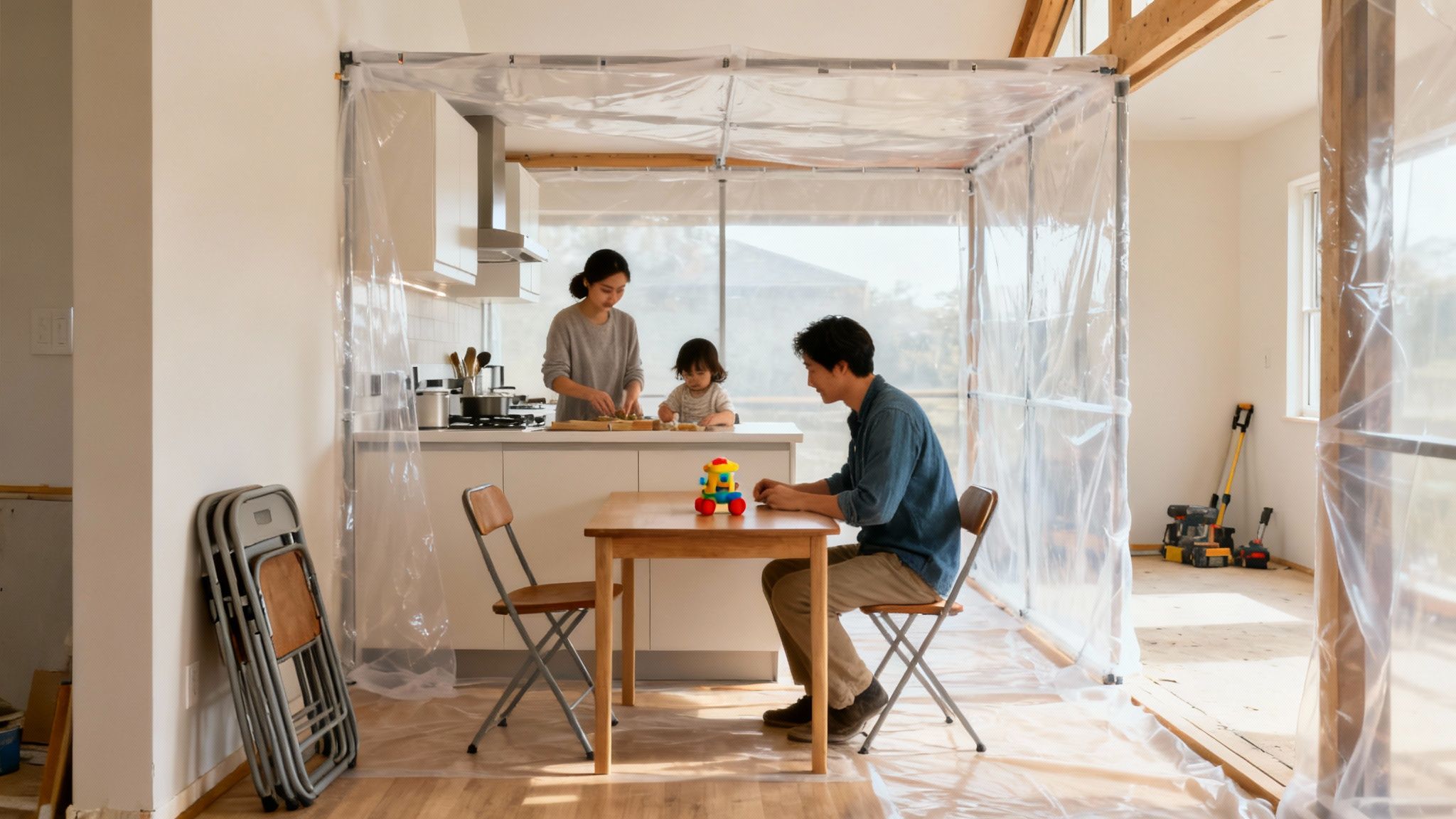
Honestly, surviving—and maybe even enjoying—the construction phase boils down to three things: protecting your space, knowing the game plan, and keeping the lines of communication wide open.
Contain the Chaos (And the Dust)
Construction dust is a special kind of menace; it has an uncanny ability to find its way into everything. Job one is creating a barrier between the work zone and your living space. We’ll put up heavy-duty plastic walls, complete with zippered doors, and even use negative air pressure machines to keep the dust contained.
Here's how you can be our partner in this dusty battle:
- Clear the Decks: Before we even start, pack up everything in the rooms next to the construction zone. We’re talking wall art, photos, books, you name it.
- Wrap It Up: For big pieces of furniture you can't move, grab some thick plastic sheeting and tape it down like you’re wrapping a precious gift.
- Save Your Floors: We lay down our own protection, but adding your own runners in hallways or high-traffic areas gives you that extra layer of security.
Thinking ahead is your superpower here. If your kitchen is out of commission, set up a temporary one in the dining room or basement. A microwave, a coffee maker, and a mini-fridge can be absolute lifesavers.
The Rhythm of the Build
Every project has its own unique beat, and understanding the rhythm can seriously reduce your anxiety. While no two jobs are identical, the construction process generally follows a familiar pattern.
A Quick Look at a Typical Timeline:
- Foundation & Framing: This is the loud, messy, and incredibly satisfying part. You’ll see the actual footprint and skeleton of your new space shoot up, and it’s a blast to watch.
- Getting Weatherproof & Rough-Ins: Next, we button up the exterior with roofing, siding, and windows. At the same time, our crews are inside running all the "guts"—the plumbing pipes, electrical wires, and HVAC ducts that live inside your walls.
- Insulation & Drywall: The noise level drops as the walls get closed in. This is the moment it stops looking like a frame and starts feeling like a real room.
- The Fun Stuff: Finishes & Fixtures: Now the personality comes out. Flooring goes in, cabinets are hung, paint goes on the walls, and lights get installed. It’s all about the final details.
A question we get all the time here in Fayetteville is about our work hours. We stick to a clear schedule, usually 7:30 AM to 4:30 PM, so you always know when to expect the crew. As a Native American-owned company built on trust, we make sure you know exactly who is at your home and what the goals are for the week.
Good Communication is a Superpower
Nothing makes a project go smoother than knowing you have a single person to call. You need a dedicated project manager—someone you can text with a quick question or call to discuss a concern. At SEGC, we schedule weekly check-ins to go over what we’ve done, what’s coming next, and any decisions you need to make. It’s this constant back-and-forth that prevents surprises.
It’s also smart to remember that we’re all at the mercy of the market. Building starts for single-family homes are projected to jump by about 2.5% in 2024, and the remodeling market could grow by 7% in 2025. A busy industry means you need a solid plan with a contractor who can lock in materials and crews. You can discover more about how housing market trends can affect your project and why planning ahead is so critical.
At the end of the day, living through a bit of disruption is the trade-off for a home that truly fits your family. By prepping your space, understanding the process, and staying in touch, you can ride out the construction wave and keep your eyes on the amazing prize.
Got Questions? We've Got Answers.
We’ve walked through a ton of information, from nailing down your budget to figuring out how to live through the construction chaos. But with more than 21 years of building home additions for families in Fayetteville, Lumberton, and all over the area, we know there are always a few more questions rattling around in your head.
Think of this as your friendly, over-the-fence chat with our SEGC team. We’re here to give you straight-up answers to the things we get asked all the time.
So, How Long Does This Whole Thing Really Take?
This is the million-dollar question, isn't it? The honest-to-goodness answer is: it really depends. Every project has its own unique rhythm, but we can break it down into two main acts.
First, there's everything that happens before a single hammer is swung. This is the pre-construction phase, and it’s a big deal. We’re talking about all the detailed planning, design, engineering, and, of course, getting the thumbs-up from the city. Just this part alone can easily take 2 to 4 months. We have to get the plans perfect and then work with the local permitting offices in Cumberland or Robeson County, which, trust us, move at their own pace.
Once we get that green light, the real fun begins. A simple, single-room bump-out? You're probably looking at 3 to 5 months of construction. But if you're dreaming bigger, like adding a whole second story or a major expansion, that timeline can stretch from 6 months to over a year. At SEGC, we don’t do guesswork. We bake a detailed, realistic schedule right into your contract from the get-go, so you always know what to expect.
How Do You Make an Addition Look Like It's Been Here Forever?
Nothing screams "bad reno" like an addition that looks completely bolted on. The real magic is making the new space feel like it was always part of the home's original blueprint. It’s a craft we’ve been perfecting for two decades.
Making it look seamless is a two-part puzzle:
- Matching the Outside Vibe: We get pretty obsessed with the little things. We're talking about matching the exact pitch of your roofline, hunting down the perfect siding or brick, and making sure the new windows have the same style and grid pattern as your existing ones. It's all about respecting the home's architectural DNA.
- Creating a Natural Flow Inside: When you walk from the old part of the house into the new, it has to feel completely effortless. That means carrying the same flooring through, meticulously matching the trim and baseboards, and designing doorways and hallways that make sense, not feel like an afterthought.
An addition is only a true success when it enhances the home's original character and becomes part of its story—not just an awkward footnote.
We once worked on a beautiful historic brick rancher here in Fayetteville. Finding a perfect brick match was a no-go. Instead of forcing it, we designed a complementary "wing" using a different siding and some clever landscaping. It honored the original home while giving the new space its own gorgeous identity.
What's This "Contingency Fund" I Keep Hearing About?
A contingency fund is your project's rainy-day fund. It’s a non-negotiable part of a smart budget, set aside for the genuine, out-of-the-blue surprises that can pop up once we start opening up walls.
What kind of surprises? Think hidden water damage behind the drywall, discovering the original wiring is a fire hazard waiting to happen, or realizing your old electrical panel can't handle the new load. That's what this fund is for. We tell every client to set aside 10% to 20% of their total construction cost for this.
As a Native American-owned and 8(a)-certified firm, our reputation is built on total transparency. A contingency fund is never, ever used to cover our mistakes or miscalculations. It’s a safety net for your house’s hidden secrets, and we’ll always show you exactly why and when it needs to be tapped into.
What's the Best Time of Year to Start Building in North Carolina?
The truth is, our crews can and do build year-round. But if you’re looking for the sweet spot to break ground here in North Carolina, starting a project in the spring or early fall is tough to beat.
Why? It’s all about dodging the worst of the weather. This timing helps us sidestep the brutal summer humidity and the winter freezes that can bring concrete work for the foundation to a screeching halt. An early spring start, for example, gives us a fantastic window to get the house framed and buttoned up with a roof and windows before the cold, wet months roll in.
But here’s the most important takeaway: the planning process needs to start months before your ideal start date. No matter when the shovels hit the dirt, a great build always starts with a rock-solid plan.
Ready to stop dreaming and start planning? The team at South Eastern General Contractors has spent over two decades building legacies, not just structures, for families across North Carolina. Let's build yours together.