A Guide to Commercial Building Permit Requirements
Getting a commercial building permit can feel like navigating a complex maze. But let’s demystify it. A permit is the official green light from your local government—it's the document that confirms your plans are solid, meet safety codes, and that you're clear to start building.
This piece of paper isn't just a formality; it's a non-negotiable legal requirement for almost any new construction, major renovation, or structural change. More importantly, it's the first step in building a safe, lasting legacy for your business and community.
Your Roadmap to the Commercial Permit Process
Navigating the commercial building permit process is a critical moment for any project. Without that official stamp of approval, you're looking at crippling delays, stop-work orders, and a legal headache you don’t need. But a permit is more than just a bureaucratic hurdle. It's a shared promise of safety and quality—a principle that has been the bedrock of our reputation at SEGC for over 21 years.
Here at SEGC, we’ve guided countless clients on this exact journey, from local businesses in Fayetteville to community projects in Lumberton. We understand that behind every stack of blueprints is a dream for something bigger, and our job is to help you build that legacy, one correctly filed form at a time. This roadmap will break down the key milestones and explain the why behind every step, empowering you with the knowledge to move forward confidently.
The Core Stages of Permitting
You can boil the entire process down to three main stages, each designed to ensure your project is built right. Understanding this flow helps you anticipate what’s coming and work seamlessly with your construction team.
To get your project off the ground, you need to dig into the local requirements. While specifics can vary, like the rules for Dubai Building Permits, the fundamental steps usually follow a similar pattern.
This visual lays out the typical path from submitting your application to getting that final sign-off.
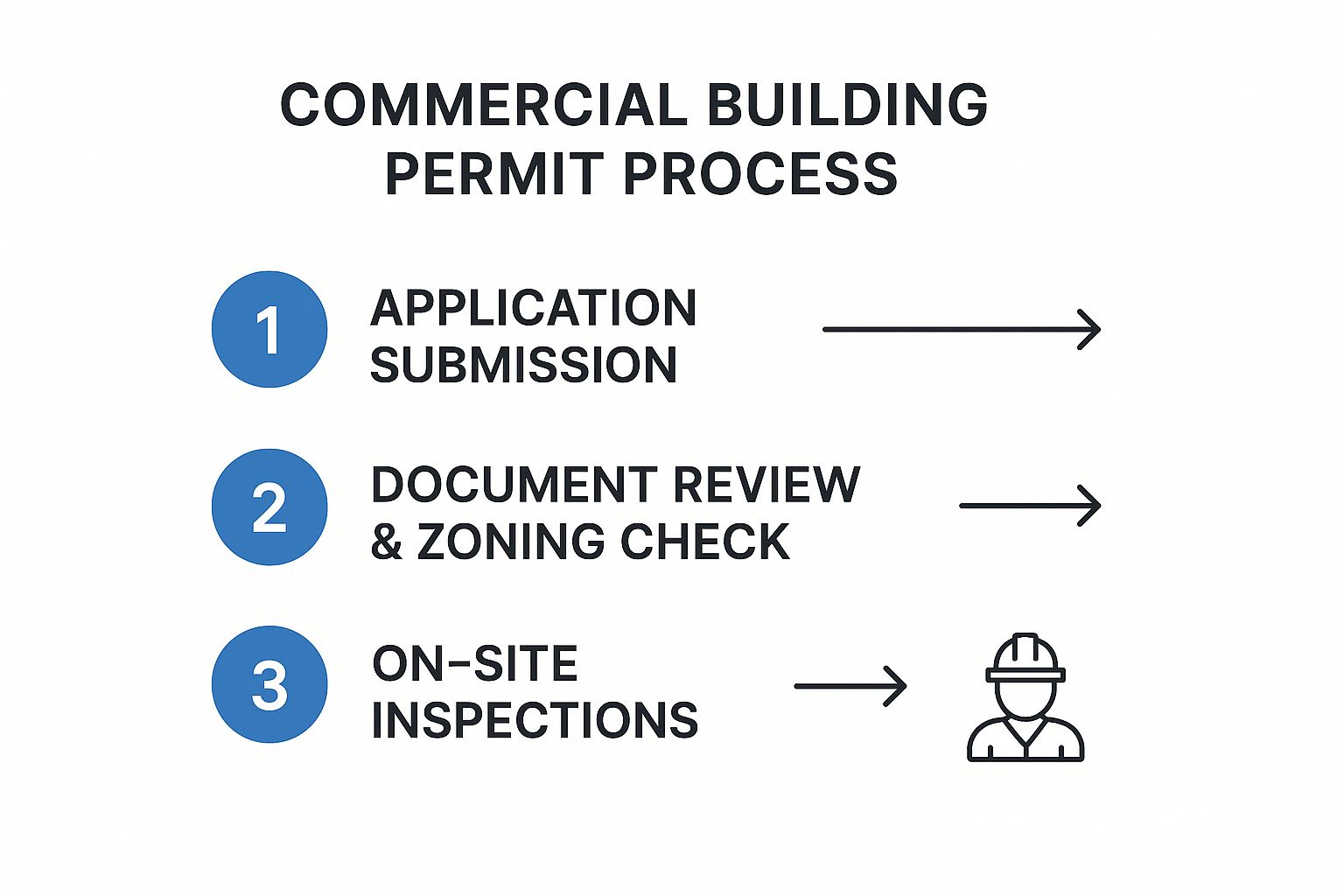
As you can see, it's a step-by-step journey. Meticulous paperwork is the key that opens the door to the next phases: review and inspection.
"A well-prepared permit application isn’t just paperwork; it’s the blueprint for a partnership between the builder, the client, and the city. It establishes trust from day one." – A Senior Project Manager at SEGC
To give you a clearer snapshot, here’s a quick breakdown of the major milestones you’ll encounter.
Quick Guide to Permit Milestones
This table summarizes the essential stages in the permit lifecycle, from your initial idea to the final handshake.
| Milestone | Objective | Key Action Required |
|---|---|---|
| Pre-Application | Confirm project feasibility and scope. | Meet with city planners; gather zoning and code information. |
| Application Submission | Formally submit all required plans and documents. | Compile architectural drawings, engineering reports, and forms. |
| Plan Review | Ensure all plans comply with local and state codes. | Respond to any reviewer comments or requests for clarification. |
| Permit Issuance | Receive the official go-ahead to start construction. | Pay all associated fees and post the permit on-site. |
| Inspections | Verify that construction work meets code at key phases. | Schedule inspections for foundation, framing, electrical, etc. |
| Final Approval | Obtain the Certificate of Occupancy. | Pass the final inspection to legally occupy the building. |
Each step is a checkpoint designed to ensure the final building is safe, sound, and ready for business.
As a Native American-owned, 8(a), and HUBZone certified firm, we specialize in crafting the kind of meticulous documentation that sails through rigorous government reviews. Our local leadership and deep experience in communities like Fayetteville become your advantage, turning a confusing bureaucratic maze into a clear, predictable path forward. It's about laying a rock-solid foundation for a building that's meant to last generations.
Assembling Your Essential Permit Documents
Think of your permit application as the master blueprint for your entire construction project. It's not just a stack of papers; it's the story of your building, told through drawings, calculations, and plans. Each document you submit is a chapter in that story, proving to the city that your vision is safe, sound, and ready to become a reality.
Getting this part right is everything. A complete and flawless document package is the secret to a smooth review process. In fact, most delays—the kind that bleed time and money—boil down to simple missing or incorrect paperwork. With over 21 years of proven results, we’ve learned this lesson firsthand so you don't have to. Meticulous preparation is your best investment.

The Core Four Document Types
While every building has its own personality, the permit office wants to see the same core group of documents for nearly every commercial project. These are the "big four" that paint a complete picture of your build from every possible angle.
- Architectural Drawings: This is what most people picture—the floor plans, elevations, and detailed sections that show how the building will look, feel, and function.
- Site Plans: Think of this as a bird's-eye view of the entire property. It shows where the building sits, where cars will park, landscaping details, and connections to water and power.
- MEP Schematics: Here's where we get technical. These drawings map out all the vital systems: Mechanical (HVAC), Electrical, and Plumbing. They're the guts of the building.
- Structural Calculations: This is the math that proves your building won't fall down. A licensed engineer prepares this report to show how the structure can handle everything from its own weight to a major storm.
Pulling these documents together is a team sport, requiring seamless coordination between your architect, engineers, and builder. Knowing how to find a good contractor who can serve as the trusted leader for this process is absolutely critical.
A Lumberton Story: How a Site Plan Saved the Day
We had a commercial project in Lumberton recently where the site plan became our golden ticket. The property had some tricky drainage issues that could have easily tied us up in zoning reviews for months.
Instead of just submitting a standard plan and waiting for red flags, our local leadership team took a proactive approach. We ordered a detailed topographical survey and a hydraulic analysis before we ever sent anything to the city. The site plan we submitted didn't just show a building; it presented a complete, pre-engineered solution to the drainage problem.
The zoning board was impressed. They told us the plan was so thorough it answered questions they hadn't even thought to ask yet. That extra layer of detail, born from our commitment to quality, got us an approval in a fraction of the time we’d budgeted.
This is exactly how we approach every project. We don't just give the city what they ask for; we anticipate their concerns and solve them on paper first, building trust from the very first submission.
The SEGC Advantage in Documentation
As a Native American-owned firm holding SBA 8(a) and HUBZone certifications, we live and breathe the world of complex government paperwork. These agencies have some of the strictest documentation standards on the planet, and our certifications prove we meet that high bar.
That deep-seated expertise is a huge advantage for our commercial clients in communities like Fayetteville and Lumberton. We prepare every single document package with the same precision demanded by a federal project.
What does that look like?
- Crystal-Clear Plans: Every drawing is meticulously detailed and clearly labeled. No guesswork for the plan reviewer.
- Code-Proofing: We double- and triple-check that every line on the page meets the latest local, state, and federal codes before it's submitted.
- No-Nonsense Submissions: We ensure every form, fee, and supplemental report is present and accounted for, preventing frustrating instant rejections.
To make sure nothing slips through the cracks on your own project, a good ultimate building permit checklist can be a fantastic resource. Our goal is to build legacies, not just buildings, and that all starts with a rock-solid foundation of impeccable, trustworthy paperwork.
Getting Past the Gatekeepers: Building Codes and Zoning Laws
Let's be honest, the moment someone brings up building codes and zoning laws, most people's eyes glaze over. But here’s a little secret from a team that’s been in the trenches for a long time: they’re actually your project’s blueprint for success.
Think of it this way: Zoning laws tell you what you can build on a piece of land. Can you build a bustling retail shop, or is this spot strictly for an office park? Building codes are the official rulebook for how to build it safely.
Tackling these rules is a must, but it shouldn't feel like you need a law degree to do it. With over 21+ years of proven results, our team at SEGC has deep expertise in the local codes in communities like Fayetteville and Lumberton. We don't just aim to check a box; we see these regulations as the starting line for creating buildings that last a lifetime.

Zoning vs. Building Codes: What's the Real Difference?
It’s easy to mash these two together, but they have completely different jobs. Understanding the distinction is your first step toward a hassle-free approval.
Let's say you want to open a new restaurant. Zoning is the reason you can't just plop it down in the middle of a quiet residential street. It’s all about creating designated zones for commercial, residential, and industrial use. Zoning officials are looking at the big picture:
- How tall can your building be?
- How far back does it need to sit from the road?
- Do you have enough parking spaces for your expected customers?
Once you get the green light from zoning, the building code inspectors step in. Their job is all about safety and structural integrity. They're focused on the nitty-gritty details to make sure your building won't fall down, catch fire, or otherwise endanger people.
The Big Three Building Codes You Can't Ignore
While every town has its own quirks, most local rules are built on a foundation of internationally recognized standards. For any commercial project, there are a few areas that will always be under the microscope.
- International Building Code (IBC): This is the comprehensive playbook most of the U.S. follows, covering everything from the strength of your foundation to the fire-resistance of your drywall.
- Fire Safety Standards: This one is non-negotiable. These rules dictate everything about your fire alarms, sprinkler systems, emergency exits, and the materials you can use. A plan that skimps on fire safety is dead on arrival.
- ADA Accessibility Requirements: The Americans with Disabilities Act (ADA) ensures your building is open and accessible to everyone. It covers the specifics of ramps, restroom layouts, doorway widths, and parking. It’s about building for the whole community.
Here’s where it gets tricky: these codes are all intertwined. A single decision—like where to put an interior wall—can affect structural loads (IBC), fire escape routes (Fire Safety), and hallway accessibility (ADA) all at once. This complex dance is where having a seasoned guide makes all the difference.
In fact, commercial building permits are more than just red tape; they're a goldmine of market data. As one industry blog explains, analyzing permit data reveals development hotspots and helps ensure every project upholds these critical standards.
A Fayetteville Client's Story: "We were on a tight deadline for our new retail store. The plans looked perfect to us, but SEGC’s team, with their deep knowledge of Fayetteville’s specific rules, immediately spotted a tiny conflict between a local fire code and an ADA rule. Catching that before we submitted saved us from a painful redesign and what would have been at least a six-week delay. Their local expertise was a total game-changer."
That’s what we do. As a Native American-owned, 8(a), and HUBZone certified firm, we bring a level of focus honed by years of navigating the most demanding government standards. We don't just follow the rules; we understand why they exist. This lets us proactively hunt down potential problems to protect your schedule and your budget. We build it right the first time, because that’s the only way to build a lasting legacy.
Navigating Permit Reviews and Inspections
So, you’ve submitted your permit application. Hitting ‘submit’ is more like the starting gun than the finish line. Now, your meticulously crafted plans land on the desks of city plan reviewers, and the real collaboration begins.
Think of this stage less as a final exam and more as a series of crucial quality checks. This is a philosophy we live by at SEGC. For over 21 years, we’ve built our reputation in Fayetteville, Lumberton, and across the region on turning the relationship with city officials into a smooth, professional partnership built on integrity and proactive communication.
The Plan Review Process Unpacked
Imagine your project plans are up for a peer review. That’s essentially what the plan review process is. A team of specialists from different city departments will pour over your blueprints, each looking at the project through their own unique lens. Their goal isn’t to nitpick; it’s to ensure the final building is a safe, functional, and valuable addition to the community.
You can expect to hear from several departments, including:
- Planning & Zoning: These are the folks ensuring your project fits the neighborhood. They’ll check land use rules, parking counts, and building setbacks.
- Building Code Enforcement: This team dives deep into the structural nuts and bolts. They’re focused on the integrity of the building and life safety systems, all measured against the International Building Code (IBC).
- Public Works: This department reviews your connections to public utilities, along with site access and how you’re managing stormwater.
- Fire Department: A make-or-break review. They scrutinize your fire suppression systems, emergency vehicle access, and evacuation routes.
This is where a great project manager becomes your MVP. They act as the single point of contact, fielding questions from every department and coordinating with architects and engineers to get answers back—fast. To get a better feel for this role, check out our guide on what a general contractor does.
An SEGC Project Manager's Tip: "The secret is to treat city officials like partners, not obstacles. We schedule pre-review meetings whenever possible to get their feedback early. A five-minute phone call to clarify a note on the blueprints can save weeks of back-and-forth later. Building that professional rapport is just as important as building the structure itself."
Key On-Site Inspection Stages
Once the permit is in hand and the first shovel hits the dirt, the on-site inspections begin. A city inspector will visit your site at critical construction milestones to make sure the work happening in the real world perfectly matches the plans they approved on paper.
Keeping your project on schedule means being 100% ready for these visits. Here are the major checkpoints you’ll need to clear:
- Foundation Inspection: This one happens before any concrete is poured. The inspector will check the excavated footings and rebar placement to ensure your building starts on a rock-solid base.
- Framing & Rough-In Inspection: With the building's skeleton up, the inspector comes back to check the structural framing and the "rough-in" of your plumbing, electrical, and HVAC systems before they get hidden behind drywall.
- Insulation & Drywall Inspection: Just before the walls are closed up, an inspector confirms that the insulation meets energy codes and that any required fire-rated walls are installed correctly.
- Final Inspection & Certificate of Occupancy: This is the big one. The inspector does a final, comprehensive walkthrough to ensure every system is working and the building is move-in ready. Pass this, and you earn your Certificate of Occupancy—the official all-clear to open your doors.
As a Native American-owned, 8(a), and HUBZone certified firm, we bring the same level of precision and detail required for complex government projects to every single inspection. Our commitment to quality means we don’t just aim to pass; we aim to set the standard. It’s about building it right the first time, every time, because that’s how you build legacies.
Understanding Permit Fees And Project Costs
Let's talk about the bottom line: money. When it comes to commercial building permits, the first question is always, "How much is this going to cost?" It's a fair question, but the answer isn't a simple number. Permit fees are a critical line item in any project budget, and they’re often misunderstood.
Think of them less as a tax and more like an investment in quality control—the city's way of ensuring your new building is safe, sound, and built to last.
Here at SEGC, our local leadership team has been navigating the financial side of construction in Fayetteville, Lumberton, and beyond for over 21 years. We believe in total transparency. Surprises are great for birthdays, not for construction projects. We're your partner in this, and that means making sure you understand where every single dollar is going.

How Permit Fees Are Calculated
You won't find a one-size-fits-all price tag for a commercial permit. Instead, most cities use a sliding scale that ties the fee directly to the size and complexity of your project. The most common calculation methods are:
- Project Valuation: This is the big one. The fee is a percentage of your total estimated construction cost.
- Square Footage: Some places keep it simple, charging a flat rate per square foot.
- Scope of Work: The fee can also hinge on what you're actually doing. A permit for an HVAC upgrade will cost far less than a permit for a multi-story office building.
Looking Beyond The Basic Permit Fee
That initial permit fee is just the beginning. A truly smart budget anticipates the other costs that pop up along the way. Getting caught off guard by these "extras" can put a serious strain on your finances.
Keep an eye out for these potential add-ons:
- Plan Review Fees: This fee covers the time for city engineers and plan checkers to review every detail of your blueprints.
- Impact Fees: This is your development's contribution to the community, helping fund public infrastructure like roads, sewers, and parks.
- Re-inspection Fees: If an inspector shows up and the work isn't ready or fails, they’ll have to come back. You'll likely get a bill for their return trip—a powerful motivator to get it right the first time.
To give you a clearer picture, here’s a sample breakdown of what the fee structure might look like for a mid-sized commercial project.
Sample Commercial Permit Fee Breakdown
| Fee Type | Basis for Calculation | Typical Cost Range |
|---|---|---|
| Building Permit Fee | Percentage of project valuation | 0.5% – 2.0% of total cost |
| Plan Review Fee | Percentage of building permit fee | 25% – 65% of the permit fee |
| Impact Fees | Per square foot or based on project type | $2,000 – $50,000+ |
| Specialty Permits | Flat fee per trade (e.g., electrical, plumbing) | $100 – $1,000 per permit |
| Re-inspection Fees | Flat fee per failed inspection | $100 – $300 per visit |
This table illustrates how different components contribute to the total cost.
Covering these initial outlays often requires smart financial planning. It's why many business owners need to secure working capital; understanding why businesses opt for unsecured loans can be a crucial part of managing your project's cash flow effectively.
It’s also important to be aware of the bigger economic picture. For instance, in early 2025, the U.S. saw a 6.1% dip in total building permits, partly driven by the rising cost of materials. Your project doesn't exist in a vacuum, and these trends matter.
At SEGC, our job is to see the whole board. We don’t just build; we anticipate. By meticulously planning and leveraging our deep local knowledge, we help our clients create budgets that are as resilient as the structures we construct together.
As a Native American-owned firm with 8(a) and HUBZone certifications, we bring a level of disciplined planning sharpened by years of managing complex government projects. We provide clear, detailed cost forecasts, ensuring your financial foundation is rock-solid from day one. Our mission is to build legacies, and that always starts with a partnership built on absolute trust and transparency.
Building Legacies, Not Just Structures
Getting your commercial building permit isn't the finish line—it's the starting gun. While this guide has walked you through the nuts and bolts of commercial building permit requirements, turning those approved blueprints into a reality requires the right partner. Choosing your construction partner is the single most important decision you'll make.
At SEGC, we don't just see a project; we see an opportunity to build something that lasts. We're in the business of building relationships and strengthening communities, from Fayetteville to Lumberton and everywhere in between.
Your Partner in Building a Legacy
As a Native American-owned, 8(a), and HUBZone certified firm, we bring a different perspective to the job site. We're built on a foundation of 21+ years of proven results, a deep commitment to quality, and a genuine dedication to our clients' success. We understand this project is your vision, your investment, and your future. That's a responsibility we honor with every action.
Our team doesn't just manage schedules and subcontractors; we serve as your trusted guide through every phase, offering clarity and honesty. We're here to help you make smart decisions, from picking the right materials to navigating a surprise inspection. It’s all part of our core mission: we’re building legacies, not just structures.
"A building is a reflection of the people who built it. Our goal is to ensure every project reflects our shared values of integrity, craftsmanship, and community."
Knowing how to structure a project from the get-go is also a huge piece of the puzzle. Our deep expertise in various construction project delivery methods means your project is set on the path to success long before the first shovel hits the dirt.
We believe the strongest material on any job site should be trust. It's about straight talk, transparent budgets, and working together toward a shared goal: creating something truly exceptional.
If you’re ready to team up with a partner that understands your vision and is committed to bringing it to life with excellence, let's talk.
Your legacy is waiting.
Got Questions? We've Got Answers.
When it comes to commercial building permit requirements, we’ve heard it all. After 21+ years serving communities like Fayetteville and Lumberton, we've seen the same questions pop up time and again.
Let's cut through the noise and give you some straight, actionable answers.
How Long Is This Permit Thing Going to Take?
The honest answer? It depends. A simple interior refresh might sail through in a few weeks, but a brand-new building could take several months. It really boils down to two things: the completeness of your application and the current workload at the local permit office.
This is where having a seasoned guide makes all the difference. At SEGC, our local leadership knows the process in places like Fayetteville and Lumberton inside and out. We build our applications to answer reviewers' questions before they even ask them, helping shave off precious time and keep your project on track.
What’s the Worst That Could Happen If I Just Start Building?
Starting work without a permit isn't just bending the rules—it's a high-stakes gamble. It can bring your entire project to a screeching halt with a stop-work order. Then come the hefty fines. In the worst-case scenario, you could even be forced to tear down what you've already built.
It's not just about the legal headaches. Unpermitted work is a red flag for lenders and insurance companies, putting your entire investment at risk. Our commitment to client trust means we don’t break ground until every 'i' is dotted and every 't' is crossed.
Is a Renovation Permit the Same as a New Build Permit?
Nope, they're different beasts, and applying for the right one is crucial.
- New Construction: This is the all-encompassing permit, covering everything from the foundation to the roof.
- Renovations: For tenant improvements or a major remodel, you'll need a renovation permit. It’s usually less intense, but officials will still scrutinize any changes to structural, electrical, or plumbing systems to ensure they meet current code.
Nailing down your project's scope from the very beginning is key. It ensures you're applying for the right permit, saving you from headaches and delays. As a Native American-owned, 8(a), and HUBZone certified firm, we live and breathe this kind of meticulous planning.
Ready to build a legacy, not just a structure? The team at South Eastern General Contractors is here to guide you through every step of your commercial project with the trust and quality you deserve. Let's start the conversation about your vision today. Contact us to learn more.