
Construction Project Delivery Methods: A Guide to Building Your Legacy
The success of any construction project is decided long before the first shovel hits the ground. It all starts with choosing the right construction project delivery method—a strategic decision that maps out every relationship, responsibility, and risk. As your trusted partner, SEGC believes this choice is the true cornerstone of your project's outcome.
Choosing Your Project's Foundation
Think of a delivery method as the operating system for your entire construction project. It’s the framework that dictates how you, the designer, and the builder will work together, communicate, and handle risk from the initial concept all the way through to completion. Making an informed choice at this stage, with guidance from a dedicated partner, is an actionable insight that ensures success.
For over 21 years, our team at SEGC has walked alongside clients to navigate this crucial decision, helping build lasting legacies in communities like Fayetteville and Lumberton. We see our role as more than just builders; we're here to educate and empower you, ensuring you select the path that perfectly aligns with your vision, budget, and timeline.
Understanding the Core Methods
At their heart, there are three primary construction project delivery methods. Each one sets up a different structure for contracts, risk, and the level of collaboration between the key players.
- Design-Bid-Build (DBB): This is the traditional, sequential approach. The design is fully completed first, and then contractors compete for the job through a bidding process.
- Construction Manager at Risk (CMAR): A more collaborative model where the owner brings a construction manager on board during the design phase. This gives you expert input on cost and buildability before committing to a Guaranteed Maximum Price (GMP).
- Design-Build (DB): An integrated, one-stop solution. A single entity—the design-build team—handles both the design and construction under one contract.
The global construction market, valued at around $16.15 trillion in 2024, is constantly pushing for more efficient ways to manage increasingly complex projects. This drive is a big reason why alternative approaches are gaining so much ground. If you're interested in the larger market trends, you can explore more construction industry statistics to see how the industry is evolving.
A Note From Our Local Leadership: "The right delivery method does more than just organize a project; it builds trust. When roles are clear and goals are aligned, everyone works toward the same outcome. That's how we've built our reputation in North Carolina—by ensuring the foundation of the project relationship is as solid as the structure itself."
To help you get started, let’s look at how these methods stack up at a high level.
Delivery Methods At-a-Glance
This table offers a quick comparison of the foundational differences between Design-Bid-Build, CMAR, and Design-Build across critical project factors.
| Delivery Method | Primary Relationship | Risk Allocation (Owner) | Best For |
|---|---|---|---|
| Design-Bid-Build (DBB) | Separate contracts with designer and builder | High (responsible for design gaps) | Simple, well-defined projects where low initial cost is the top priority. |
| CMAR | Contracts with designer and CM; CM holds sub-contracts | Medium (shares risk with the CM) | Complex projects needing early budget control and expert collaboration. |
| Design-Build (DB) | Single contract with the design-build team | Low (single point of responsibility) | Projects where speed, collaboration, and innovation are most important. |
As a Native American-owned, 8(a), and HUBZone certified firm, we bring deep experience in all three methods, especially on federal projects where total clarity and accountability are non-negotiable. An actionable insight for our clients is to choose a partner who truly understands these nuances; it's the first, most important step toward building your legacy.
The Traditional Path With Design-Bid-Build
The Design-Bid-Build (DBB) method is probably the most familiar of all construction project delivery methods. It’s often called the "traditional" path for a reason—its linear, three-step process is deeply rooted in the industry. First, an owner hires an architect to complete a full design. Next, they put that design out for competitive bids from contractors. Finally, they award the job to the lowest qualified bidder to build it. It’s a very clear separation of duties.
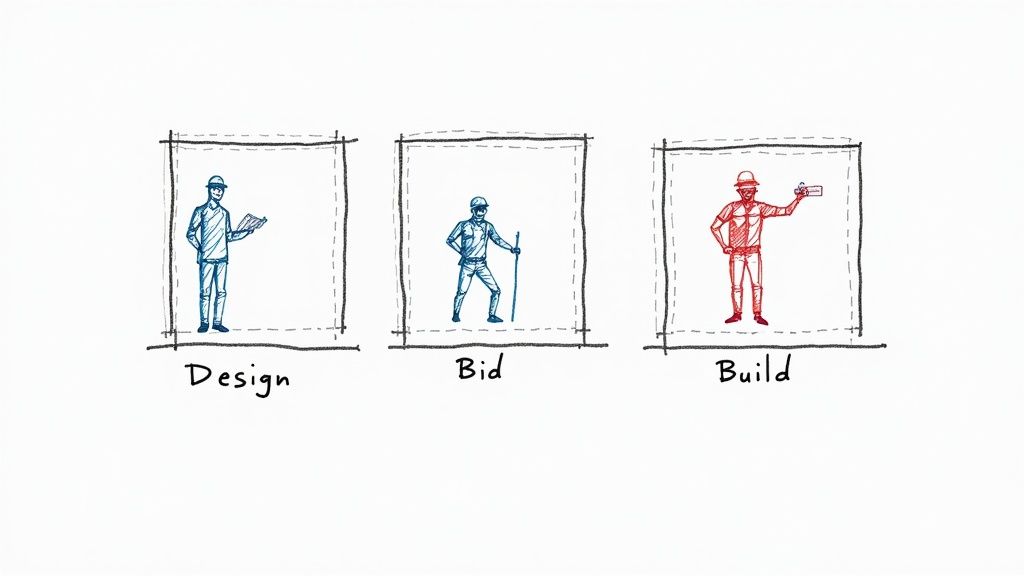
Because it focuses so heavily on getting the lowest price through open competition, DBB is often the default choice for public sector work. For simpler projects where the scope is locked in and changes aren't expected, this approach can look very appealing. The distinct roles give you a sense of order and cost control right from the start.
The Trade-Offs of a Linear Process
Here’s the catch: the very structure that makes DBB seem straightforward is also its biggest weakness. The design and construction phases are completely separate, which means the builder has absolutely no input while the project is being designed. This gap can cause major, unexpected problems down the road.
At SEGC, we’ve handled countless DBB projects for public and private clients around Fayetteville. Our 21+ years of proven results have shown us time and again that a design that’s perfect on paper can create massive constructability headaches in the field. Without a builder’s real-world expertise during planning, a design might be inefficient, more expensive than it needs to be, or just plain difficult to build with the materials and labor you have.
"In a Design-Bid-Build project, the owner carries all the risk for design errors or omissions. If there's a flaw in the plans, the resulting change orders and delays fall squarely on their shoulders. Our job is to be our client's fiercest advocate, anticipating these issues before they impact the budget. This is the client-first approach we bring to every project." – SEGC Project Manager
This setup can easily foster an adversarial relationship instead of a collaborative one. The contractor's job is to build exactly what's in the documents they bid on. Any change, no matter how small or necessary, turns into a change order. This leads to disputes, schedule blowouts, and a final cost that is often way higher than that attractive low bid. This is the critical risk every owner needs to grasp.
Navigating DBB for Project Success
Despite its downsides, DBB isn’t going anywhere. Successfully delivering a project under this framework is a real measure of a contractor's skill and integrity. It demands a partner who can meticulously manage the process and protect your interests, even within a rigid contract.
This is where our experience truly shines, especially on federal projects where our 8(a) and HUBZone certifications are crucial. Here is our actionable insight on how we make DBB projects work:
- Conducting Rigorous Plan Reviews: Before a single shovel hits the dirt, we comb through every inch of the design to spot potential conflicts, unclear details, or constructability issues.
- Proactive Communication: We open clear, constant lines of communication with the owner and designer. The goal is to solve problems together before they balloon into expensive change orders.
- Building Trust: Our dedication to quality and transparency helps close the gap between the design and construction teams, creating a sense of teamwork even when the contracts don't encourage it.
While we often suggest more collaborative construction project delivery methods, we also know how to make the traditional path work for our clients. By choosing a partner dedicated to building legacies, not just structures, you can turn a potentially confrontational process into a successful project.
The Collaborative Approach With CMAR
When a project is too complex for the traditional Design-Bid-Build (DBB) route, the Construction Manager at Risk (CMAR) method offers a far more collaborative and forward-thinking solution. This model fundamentally changes the project dynamic. Instead of waiting for finished plans, a construction expert joins the team during the design phase, ensuring the project's vision aligns with its real-world budget and schedule from day one.

In a CMAR setup, the owner hires the construction manager (CM) to serve as a consultant and advocate right from the start. The CM provides essential pre-construction services, offering expert input on cost, material availability, scheduling, and overall constructability while the design is still fluid. This early guidance is a priceless, actionable insight that helps steer the design toward efficiency and prevents expensive surprises later on.
From Consultant to Contractor
The CMAR process plays out in two distinct phases. At first, the CM acts as a trusted advisor. Once the design is developed enough, their role shifts. They present a Guaranteed Maximum Price (GMP), which is a firm ceiling on the total construction cost.
After the owner accepts the GMP, the CM transitions from consultant to a contractor who is now "at risk." This is a critical distinction. It means they are financially on the hook to deliver the project within that budget. Any cost overruns are their problem, not the owner's. This structure gives the CM a powerful incentive to manage the project with total efficiency and transparency.
A Legacy of Trust in Lumberton: "On a recent community project in Lumberton, the CMAR model was indispensable. Early in the design phase, our team identified complex subsurface utility conflicts that the initial plans missed. By addressing these issues collaboratively with the owner and designer before setting the GMP, we prevented what would have been months of delays and six-figure change orders. That’s how you build trust—by solving problems before they happen."
This team-first mindset is the heart and soul of the CMAR approach. The owner, designer, and CM function as one cohesive unit, all driving toward the same objective: a high-quality project delivered on time and on budget.
Why CMAR Excels on Complex Projects
The CMAR model shines on projects with an intricate scope, a tight budget, or a critical schedule. It strikes a balance between owner control and expert collaboration that many find reassuring.
As a firm with deep roots in North Carolina, SEGC has used the CMAR method to achieve outstanding results for both public and private clients. This model is a natural fit for the value-driven goals common in federal contracting, where our 8(a) and HUBZone certifications position us as a uniquely qualified partner. The government isn’t just buying a building; it’s investing in a reliable outcome, and CMAR delivers that assurance.
The broader construction industry is taking note of this collaborative model's power. A 2024 analysis from Deloitte highlights these industry trends, showing how firms are adopting methods like CMAR. With a tight labor market, early collaboration and digital tools are becoming key to boosting productivity and keeping projects on track.
Choosing CMAR is about more than just managing risk. It’s about building a partnership based on shared goals and mutual respect. For owners who want expert guidance without giving up control, CMAR is one of the most effective construction project delivery methods out there.
The Integrated Solution With Design-Build
When getting a project done fast with everyone on the same page is what matters most, the Design-Build (DB) method really shines. It flips the traditional model on its head by bringing the designers and contractors together as one team, under one contract, right from the start. This approach breaks down the usual walls between the design phase and the construction phase, creating a much smoother process from concept to completion.
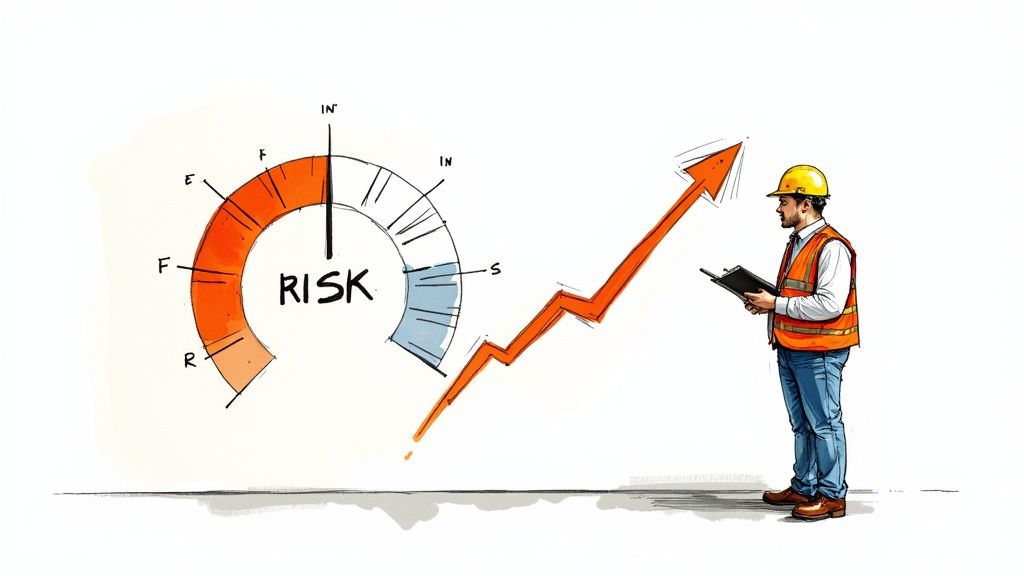
The biggest advantage here is the single point of accountability. As the project owner, you have one contract and one point person. That’s it. This setup dramatically simplifies communication and cuts down on the finger-pointing that can happen when the design and construction teams are separate. It frees up the entire team to focus on creative problem-solving.
Unifying Vision and Execution
In a typical project, the builder doesn't see the plans until they're already finished. Design-Build is different. The construction experts are involved from day one, and that early input makes a world of difference.
The team collaborates to find the smartest, most efficient way to bring the vision to life, balancing great design with practical, buildable solutions. This constant feedback loop is an actionable insight that helps identify potential construction headaches before they turn into expensive change orders. Because design and construction happen in parallel, projects can often be fast-tracked, which can lead to a much quicker delivery. To dig deeper into how this works, check out our guide on what Design-Build construction is.
Client Insight Building a Community Legacy: "Working with SEGC on our new community facility in Fayetteville was a game-changer. Having one team responsible for everything gave us incredible peace of mind. They listened to our vision, then brought it to life ahead of schedule and with a level of quality that exceeded our expectations. The trust we built with them was the most valuable part of the entire process."
A Proven Model for Complex Projects
The Design-Build approach is especially powerful for complex jobs that demand real innovation and teamwork. As a Native American-owned firm, we’ve used this model to deliver outstanding results for clients facing unique challenges and chasing ambitious goals.
A great example is a multi-use community facility we built near Fayetteville. The project involved specialized equipment, strict accessibility requirements, and a tricky site, all funded by a fixed community budget. For a project this complicated, Design-Build was the only way to go.
Our integrated team was able to:
- Accelerate the Timeline: We started site prep while the interior designs were still being finalized, which cut months off the schedule.
- Maximize the Budget: Our builders gave the design team instant cost feedback, which helped us choose materials that offered the best value without compromising quality.
- Foster True Partnership: The client was a key part of the process every step of the way, making sure the final building was a perfect reflection of their vision.
This project proves what we’ve always believed: a unified team doesn’t just build structures—it builds trust and creates legacies. As an 8(a) and HUBZone certified firm with over 21 years of proven results, we know that when you get everyone pulling in the same direction, you get incredible results. For any owner who wants an efficient, collaborative, and straightforward path to success, Design-Build is often the best choice.
A Framework for Your Project Decision
Choosing the right construction project delivery method isn't about a gut feeling—it’s about a clear, honest assessment of what your project truly needs to succeed. This decision is the foundation for everything else, from your budget to your final ribbon-cutting. You need a practical way to look past the surface and pick the approach that aligns with your specific goals.
With over 21 years of experience, our leadership team at SEGC has walked countless clients in communities like Fayetteville and Lumberton through this exact process. We want to empower you with the right knowledge to weigh these options confidently. This is about building a successful legacy, not just signing a contract.
Key Variables That Drive Your Choice
Every project has its own DNA, shaped by its schedule, budget, complexity, and how involved you want to be. One method might prioritize speed, while another offers rock-solid cost control. The trick is to pinpoint your non-negotiables and match them to the delivery method that champions those strengths.
For instance, the traditional Design-Bid-Build model can seem attractive with its low initial bid. But in our experience, a more collaborative approach like CMAR or Design-Build often delivers far greater value in the long run. By bringing the builder’s expertise into the design phase, we provide an actionable insight that heads off the expensive change orders and frustrating delays that so often plague linear, siloed projects.
This decision tree offers a great starting point, helping you visualize how your priorities lead to a particular method.
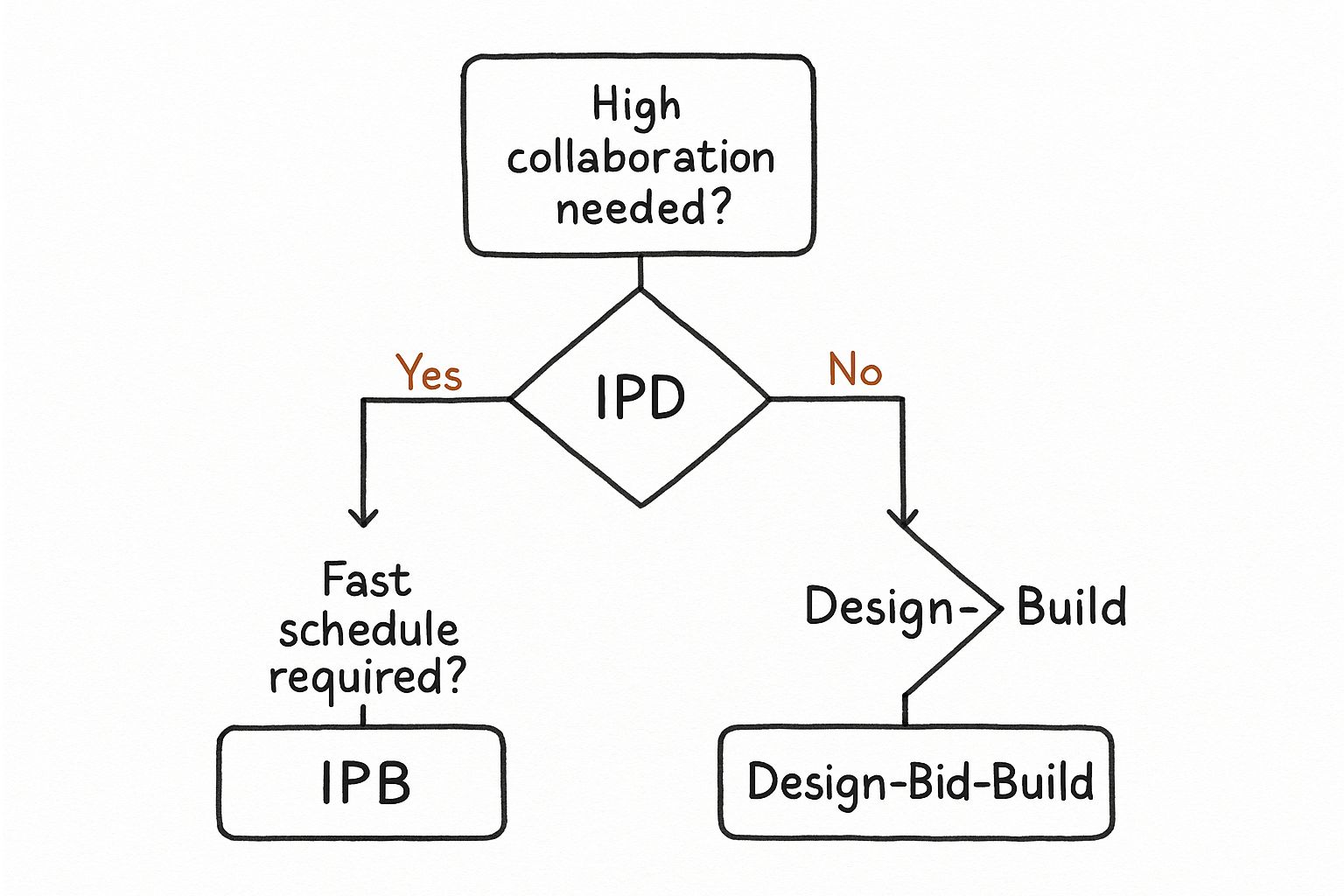
As the graphic shows, a few key questions about your needs for speed, collaboration, and risk can quickly narrow down the best path forward.
Decision Matrix For Your Delivery Method
For a more granular look, the following matrix breaks down how each primary method stacks up against critical decision factors. Use this actionable insight to align your project's top priorities with the strengths of each delivery method, guiding you to the best fit. As a firm with Native American-owned, 8(a), and HUBZone certifications, we've applied all these frameworks to meet the rigorous demands of diverse projects, especially in the federal space.
| Decision Factor | Design-Bid-Build (DBB) | Construction Manager at Risk (CMAR) | Design-Build (DB) |
|---|---|---|---|
| Schedule Acceleration | Poor. Its rigid, sequential nature makes it inherently slow. Phases can't overlap, so delays are common. | Good. Allows for some fast-tracking. We can order long-lead items while design is still being finalized. | Excellent. The integrated team allows construction to begin before design is 100% complete, dramatically shortening the timeline. |
| Budget Control | Poor. That low bid is often a mirage. The risk of change orders and cost overruns from design gaps is very high. | Excellent. A Guaranteed Maximum Price (GMP) is established early with the builder's input, ensuring cost certainty. | Very Good. A firm price is set early. The single point of contact minimizes the costly disputes that lead to budget creep. |
| Project Complexity | Poor. A terrible fit for complex projects. Without builder input during design, major constructability issues are almost inevitable. | Excellent. The ideal choice for complex or unique builds. The CM provides expert risk analysis and solutions from day one. | Very Good. The integrated team structure naturally fosters the innovation and creative problem-solving needed for complex jobs. |
| Owner Involvement | High (and Fragmented). You manage two separate contracts and must act as the referee in any dispute between designer and builder. | Medium. You remain central to key decisions but delegate the day-to-day management and risk to the CM. | Low. Your role is streamlined. You manage one contract and one relationship, freeing you from daily site-level intervention. |
By comparing these attributes side-by-side, it becomes much clearer which model provides the structure and support your specific project requires to thrive.
In the end, it’s all about understanding the practical trade-offs. If you’re interested in learning more about what we feel is one of the most balanced and collaborative approaches, check out our in-depth guide on what construction management is and how it’s designed to protect your interests from start to finish.
Building Legacies with the Right Partner
Picking the right construction project delivery method is a huge first step, but it’s only half the equation. Even the best-laid plans are only as strong as the team you choose to execute them. This guide has given you the technical know-how to select a framework; at SEGC, we’re the team that turns that strategic choice into a high-quality, tangible reality.
Our whole philosophy is built on trust, quality, and a genuine commitment to the communities we serve, from our hometown of Fayetteville to our neighbors in Lumberton. We don’t just build in these areas—we live here. That means our reputation is built one project, and one relationship, at a time, backed by over 21 years of proven results.
The SEGC Difference: Your Partner in Success
What really sets a construction partner apart? It's their ability to truly understand and align with your vision and goals. As a Native American-owned, 8(a), and HUBZone certified firm, we bring a unique perspective and proven capability to every job, especially projects with the strict requirements of federal contracting. These aren’t just labels; they’re proof of our reliability, financial strength, and commitment to the highest performance standards.
"Choosing a delivery method is a technical decision. Choosing a partner is a decision of trust. A great partner makes any delivery method work better by fostering communication, proactively solving problems, and putting the client’s success above all else. That is the standard we hold ourselves to on every project." – SEGC Leadership
We get it—you're not just putting up a building. You're creating a legacy for your family, your business, or your community. This mindset is woven into our company's DNA. It shapes how we communicate, manage budgets, and ensure every last detail meets an uncompromising standard of quality. Finding the right firm is a critical process, which is why we created a detailed guide on how to find a good contractor to help you effectively vet potential partners.
Let's Build Your Legacy Together
Ultimately, selecting a delivery method and a contractor comes down to one thing: confidence. You need confidence in the plan, the budget, and most importantly, the people who will bring it all to life. For more than two decades, our mission has been to build legacies, not just structures. We measure our success by yours.
We invite you to partner with a firm that is as invested in building lasting legacies as you are. Take a look at our portfolio to see our dedication to quality in action and discover how our client-first approach turns big ideas into concrete realities. When you're ready to build with a team that values trust and quality above all else, we’re here to start the conversation.
Frequently Asked Questions
It's completely normal to have questions when you're trying to wrap your head around construction project delivery methods. We get them all the time. Drawing on our 21+ years of hands-on experience, we've put together answers to a few common questions we hear from clients to provide actionable insights.
What Is the Biggest Risk in Design-Bid-Build (DBB)?
With Design-Bid-Build, the single biggest risk lands squarely on you, the owner. You're on the hook for any mistakes or gaps in the design documents. Since the contractor isn't involved during the design stage, any clashes or buildability problems that pop up during construction turn into expensive change orders and schedule delays—and that cost falls to you.
This is exactly why we become such a strong advocate for our clients in Fayetteville and Lumberton, even on a DBB project. We dive deep into plan reviews to spot potential headaches before they hit your wallet and your timeline.
An experienced partner can certainly help reduce DBB risks, but you can't escape the fact that the contract itself puts the burden of a bad design on the owner. An actionable insight is to go in with your eyes open if you choose this traditional route.
Can Delivery Methods Be Combined?
Absolutely. We're seeing more and more hybrid models in the field. For example, a project might kick off using a CMAR for pre-construction to nail down the budget and design, and then shift into a contract that looks more like Design-Build for the actual construction.
Pulling off these custom approaches really depends on having a seasoned and adaptable team. As a Native American-owned firm with 21+ years of proven results, we know how to craft a hybrid solution that fits your project like a glove, taking the best parts of each model to get the job done right.
Which Method Is Best for Federal Projects?
For federal work, both CMAR and Design-Build are excellent fits. The government puts a huge emphasis on budget reliability, tight schedules, and having a single point of accountability—all things these collaborative methods deliver. They really mesh well with the value-focused procurement goals you see in federal agencies.
Our 8(a) and HUBZone certifications make us a go-to partner for these types of projects. We have a long history of successfully completing complex jobs for government clients who need the kind of transparency and risk control that CMAR and Design-Build offer. Our expertise in these methods is an actionable insight for any entity looking to secure a federal contract.
At South Eastern General Contractors, we believe a well-informed client is the best kind of partner. Picking the right delivery method isn't just about the paperwork; it's about laying the foundation for a relationship built on trust and a common goal. We’re not just putting up buildings—we're building lasting legacies.
Ready to build with a partner committed to your legacy? Contact SEGC today to start the conversation.