

Construction Quality Assurance Checklist: 7 Key Steps for 2025
In construction, the difference between a building and a legacy lies in the details. A handshake is a promise, and a foundation is more than concrete; it's the start of a family's story or a community's future. For over 21 years, South Eastern General Contractors (SEGC) has built our reputation on this principle, delivering proven results one meticulously managed project at a time across North Carolina.
As a Native American-owned, 8(a), and HUBZone-certified firm, we don't just meet standards; we set them. Our unwavering commitment to quality is woven into every project, from luxury custom homes in Fayetteville to critical government facilities in Lumberton. We believe that true quality assurance isn't just about catching mistakes, it's about preventing them from ever happening. It's the system that ensures every beam, bolt, and blueprint detail aligns perfectly with the client's vision and our promise of excellence.
But how do you turn that vision into a structure that stands the test of time? It starts with a rigorous, non-negotiable process. Forget the generic advice and vague tips. We're pulling back the curtain to share the ultimate construction quality assurance checklist. This isn't just a list of tasks; it’s a philosophy. These are the same foundational principles SEGC uses to build trust, guarantee excellence, and transform client relationships into lasting partnerships. Let's build it right, together.
1. Pre-Construction Site Preparation and Documentation Review
Think of pre-construction as the "measure twice, cut once" phase, but on a colossal scale. Skipping this step is like trying to bake a Michelin-star cake without a recipe, preheating the oven, or even checking if you have flour. This initial stage is where quality is born, long before a single shovel hits the dirt. It’s a meticulous deep-dive into every document, permit, and report to ensure your project’s foundation is rock-solid, both literally and figuratively.
This comprehensive review confirms that all designs are compliant, permits are secured, and the site itself has been thoroughly vetted. It’s about catching a million-dollar problem when it’s still just a typo on a blueprint. For our clients in Fayetteville and Lumberton, this process builds trust from day one, ensuring the project starts on a foundation of clarity and precision. It’s a non-negotiable standard that prevents surprises and keeps your project on track.
The Paperwork Gauntlet: Why It Matters
Proper documentation isn't just bureaucratic red tape; it's your project's DNA. This includes everything from architectural drawings and structural calculations to geotechnical soil reports and environmental assessments. The Burj Khalifa's success story, for instance, hinged on extensive pre-construction wind tunnel testing and foundation analysis. Conversely, Boston's infamous "Big Dig" became a cautionary tale, with its massive cost overruns and structural failures underscoring the catastrophic price of inadequate geotechnical reviews.
At SEGC, with over 21 years of proven results in communities like Fayetteville and Lumberton, we treat this phase with the gravity it deserves. As a Native American-owned, 8(a)-certified firm, our commitment to unwavering quality is embedded in our process. We ensure every "i" is dotted and every "t" is crossed before we even think about mobilizing on-site.
Actionable Tips for a Bulletproof Pre-Construction Phase
To make this crucial stage manageable, break it down into a systematic checklist:
- Master Document Checklist: Create a centralized tracker for every required document, from permits to consultant insurance certificates. Use it to monitor submission and approval statuses in real-time.
- Leverage Modern Tech: For creating highly precise topographical data and 3D models crucial for accurate site planning and initial documentation, leveraging advanced tools like drones with LiDAR for 3D mapping is invaluable. This technology provides an incredibly detailed starting point.
- Host a Stakeholder Kick-off: Assemble everyone, from the architect to the lead subcontractor, for a formal pre-construction meeting. This is the time to align on expectations, review the plans together, and identify potential conflicts before they become on-site battles.
- Document Existing Conditions: Before any work begins, thoroughly photograph and video the entire site. This pre-existing condition report is your baseline and can be a lifesaver in the event of disputes.
The following infographic illustrates the core workflow for this documentation review, a foundational part of any serious construction quality assurance checklist.
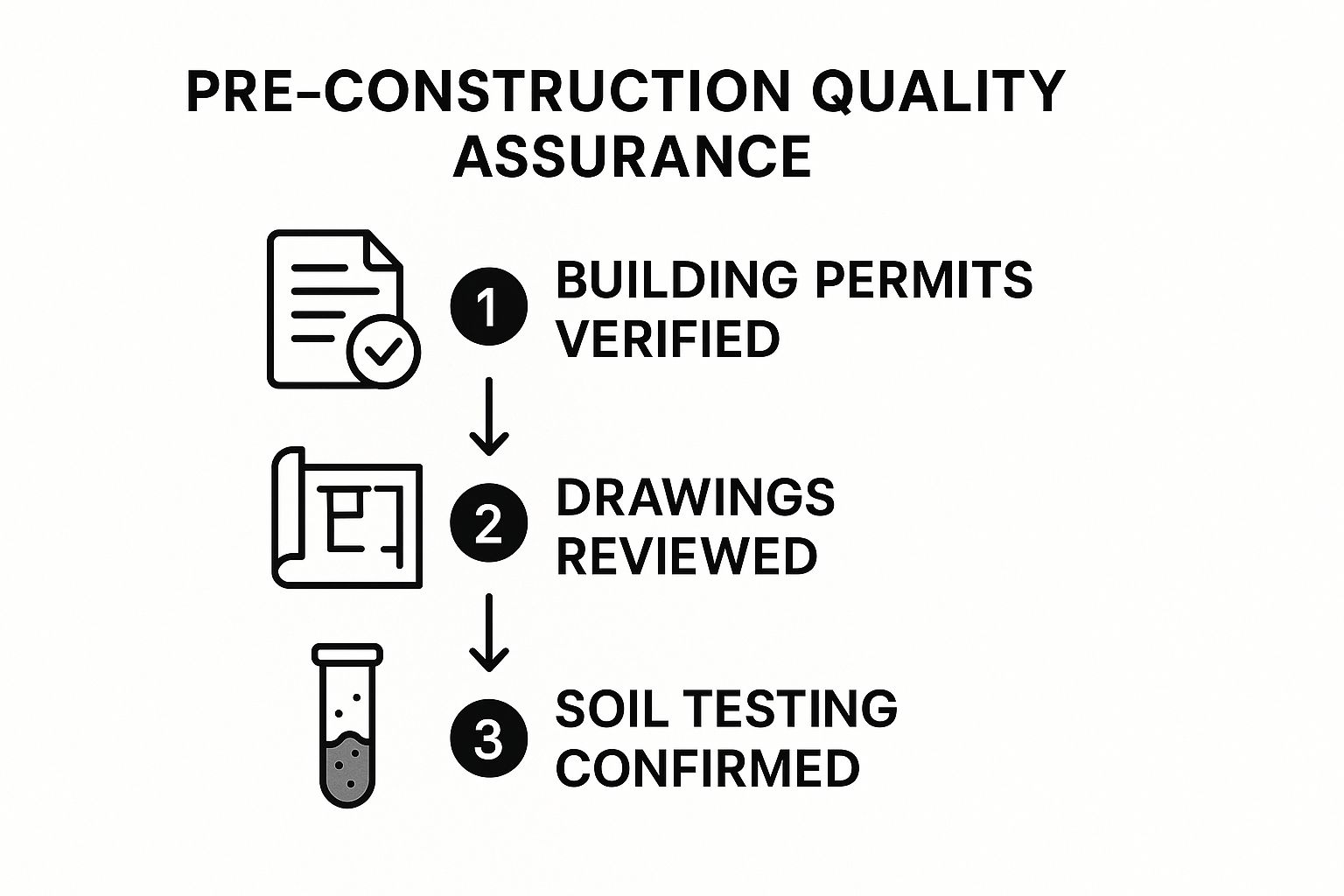
This simple, sequential process ensures that regulatory, design, and environmental requirements are met in the correct order, preventing costly rework. By verifying each stage before proceeding, you build a foundation of certainty for the project. For a deeper dive into what this entails on the ground, you can learn more about site preparation for building construction.
2. Foundation and Structural Integrity Inspections
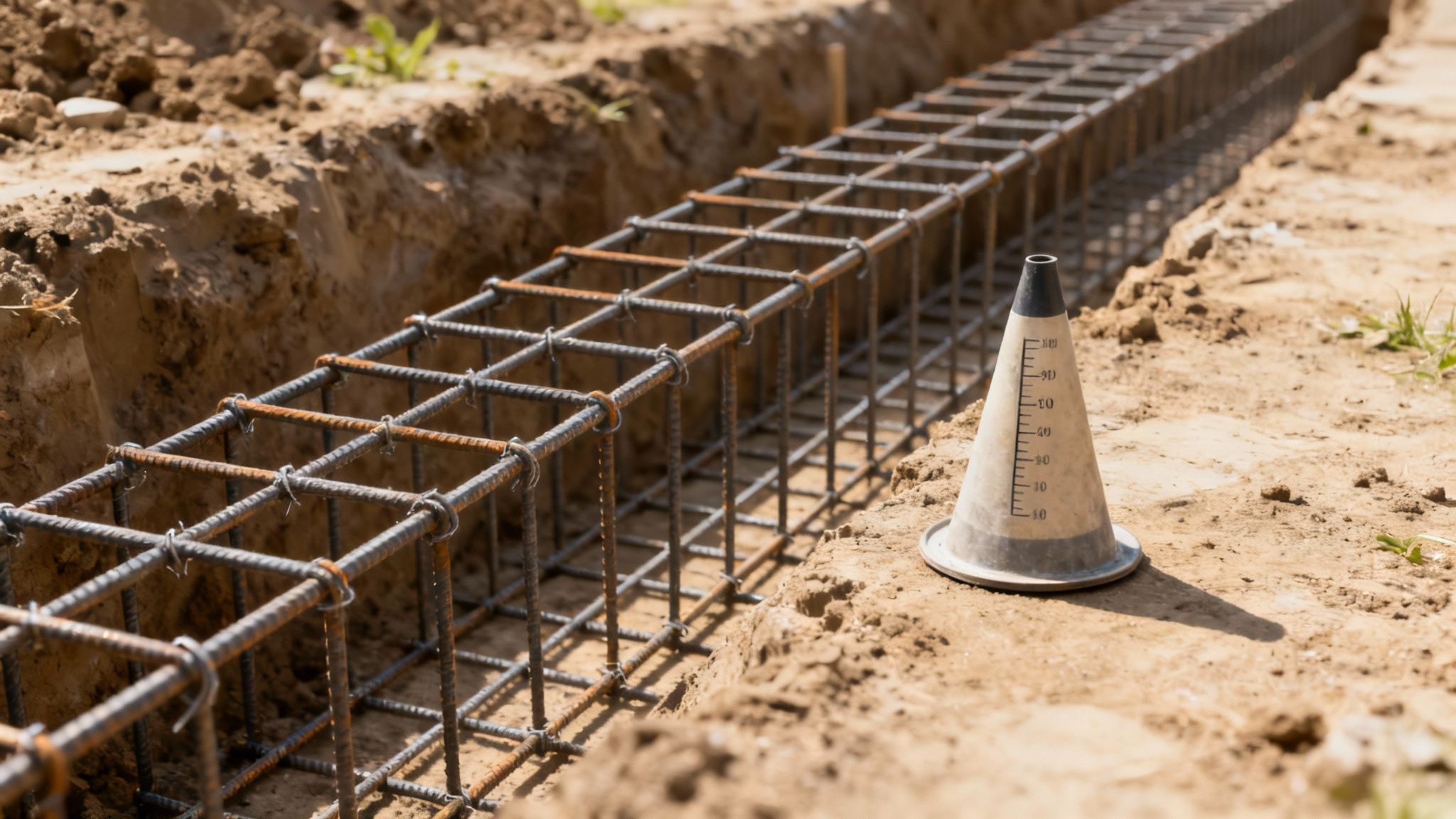
If pre-construction is the "measure twice" phase, then foundation and structural inspections are the "cut once" moment of truth. This isn't just about pouring concrete; it's about creating the very skeleton of your building. Get this wrong, and you're not just facing a costly fix; you're looking at a potential catastrophic failure. This stage involves a systematic series of checks on everything from the rebar grid to the final concrete pour, ensuring the structural framework can withstand every force it's designed to encounter.
Think of it as the project's point of no return. Once the concrete is poured and the walls go up, the foundation is hidden forever. Organizations like the American Concrete Institute (ACI) and the American Society of Civil Engineers (ASCE) have established rigorous standards because they know that a building is only as strong as its base. These inspections are the physical manifestation of the engineering blueprints, translating complex calculations into tangible, unyielding strength. It’s the process that prevents a building from becoming a headline for all the wrong reasons.
The Bedrock of Quality: Why It's Non-Negotiable
A flawless foundation is the unsung hero of every successful structure. The infamous leaning of San Francisco's Millennium Tower serves as a stark, multi-billion-dollar reminder of what happens when foundation and soil analysis are not given the obsessive attention they require. In contrast, the Panama Canal expansion project's success hinged on extreme quality control over its concrete, with protocols designed to ensure a lifespan of over a century.
This meticulous oversight is a cornerstone of our process at SEGC. Serving communities from Fayetteville to Lumberton for over 21 years, our 8(a)-certified team understands that building a legacy starts from the ground up. We implement strict hold-points in our projects, ensuring that no concrete is poured until every piece of rebar and every form is personally verified by our quality control managers and the relevant inspectors. This is a non-negotiable step in our construction quality assurance checklist.
Actionable Tips for Flawless Foundations
To ensure your structure stands the test of time, implement these critical inspection checkpoints:
- Establish "Hold Points": Make it a mandatory policy that work stops at critical junctures, such as pre-pour rebar inspection. Work cannot proceed until a QA manager or a third-party inspector signs off, preventing mistakes from being buried in concrete.
- Document Every Batch: Never let a concrete truck leave the site without documenting its batch ticket. Maintain meticulous records of slump tests, air entrainment, and temperature for every single pour. This traceability is your proof of quality.
- Embrace Third-Party Testing: Use qualified, independent laboratories for concrete cylinder testing and soil compaction reports. Unbiased, third-party verification eliminates conflicts of interest and provides irrefutable data on material strength and compliance.
- Pre-Closeout Visuals: Before any formwork is closed or backfilled, conduct a thorough photographic and video survey. This creates a permanent visual record of the reinforcement, waterproofing, and drainage systems, proving they were installed to specification.
3. Materials Testing and Certification Verification
Think of construction materials as the ingredients in your five-star meal. Using low-quality or unverified components is like swapping prime rib for mystery meat; the final product is guaranteed to be a disaster. This phase of your construction quality assurance checklist is about rigorously confirming that every piece of steel, every pane of glass, and every bag of concrete is exactly what it's supposed to be. It’s a systematic process of testing, checking certifications, and tracking materials from the factory to the job site to ensure they meet project specifications.
This isn’t just about ticking boxes; it’s about preventing catastrophic failures. Organizations like ASTM International and Underwriters Laboratories (UL) have set the gold standard for material safety and performance. Their guidelines are the bedrock of modern construction, ensuring that the materials holding up our buildings are strong, safe, and durable. This verification process prevents counterfeit or substandard products from ever being installed, safeguarding the project's structural integrity and long-term value.
The Certification Gauntlet: Why It Matters
Proper material verification is the project's immune system, catching problems before they can infect the entire structure. This involves scrutinizing mill certificates for steel, testing concrete slump on-site, and confirming that every product delivered matches the submittals approved by the architect. The Beijing National Stadium, or "Bird's Nest," famously used advanced tracking for its 110,000 tons of steel to ensure authenticity. In contrast, the discovery of counterfeit bolts in critical infrastructure years ago led to stringent new regulations that are now standard practice, highlighting the severe risks of unverified materials.
At SEGC, we understand that a building is only as strong as its weakest component. Serving communities from Fayetteville to Lumberton for over 21 years, our reputation is built on an uncompromising commitment to quality. As a Native American-owned and 8(a)-certified firm, we enforce a strict material verification protocol on every project. We don't just trust; we verify, ensuring the materials we use will stand the test of time.
Actionable Tips for Bulletproof Material Verification
To turn this critical process into a manageable workflow, implement a clear system:
- Establish a QA Checkpoint: Designate a specific material receiving area on-site. Nothing gets past this point without a quality assurance technician verifying the delivery against the approved submittals and purchase orders.
- Demand Advance Documentation: Require suppliers to submit all necessary documentation, like mill certificates or test reports, before the material is even shipped. This prevents a truckload of non-compliant materials from showing up and causing delays.
- Create a Material Substitution Log: No project goes exactly to plan. If a specified material is unavailable, any proposed substitute must go through a formal approval process, signed off by the architect, engineer, and owner.
- Maintain an Approved Supplier List: Vet your vendors beforehand. A pre-qualified list of trusted suppliers who understand your quality standards is one of the most effective risk-mitigation tools you can have.
4. MEP Systems Installation and Coordination Verification
Think of MEP verification as the conductor in an orchestra, making sure every duct, pipe, and cable hits its cue. Skipping this step in your construction quality assurance checklist is like launching a symphony without a score—chaos guaranteed. Proper MEP coordination catches clashes, code violations, and routing errors before walls close in and budgets balloon.

In this phase, inspectors verify that mechanical, electrical, and plumbing installations match design specifications to the letter. Authorities such as NFPA, ASHRAE, NEC, and the Mechanical Contractors Association of America have made MEP coordination a cornerstone of any robust construction quality assurance checklist. At Southeastern General Construction (SEGC)—a Native American-owned, 8(a)-certified, HUBZone firm with 21+ years of proven results in Fayetteville and Lumberton—we use BIM clash detection, weekly trade coordination meetings, and field verifications to keep projects on schedule and under budget.
Why MEP Coordination Is a Game-Changer
When MEP trades clash, the ripple effects can cripple timelines and inflate costs. The Shard in London leveraged BIM coordination to resolve over 1,500 clashes pre-installation, saving an estimated £10 million. Apple Park held weekly 3D HVAC coordination meetings, achieving 99 percent first-time install accuracy. One World Trade Center’s digital MEP inspection checklist cut punch‐list items by 40 percent. These successes prove that rigorous MEP verification is non-negotiable for quality builds.
Actionable Tips for Seamless MEP Installations
- Use BIM clash detection software before any rough-in work begins
- Host regular coordination meetings with all mechanical, electrical, and plumbing trades
- Implement color-coding for hot water, chilled water, power, and data conduits
- Inspect rough-ins prior to drywall installation or ceiling grid placement
- Verify equipment clearances against manufacturer requirements
- Document every deviation from shop drawings with timestamped photos
- Test electrical grounding and bonding at multiple stages
- Confirm fire-stopping at all penetrations per NFPA 101 guidelines
- Produce as-built drawings during construction, not after project closeout
- Maintain a digital MEP inspection log accessible to all stakeholders
By following these steps, you’ll eliminate surprises, reduce rework, and uphold the highest code standards. SEGC’s MEP verification process reflects our mission: building legacies, not just structures.
5. Weatherproofing and Building Envelope Testing
Think of a building's envelope as its high-tech winter coat. A poorly designed one lets in wind, water, and cold, making life miserable inside. A great one keeps you perfectly comfortable, dry, and energy-efficient. Weatherproofing and envelope testing is the process of rigorously checking every seam, seal, and layer of this "coat" to ensure it performs flawlessly. This isn't just about avoiding a few drips; it’s about safeguarding the building's structural integrity, indoor air quality, and long-term energy performance.
This critical phase of any construction quality assurance checklist verifies that the building effectively manages moisture, air infiltration, and heat transfer. Organizations like the Air Barrier Association of America (ABAA) and the Passive House Institute have set the gold standard, demonstrating how meticulous envelope testing can slash energy costs and prevent catastrophic failures. It's about catching the tiny gap that could lead to a massive mold problem or an astronomical utility bill.
The Envelope's Last Stand: Why It's Non-Negotiable
A building's envelope is its first and most important line of defense against the elements. A failure here is not a minor inconvenience; it's a foundational flaw. The infamous "leaky condo crisis" in Vancouver during the 1990s stands as a stark reminder, causing over $4 billion in damages and forcing a complete overhaul of building codes. Conversely, the Empire State Building's ambitious retrofit project, which included comprehensive envelope testing, resulted in a staggering 38% reduction in energy consumption.
At SEGC, we understand that a building's performance in the harsh North Carolina climate, from the humidity of Lumberton to the varied seasons in Fayetteville, depends on a perfect envelope. As an 8(a)-certified firm with over 21 years of experience, we build structures designed to last for generations, and that starts with an impenetrable, high-performance exterior. We don't just build to code; we build for resilience.
Actionable Tips for a Bulletproof Building Envelope
To ensure your building is sealed tight and protected from the elements, integrate these systematic checks:
- Mock-Up and Flood Test: Before full-scale installation, build a mock-up of a window or wall assembly and conduct a rigorous water test. This allows you to identify and solve potential issues on a small scale, saving immense time and money.
- Strategic Blower Door Testing: Don't wait until the end. Schedule a blower door test after the air barrier is in place but before drywall is installed. This makes it infinitely easier to find and seal leaks. A final test will then confirm your success.
- Thermal Imaging Scans: On a cold day, use a thermal imaging camera to scan the exterior walls. This technology makes insulation gaps, thermal bridges, and air leaks visually obvious, showing you exactly where heat is escaping.
- Document and Verify Sealants: Meticulously track every sealant type used, ensuring it is appropriate for the substrate and applied within the manufacturer's specified temperature and weather conditions. Proper application is just as crucial as the product itself.
6. Safety and Regulatory Compliance Audits
Think of safety audits as the project's guardian angel, constantly watching over the site to prevent disasters before they happen. This isn't about ticking boxes on a form; it's about creating an unshakeable culture of safety that protects your most valuable asset: your people. This stage of the construction quality assurance checklist involves systematic, ongoing reviews of safety practices, equipment, and regulatory adherence, ensuring the site is a fortress of compliance, not a house of cards.
This proactive approach moves beyond mere reaction to incidents. It's about meticulously verifying that every worker has the right training, every piece of equipment is functioning correctly, and every procedure meets or exceeds OSHA standards. Organizations like the Associated General Contractors of America (AGC) and the National Safety Council have proven that a rigorous safety audit program is directly linked to lower incident rates, reduced liability, and ultimately, higher quality project outcomes. It’s the difference between hoping for a safe project and engineering one.
The Zero-Accident Mindset: Why It Matters
A safe site is an efficient site. When workers feel secure, they can focus on craftsmanship and quality instead of worrying about their well-being. Skanska's groundbreaking "zero-accident vision" program, for example, slashed their incident rate by 83% through rigorous daily safety audits. Similarly, the construction for the London 2012 Olympics achieved a staggering 95 million work hours with zero fatalities, a testament to the power of a comprehensive safety quality assurance program.
At SEGC, our commitment to safety is woven into every project we undertake in Fayetteville, Lumberton, and beyond. As a Native American-owned firm with a legacy of building lasting community structures, protecting our team and trade partners is non-negotiable. Our 21+ years of experience have taught us that a project's true success is measured not just in its final form but in the well-being of every person who helped build it. For more on how this fits into the bigger picture, you can learn more about how to manage construction projects effectively.
Actionable Tips for Bulletproof Safety Audits
To integrate world-class safety into your project, transform your approach from a task into a daily habit:
- Implement "Stop-Work Authority": Empower every single person on-site, regardless of their role, with the authority to halt any activity they deem unsafe. This creates universal accountability.
- Conduct Daily Toolbox Talks: Before any work begins, gather the crew for a quick, focused safety meeting. Discuss the day's tasks, potential hazards, and relevant safety protocols.
- Use Digital Inspection Apps: Move beyond paper checklists. Modern apps allow for real-time safety tracking, instant reporting with photographic evidence, and immediate assignment of corrective actions.
- Promote Near-Miss Reporting: Use safety observation cards or digital forms to encourage workers to report near-misses without fear of reprisal. Analyzing these incidents is key to preventing future accidents. To systematically review an organization's safety management systems and procedures, refer to a guide on Mastering a Workplace Health and Safety Audit.
7. Quality Control Testing and Commissioning
Think of commissioning as the building’s final exam, where every system must prove it can do what the blueprints promised. It’s the meticulous process of testing, verifying, and documenting that all the complex guts of the building- mechanical, electrical, plumbing, and safety systems- are working in perfect harmony. Skipping this is like buying a supercar without ever test-driving it; you might have all the high-end parts, but you have no idea if they’ll actually get you down the road.
This systematic verification ensures that the building not only functions as designed but also operates efficiently and safely before the keys are handed over. Organizations like ASHRAE and the U.S. Green Building Council have made commissioning a cornerstone of high-performance construction. It’s the difference between a building that simply exists and one that truly performs, saving owners significant operational costs over its lifetime.
From Theory to Reality: Why Commissioning is a Game-Changer
Commissioning bridges the gap between design intent and on-the-ground reality. It’s about more than just flipping a switch to see if the lights turn on. The Seattle Central Library, for example, used a rigorous commissioning process that identified over $500,000 in system deficiencies before opening, all while achieving 30% better energy performance than the code required. Similarly, Seattle's Bullitt Center, the greenest commercial building in the world, achieved its groundbreaking Living Building Challenge certification through meticulous commissioning that verified its net-zero energy performance.
At SEGC, our 21+ years of experience in communities like Fayetteville and Lumberton have shown us that this final verification step is non-negotiable for delivering lasting quality. As a Native American-owned, 8(a)-certified firm, our commitment to building legacies means ensuring every system we install is optimized for peak performance from day one. We don’t just build structures; we deliver fully functional, reliable environments.
Actionable Tips for Flawless Commissioning
To ensure your building’s systems are ready for prime time, integrate these commissioning steps into your process:
- Start Early: Engage a commissioning agent (CxA) during the design phase. Their early input can identify potential system conflicts and maintenance challenges before they are even built.
- Develop Detailed Test Scripts: Before equipment is installed, create comprehensive functional performance test scripts. These documents outline exactly how each piece of equipment will be tested, leaving no room for ambiguity.
- Witness and Document Everything: The commissioning team should physically witness all major system start-ups. Document every test result with data logs, photos, and videos to create an irrefutable record of performance.
- Test Systems, Not Just Components: Don’t just test the boiler and the chiller in isolation. Conduct integrated system testing to verify they work together seamlessly under various simulated conditions, like a power failure or fire alarm activation.
By integrating these steps, you ensure the project's systems are robust and reliable. This methodical approach is a key element of any comprehensive construction quality control checklist.
7-Point Construction QA Checklist Comparison
| Quality Assurance Item | Implementation Complexity 🔄 | Resource Requirements ⚡ | Expected Outcomes 📊 | Ideal Use Cases 💡 | Key Advantages ⭐ |
|---|---|---|---|---|---|
| Pre-Construction Site Preparation and Documentation Review | Medium – requires coordination among agencies | High – dedicated quality manager, document control systems | Improved compliance, fewer delays, clearer benchmarks | Projects needing regulatory approvals and risk mitigation | Early issue detection, legal compliance, risk reduction |
| Foundation and Structural Integrity Inspections | High – specialized inspectors and equipment | High – lab tests, destructive & non-destructive testing | Safe, stable structures, insurance documentation | Critical structural components, large-scale projects | Prevents failures, validates engineering specs, safety assurance |
| Materials Testing and Certification Verification | Medium – documentation and sampling protocols | Medium – testing labs, storage for samples | Use of certified materials, warranty support | Projects with strict material specs and certification needs | Prevents substandard materials, supports sustainability |
| MEP Systems Installation and Coordination Verification | High – complex system coordination required | High – experienced inspectors, BIM software | Reduced rework, efficient system function | Projects with complex MEP systems requiring tight trade coordination | Prevents conflicts, ensures system efficiency and safety |
| Weatherproofing and Building Envelope Testing | Medium – specialized testing equipment needed | Medium – thermal cameras, blower door tests | Improved energy efficiency, moisture control | Energy-code-driven buildings, climates with moisture challenges | Prevents water damage, improves comfort, extends building life |
| Safety and Regulatory Compliance Audits | Medium – ongoing audits and documentation | Medium – safety personnel and training resources | Reduced accidents, regulatory compliance | All construction sites, high-risk environments | Lowers injuries, avoids fines, improves morale and productivity |
| Quality Control Testing and Commissioning | High – requires specialized agents and coordination | High – testing equipment, multiple phases | Optimized system performance, energy savings | Complex buildings with integrated systems | Validates system performance, reduces energy costs, owner readiness |
Your Legacy is Our Blueprint: Partner with SEGC for Uncompromising Quality
So, there you have it. A deep dive into the nuts, bolts, and laser-precise measurements that separate a good building from a generational landmark. We’ve journeyed through every critical phase, from the initial pre-construction document review that sets the stage for success, to the meticulous final commissioning that brings a project to life. This isn't just another list; it's a battle-tested roadmap for achieving excellence.
We’ve covered the non-negotiables: verifying the integrity of your foundation, confirming the certification of every material that enters your site, and ensuring your MEP systems are a symphony of efficiency, not a cacophony of future problems. We’ve highlighted the importance of a watertight building envelope, the constant vigilance required for safety audits, and the rigorous testing that proves every system works exactly as designed. Think of this comprehensive construction quality assurance checklist as your project’s ultimate guardian angel.
Beyond the Checklist: The Culture of Quality
But here’s the secret weapon that checklists alone can't provide: a culture of unwavering quality. A checklist is a tool, but the real magic happens when it’s wielded by a team that sees beyond the specs and envisions the legacy you’re building. It’s about having a project manager who treats your investment like their own, a superintendent who knows the Fayetteville soil like the back of their hand, and a team that’s been delivering proven results in our local community for over 21 years.
"A checklist ensures a building is sound, but our values ensure it endures."
This is the SEGC difference. Our commitment to quality is woven into our identity. As a Native American-owned, 8(a), and HUBZone certified firm, accountability isn't just a corporate buzzword; it's a promise we make to our clients, our community, and the federal agencies we proudly serve. From crafting dream homes for relocating military families to developing complex commercial properties in Lumberton, our mission remains the same: to build with integrity.
Turning Your Vision into a Tangible Legacy
Mastering the principles in this checklist is about more than just avoiding costly rework or passing inspections. It’s about peace of mind. It’s the confidence that comes from knowing every detail has been scrutinized, every material verified, and every system tested. It’s the assurance that your custom home, commercial facility, or government project isn't just built to code, but built to last for generations.
This is the standard we’ve set for ourselves over two decades. It's why first-time custom home clients trust our transparent, step-by-step guidance and why developers rely on our ability to manage immense complexity. We don’t just build structures; we build relationships grounded in trust and a shared commitment to uncompromising quality. Your vision deserves a partner who can translate your blueprint into a masterpiece.
Ready to build with a partner who puts quality at the core of everything they do? The team at South Eastern General Contractors transforms this checklist from a document into a daily practice, ensuring your project is a true and lasting legacy. Start the conversation about your project with us today.