Design Build vs General Contractor: A Guide for Owners
Deciding between design-build vs. general contractor really boils down to one simple thing: How do you want your team to work together? The design-build model brings everyone to the table under one contract, making the designer and builder partners from day one. On the other hand, the traditional general contractor model, often called "Design-Bid-Build," keeps them separate with separate contracts, creating a more linear, sequential process.
The Critical Choice for Your Construction Project
Picking your project delivery method isn't just a box to check; it’s the single most important decision you'll make right out of the gate. One path gives you a single point of responsibility, a unified team focused on one goal. The other creates a system of checks and balances, where the design is set in stone before a single contractor even bids on it.
This guide is here to cut through the noise and give you a straight-talking comparison of both approaches. We'll get into what this all really means for your wallet, your schedule, and your sanity. As a Native American-owned firm with over 21 years of proven results in communities like Fayetteville and Lumberton, we at SEGC see every project as a legacy. Our advice comes from a place of building trust and delivering on our promises, so you can make a smart choice from the start.
Collaboration vs Checks and Balances
This image really gets to the heart of the philosophical difference between the two models.
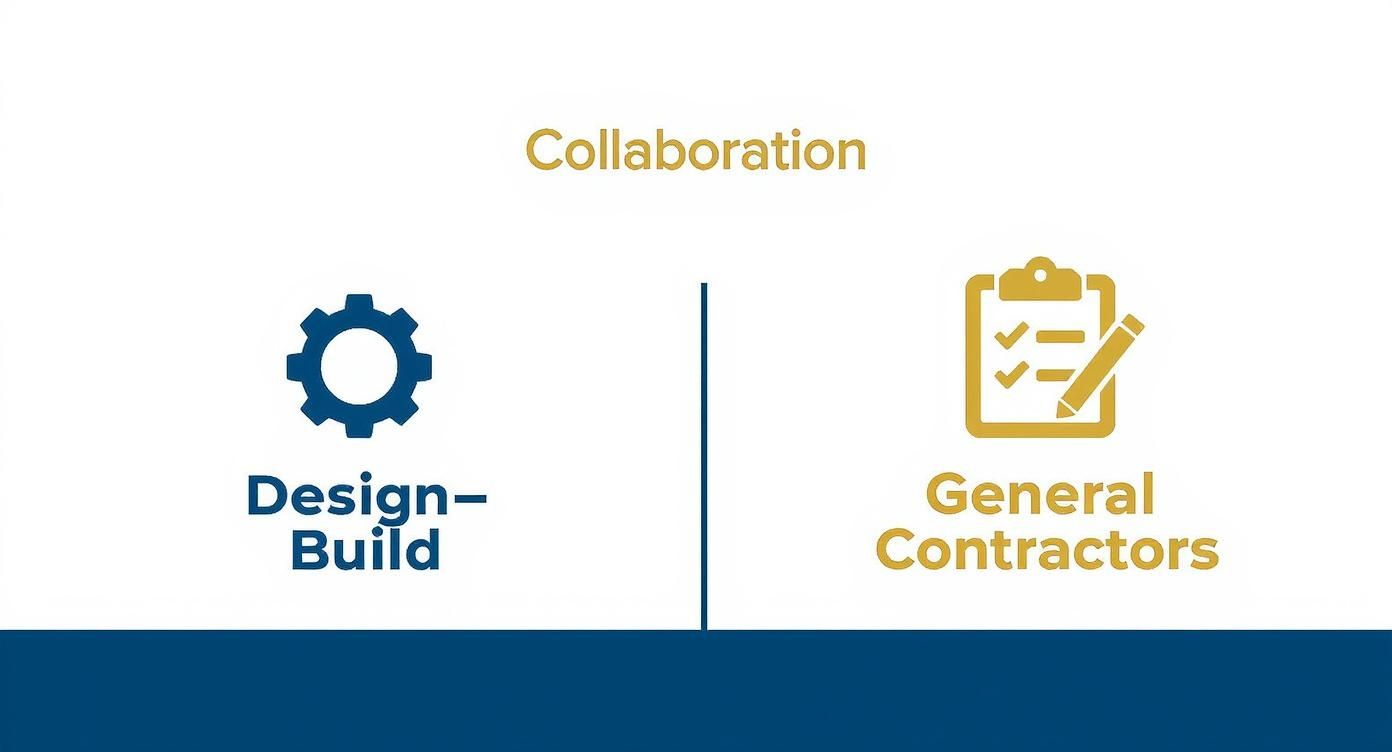
It’s a fundamental split. Design-Build is built on teamwork and creative problem-solving from the get-go. The General Contractor model is designed for independent oversight, with the architect and builder operating in their own lanes.
Expert Insight from SEGC: We've seen firsthand that there’s no single "right" answer. It all depends on what you, the client, need to achieve. If you need to get a project done fast and want innovative thinking, Design-Build is often the way to go. But for a public project with rigid oversight requirements, the traditional Design-Bid-Build approach might be mandated. As a firm with deep experience in both Fayetteville and Lumberton, our team can help you navigate that choice with confidence.
As you weigh your options, don't forget how much technology has changed the game. For instance, understanding modern drone use in construction shows just how much efficiency can be gained on a job site, no matter which delivery method you pick.
Design-Build vs General Contractor At a Glance
To make this decision a little easier, we’ve put together a quick-reference table. Think of it as your cheat sheet for seeing how each model stacks up on the things that matter most.
| Criteria | Design-Build Model | General Contractor (Design-Bid-Build) | SEGC's Expert Insight |
|---|---|---|---|
| Contract Structure | Single contract with one firm for both design and construction. | Two or more separate contracts for architect/designer and builder. | Actionable Insight: A single contract streamlines communication and reduces your administrative burden from day one. |
| Primary Relationship | A collaborative partnership between the owner and the design-build team. | A linear relationship. The owner manages separate designer and contractor contracts. | The Design-Build model creates a real team dynamic, which is invaluable for complex jobs right here in Fayetteville. |
| Accountability | Single point of responsibility. The design-builder owns the entire process. | Divided accountability. Issues can lead to finger-pointing between designer and builder. | For clients who just want peace of mind, that single point of accountability is a huge plus. |
| Timeline | Often faster due to overlapping design and construction phases. | Typically longer, as design must be fully complete before bidding begins. | Our 8(a) and HUBZone certifications often put us on time-sensitive projects, where Design-Build is a game-changer. |
Ultimately, the table highlights the trade-offs. Each model offers distinct advantages depending on your priorities for control, speed, and collaboration.
Mapping Your Project Journey From Start to Finish
Think of your project’s lifecycle as a road trip. The route you take—the linear relay race of a General Contractor or the collaborative huddle of Design-Build—doesn't just map the stops along the way; it defines the entire experience. One is a sequential, step-by-step affair. The other is dynamic and all-in from the get-go.
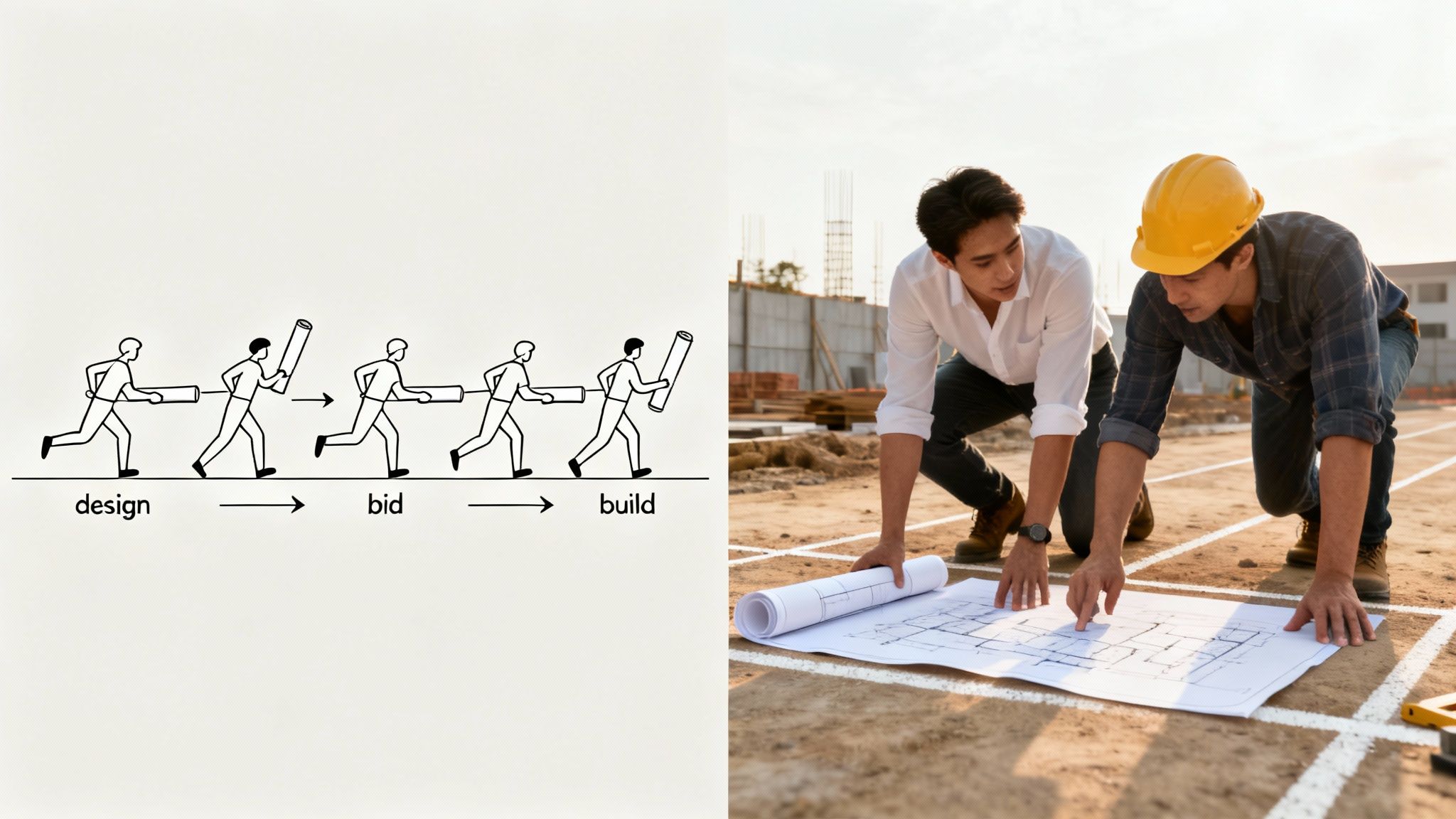
Getting a handle on these workflows is critical. It shapes your daily involvement, how you get updates, and ultimately, who owns the outcome when things go sideways. Let's trace these two very different paths to see how an idea becomes a finished building.
The Traditional General Contractor Workflow: A Relay Race
The old-school approach, properly known as Design-Bid-Build, is a series of handoffs. Each leg of the race has to be completely finished before the next runner can take the baton and start their part. It’s methodical, but it can be slow.
Here’s how the milestones typically play out:
- Hire the Architect: Your first move is to find an architect or design firm and contract with them to draw up a full set of construction documents. You’re the one managing this relationship.
- Complete the Design: The design team works with you to iron out every single detail, from the big-picture floor plans down to the specific brand of doorknobs. This can take months, and all of it happens before a builder ever sees the plans.
- The Bidding Gauntlet: Once the designs are 100% complete, you put them out to bid. Multiple general contractors will compete for the job, with the decision often boiling down to who comes in with the lowest number.
- Award the Contract: You pick your GC, sign a completely separate contract, and they finally take over to start building.
- Construction Begins: The general contractor now has the job of building exactly what the architect drew. If a problem pops up on-site, it can kick off a formal, often frustrating, back-and-forth between the builder, you, and the architect.
This strict separation of duties can become a major point of friction. When something goes wrong, the blame game starts: Is it a flaw in the design, or an error in the construction? As the owner, you’re stuck in the middle, playing referee. To get the full picture, it's worth understanding what a general contractor does in this model.
The Design-Build Workflow: A Collaborative Huddle
Design-Build flips the script entirely. Instead of a relay race, picture a football team huddling up before the first play. The architect, builder, and key subcontractors are all on the same team, under one contract, from the very beginning.
At SEGC, we often turn to the Design-Build model for our 8(a) and HUBZone certified projects. For our government clients here in the Fayetteville area, this integrated approach lets us deliver complex projects with more speed and better budget control. Why? Because everyone is pulling in the same direction from day one, which builds trust and efficiency.
The workflow is fundamentally different and much more fluid:
- One Team, One Contract: You hire a single company—the design-builder—who takes full responsibility for everything, from the first napkin sketch to the final punch list.
- Design with a Reality Check: The builder is in the room during the design phase, providing real-time feedback on costs and constructability. This crucial input stops expensive ideas that won't work in the real world before they ever make it onto the blueprints.
- Overlapping Timelines: Because the whole team is in sync, things can happen simultaneously. You can order long-lead-time materials like steel or specialized windows while the final interior design details are still being tweaked. This "fast-tracking" can shave a ton of time off the project schedule.
This overlap is where Design-Build really pulls ahead on the timeline. A Federal Highway Administration study found that design-build projects saw an average 4.2% decrease in total project time, while traditional projects actually ran an average of 4.8% longer than planned.
Ultimately, your choice comes down to what you value most. Do you prefer the rigid, sequential process with its distinct checks and balances? Or do you lean toward an integrated, collaborative journey built for speed and creative problem-solving? The answer will define your project from this day forward.
Who's on the Hook When Things Go Sideways?
When a problem hits the job site, the first question is always the same: who’s paying to fix it? This is where the design-build vs. general contractor debate gets really interesting. It’s not just about who does what; it’s about who carries the financial weight when the plan goes off the rails.
In a traditional setup with a general contractor, you’re the one juggling separate contracts with the architect and the builder. So, when a design flaw leads to a construction screw-up, you get stuck in the middle of a frustrating blame game. The architect points a finger at the builder, the builder points right back, and you’re left refereeing the whole mess while the project stalls and the costs climb.
The General Contractor Model: A Recipe for Finger-Pointing
With the old-school Design-Bid-Build approach, risk is split up, and unfortunately, a lot of it lands squarely on your shoulders. You, the owner, are ultimately responsible for making sure the design is accurate and complete. If the architect's plans have a mistake that doesn't show up until the crew is on-site, the change orders and delays that follow are usually your problem.
This separation creates some classic headaches:
- Blueprint Blunders: The plans show a wall in the wrong spot, so the GC builds it there. The cost to tear it down and rebuild it correctly? That often falls to you, and then you have to chase the designer to get reimbursed.
- Material Mix-Ups: An architect specifies a particular material that, surprise, has a six-month lead time or isn't even made anymore. The builder had no way of knowing. This can blow up the schedule and the budget, and good luck figuring out whose fault it is.
- The Blame Game: The most common issue is the endless loop of "It's a design flaw!" versus "It's a construction mistake!" This forces you into the role of a mediator, which is the last thing any client wants to be.
The Design-Build Model: One Throat to Choke
The Design-Build model completely flips the script on risk. By putting everything under a single contract, you create a single point of accountability. There's one team, one contract, and one entity responsible for getting the project done right, from the first sketch to the final walkthrough.
At SEGC, we believe trust is built on transparency, especially when it comes to managing risk. On our projects in Fayetteville and Lumberton, that single point of accountability is the bedrock of a smooth process. When our design and construction teams are one and the same, problems get solved internally long before they ever become a client’s headache. This commitment to quality is why we have 21+ years of proven results.
This all-in-one approach means if a design issue pops up during construction, the design-build firm owns it. Period. There’s no one else to blame. The team is motivated to work together to find the smartest, most cost-effective solution without dragging you into their internal debates.
Of course, this is a huge plus for the owner, but it puts a ton of pressure on the design-builder. A 2022 analysis by construction risk experts confirmed that design-build shifts a much greater amount of risk onto the contractor’s shoulders. While this shields owners from disputes, it means the design-build firm has to be an absolute pro at managing every single variable. You can read more on this at Berkley Construction Professional.
This is exactly why the contract itself is so critical. If you're leaning this way, taking a look at a design-build contract template can show you exactly how risk, scope, and accountability are spelled out. Choosing a firm with a proven track record, like SEGC's 21+ years of results, ensures you're partnering with a team that has the experience to handle that risk without breaking a sweat.
Managing Your Budget and Project Costs
Let's talk about the one thing that keeps every client up at night: the budget. When you're building something, the bottom line isn't just a line item—it's everything. The path you choose here, whether it’s design-build or the traditional general contractor route, will completely change how the financial story of your project gets written.
One approach tries to nail down costs from the very beginning, weaving budget talks into the creative process. The other gives you a hard number, but only after all the creative work is done and dusted. Getting this right is the difference between steering your budget with confidence and just bracing for impact.
The General Contractor Model and Cost Certainty
With the classic general contractor model, you get a number that feels solid and dependable. Your architect wraps up the blueprints, you send them out to bid, and a handful of contractors fight it out to give you their best price. You pick the lowest qualified bid, and voilà, you have a fixed cost before the first shovel hits the dirt. Sounds great, right?
But here's the catch—that "certainty" can be a bit of an illusion. The price is based on a design that was cooked up without a builder in the room to whisper, "Hey, that material is going to cost a fortune," or "There's a much cheaper way to build that." If all the bids come back way over your budget (and they often do), you're backed into a corner.
You're left with two pretty lousy choices:
- Go Back to the Drawing Board: This means paying your architect to redesign everything, which costs you both money and precious time.
- Start Slashing Your Dream: You begin chopping away at features and compromising on quality just to make the numbers work.
And don't even get me started on change orders. Any little surprise on the job site or a vague detail in the plans can trigger a change order, and each one nibbles away at that "fixed" price until it's a distant memory.
The Design-Build Advantage in Budget Management
Design-build flips this whole scenario on its head. Cost isn't an afterthought; it's a core part of the conversation from the very first sketch. Your designer and builder are teammates, which means you get instant, real-world cost feedback as the design evolves.
This is where our 21+ years of proven results at SEGC really make a difference for our clients in Fayetteville and Lumberton. We're not just builders; we’re your financial guardians from day one.
We have a saying around here: "Design to a budget, don't budget a design." It means we can tell you right away if a specific countertop or a fancy roofline is going to blow your budget. More importantly, we can suggest a smarter alternative that looks just as good and works just as well, saving you the sticker shock later. This proactive approach builds client trust and ensures we're building a legacy, not just a structure.
This process is often called value engineering, and in design-build, it just happens naturally. It’s not about cutting corners—it’s about finding brilliant, efficient ways to bring your vision to life without breaking the bank. When you're trying to get a handle on your budget, it's smart to look at all the potential expenses. For example, a great resource for understanding metal building costs can give you a much clearer financial picture.
Interestingly, things can get complicated on massive projects. Research on highway construction found that while design-build bids often started lower, the final cost sometimes grew more by the end compared to traditional methods. This just goes to show that even with fantastic early-stage control, project complexity can still throw you a curveball.
That’s precisely why you need a partner with a rock-solid history of managing money. As a Native American-owned, 8(a), and HUBZone certified firm, we’ve spent decades delivering projects on budget for clients who count on our financial discipline. We build trust by making sure every dollar is used wisely, creating a legacy of value, not just a building.
How to Choose the Right Construction Model
Picking between a design-build firm and a general contractor isn't about finding some magic formula. It’s about matching the delivery method to your project's unique DNA. There’s no single “best” choice here. The right answer comes down to your specific goals, how hands-on you want to be, and your personal comfort level with risk.
Making the right call means knowing the specific scenarios where each approach really shines. This isn't just about theory; it's about aligning the process with the legacy you're trying to build.
When Design-Build Is the Clear Winner
The design-build model absolutely thrives when speed, collaboration, and creative problem-solving are at the top of your list. It's the go-to choice when a project's vision is complex or when getting to market fast is a make-or-break business driver.
You should lean toward design-build if your project sounds like this:
- You Have an Aggressive Timeline: If your schedule is tight, design-build is your best friend. The ability to "fast-track"—starting site work while the final designs are still being polished—can literally shave months off a project. That’s a massive advantage we often see in commercial builds around Lumberton.
- Your Project is Complex: Got a building with funky architectural features, highly specialized systems, or a really tricky site? Having the builder and designer in the same room from day one is priceless. They can hash out creative solutions before they turn into expensive change orders down the road.
- You Want a Single Point of Contact: If you value simplicity and knowing exactly who is accountable, design-build delivers. You have one contract and one team. That means one partner is responsible for guiding the entire project, which seriously cuts down on your management headaches. To get a deeper dive, explore our guide on what is design-build construction and its benefits.
Local Project Story: We had a commercial client in Fayetteville who absolutely had to get their new facility up and running before their peak season. The traditional bidding process would have delayed their opening by months. By going with design-build, we overlapped the design and permitting phases with initial site prep. They hit their ambitious deadline and maximized their revenue potential. It was a huge win for them and a point of pride for our team.
When a General Contractor Makes More Sense
Now, while design-build has some powerful advantages, the classic general contractor model (often called Design-Bid-Build) still has its place. It holds its own, especially when total design control, fierce cost competition, and rigid government regulations are the main priorities.
This traditional route is often a better fit in these situations:
- Public Projects with Strict Bidding Rules: Many government and municipal projects are legally required to use the open, competitive bidding process that defines the Design-Bid-Build model. As an 8(a) and HUBZone certified firm, we know these rules inside and out and can execute flawlessly within that framework.
- You Want Maximum Control Over Design: Maybe you have an architect you've worked with for years and you want them to have complete creative freedom, without any builder input during the design phase. This model is built to preserve that clear separation.
- Your Design is Simple and Unlikely to Change: For a straightforward project where the scope is perfectly clear and you’re not looking to reinvent the wheel, the traditional model can work just fine. The fixed-bid price you get upfront provides a solid sense of initial cost security.
At the end of the day, choosing your construction model is a strategic decision. Think hard about your project's complexity, your need for speed, and how involved you want to be. By weighing these factors, you can pick the path that turns your vision into a successful, lasting legacy.
Partner with SEGC to Build Your Legacy
Look, whether you go the all-in-one route with design-build or stick to the traditional path with a general contractor, the real make-or-break factor is the team you hire. It's as simple as that. Here at SEGC, we don’t just put up walls and roofs; we’re in the business of building legacies. We construct buildings that do more than just stand there—they serve their communities and stand the test of time. Your project isn't just a stack of blueprints; it's the start of something big.
Our foundation isn't just concrete and steel. It’s built on 21+ years of proven results, delivering for clients who trust us with their most critical investments. That experience is backed by our unique perspective and capability as a Native American-owned firm, giving us a deeper connection to the land and the communities we serve.
More Than a Contractor—A Certified Partner
SEGC’s federal certifications aren't just fancy badges. They're proof of our reliability, our high standards, and our dedication to both our community and our country. For our clients, these designations open up some serious advantages.
- SBA 8(a) Certified: This certification lets us form direct, trusted partnerships on federal projects, cutting through red tape and guaranteeing a level of accountability you won't find everywhere.
- HUBZone Certified: With deep roots in Fayetteville and Lumberton, this certification shows we’re committed to reinvesting right back into our local economy and creating opportunities for our neighbors.
This mix of local leadership and federal backing means we bring a unique blend of community-first care and government-level discipline to every job site. We know the people, we know the terrain, and we know what it takes to build something that lasts right here in North Carolina.
At SEGC, we see every project as a chance to make our community stronger. From Fayetteville to Lumberton, we're not just building for a client—we’re building for our neighbors. That kind of accountability means everything to us.
Let's Build Your Legacy, Together
The whole design build vs general contractor debate is an important one, but it's just the start of the conversation. A true partner will help you pick the right model for your specific needs, manage the entire process with honesty, and be there for you long after the project is done. We invite you to explore our portfolio and see for yourself what our partnership approach looks like in the real world.
Don’t just start another project. Start a legacy.
Let's talk about what we can build together.
Got Questions? We’ve Got Answers.
Choosing between a design-build firm and a general contractor can feel like a high-stakes decision. To help you sort it out, we've pulled together the most common questions we hear from clients across Fayetteville and Lumberton. Here are the straight-up answers, based on our 21+ years in the trenches.
Can I Bring My Own Architect to a Design-Build Project?
That’s a big one, and the short answer is: usually, yes.
While a design-build firm has its own design team ready to go, many are happy to work with your preferred architect. The main thing that changes is the contract structure. Your architect would work under the design-builder’s single contract, keeping everyone on the same team and maintaining that all-important single point of accountability.
Which Is Better If I’m on a Strict Budget?
This is where the two paths really diverge. It’s less about which is “better” and more about how you want to manage financial risk.
- Design-Build: This model builds cost control right into the design phase. As architects draw, the builders are right there providing real-time pricing feedback. This lets you design to a budget from the very beginning, heading off the need for costly redesigns later.
- General Contractor: Here, you get a fixed bid based on a completed design. While that number feels firm, it’s only as good as the plans. If unforeseen issues pop up or the design has flaws, you’ll be facing change orders—and those can add up fast.
Our SEGC Insight: For clients who can't afford budget surprises, the design-build approach usually offers more stability. You’re not just hoping the design fits the budget; you’re ensuring it does, step by step. This client-first approach is central to how we build trust and lasting partnerships.
What Are the Rules for Design-Build on Public Projects in North Carolina?
North Carolina has a very specific playbook for how local governments can use the design-build method. It’s a structured process designed for total transparency.
It involves issuing a formal Request for Qualifications (RFQ) and evaluating firms based on set criteria before negotiating with the most qualified team. As an 8(a) and HUBZone certified firm, we live and breathe these regulations and have a long track record of delivering successful public projects on time and on budget.
At South Eastern General Contractors, we’re not just putting up buildings—we’re building legacies. Whether you need an all-in-one design-build partner or a top-tier general contractor, we bring the same unwavering commitment to making your vision a reality.