

General Contractor vs Construction Manager: A Fayetteville & Lumberton Guide
The real difference between a General Contractor (GC) and a Construction Manager (CM) boils down to two things: when they join your project and who they truly work for. A GC is typically brought in after the blueprints are done, ready to build exactly what's on the page for a set price. A CM, on the other hand, is your partner from the very beginning, acting as your trusted advisor during the design phase to keep costs in check and the schedule on track.
Understanding The Core Difference
Picking between a general contractor and a construction manager is one of the biggest decisions you'll make for your project. People sometimes toss these terms around like they're the same thing, but they represent two totally different ways to get a building out of the ground. For businesses and organizations in Fayetteville and Lumberton, getting this choice right is the first step toward creating something that lasts and serves our community.

Here at South Eastern General Contractors (SEGC), our 21+ years of proven results have taught us that the right leadership can make or break a project. This isn't just about a title. It’s about timing, trust, and alignment. A GC’s job is often transactional—they're there to deliver a specific scope of work based on a contract. A CM's role is relational—they are your advocate, collaborating from the start to get the absolute best results for your investment. Our commitment is to client trust and quality, ensuring we build legacies, not just structures.
A Quick Comparison
Think of it this way: Construction Managers get involved early. They're strategic partners who guide your project from a rough idea to a finished reality. They'll be in the room with the architects and engineers, hashing out the design, finding ways to save money (that's value engineering), and building a realistic schedule to head off problems before they even start.
General Contractors, on the other hand, usually come in once the design is set in stone. Their focus is purely on the physical work of building what’s been designed. You can dive deeper into what makes these roles unique in our detailed guide on what a general contractor does.
To really see the difference, a side-by-side look helps.
Quick Look: GC vs CM at a Glance
This table breaks down the fundamental differences between the two roles to give you a clear, high-level overview.
| Key Aspect | General Contractor (GC) | Construction Manager (CM) |
|---|---|---|
| Project Involvement | Joins after the design phase is locked in (Design-Bid-Build model). | Joins early, during the pre-construction and design phase. |
| Primary Allegiance | Their primary loyalty is to the contract and its fixed terms. | They act as the owner's advocate and trusted advisor. |
| Role | Executes the build based on a completed set of plans. | Manages the entire project lifecycle, from concept to keys. |
| Cost Structure | Usually works for a fixed, "lump-sum" price based on a bid. | Typically fee-based (a percentage of the total project cost). |
Ultimately, this choice shapes everything—from how you communicate with your team to how you handle risk. As a Native American-owned firm with 8(a) and HUBZone certifications, SEGC has worn both hats, adapting our approach for all kinds of commercial, government, and residential projects. No matter which path you take, our goal is always the same: to earn your trust, deliver quality, and build a lasting legacy for our clients in the Fayetteville and Lumberton communities.
So, How Does This All Actually Work on a Job Site?
Choosing between a general contractor and a construction manager isn't just about picking a person; it's about picking a game plan. This "game plan" is what we in the industry call a project delivery model. It’s the roadmap for your entire project, setting the rules for who's responsible for what, who talks to whom, and where the financial risk lies. Get this right, and you're set up for success from day one.
With over 21 years in the trenches, we've seen it all at SEGC. From straightforward commercial builds in Lumberton to highly complex government facilities in Fayetteville, we know that the right model can be the difference between a project that’s a constant headache and one that becomes a landmark. Our local leadership understands the unique challenges and opportunities in our region.
Let's break down the main ways projects get built.
The Old School Way: Design-Bid-Build (The GC's Playground)
This is the classic, most traditional path, and it’s called Design-Bid-Build (DBB). If you've ever heard of a project "going out to bid," this is probably what was happening.
It’s a simple, one-two-three process. First, the owner hires an architect to draw up a 100% complete set of plans. Once every single detail is on paper, the owner puts those plans out on the street, and general contractors compete for the job. Usually, the lowest qualified bidder wins the contract and gets to work building exactly what was drawn for a fixed price.
- Best For: Projects where the scope is crystal clear, the budget is king, and you don’t expect any mid-stream design changes. Think of a franchise store or a simple warehouse where the plans are non-negotiable.
- SEGC in Action: Let’s say you’re building a standard retail storefront in Lumberton. You have precise, approved plans from your architect. With a DBB model, we can give you a sharp, competitive price to bring that vision to life—no surprises, no fuss.
The real appeal of Design-Bid-Build is its upfront cost certainty. You know the exact price before the first shovel hits the dirt, which is a huge comfort for clients who need to lock in their budget above all else.
The Owner's Advocate: Construction Manager as Agent (CMaA)
Now let's flip the script. The Construction Manager as Agent (CMaA) model is totally different. Here, the CM isn't the builder; they're your expert advisor, your advocate, and your representative in every meeting. They have a legal fiduciary duty to act in your best interest, and only your best interest.
You hire a CMaA early, often before the architect is even finished, to help guide the design process with an eye on budget and buildability. They don't swing hammers or hire the plumbers directly. Instead, they manage the entire process on your behalf for a set fee, making sure you get the best quality and value from the contractors who are hired.
The Hybrid Powerhouse: Construction Manager at Risk (CMAR)
This is where things get really interesting. The Construction Manager at Risk (CMAR) model has become incredibly popular because it combines the best of both worlds.
Like the CMaA, a CMAR joins your team during the design phase. They're your collaborative partner, offering critical advice on costs, materials, and scheduling long before construction begins. But here’s the twist: once the design is locked in, the CMAR gives you a Guaranteed Maximum Price (GMP). This is a rock-solid price cap for the entire project.
From that point on, they become "at risk." They essentially take off their advisor hat and put on a GC hat, hiring all the subcontractors and managing the build. If the project goes over the GMP, that's their problem, not yours.
The magic of the CMAR model is that Guaranteed Maximum Price. It gives an owner the collaborative expertise of a CM during the design phase and the budget security of a fixed-price contract. You get the brains and the brawn, with a safety net.
This model is a huge part of what we do at SEGC, especially on government projects where budget blowouts are simply not an option. Our 8(a) and HUBZone certifications make us a go-to CMAR partner for federal jobs in Fayetteville and beyond. We can provide that crucial early collaboration while guaranteeing the final cost.
The All-in-One: Design-Build
Finally, there’s Design-Build. This model throws the traditional rulebook out the window. Instead of you, the owner, juggling separate contracts with an architect and a builder, you hire one single company to handle everything from the first sketch to the final coat of paint.
This creates a truly unified team from the very beginning. The designers and builders are in the same room, solving problems together, which can massively speed up the timeline and spark some really creative, cost-effective solutions. As a Native American-owned firm that’s built on trust, we excel in this kind of collaborative setup, working as a single, seamless team to turn a client's idea into a finished building.
A Detailed Comparison of Roles and Responsibilities
It’s one thing to know the textbook definitions of a general contractor and a construction manager, but it’s another thing entirely to see how they operate on a real-world job site. Their day-to-day responsibilities are worlds apart, and that difference can make or break your project’s budget, timeline, and final quality. Let's dig into what each of these pros actually does.

The core distinction is simple but has massive implications. A construction manager is your strategic partner from the very beginning, while a general contractor is the execution specialist you hire to build from a finished set of plans. When they join the project and who they answer to changes everything.
Pre-Construction: The Planning Stage
Nowhere are the differences between a GC and a CM more obvious than in the planning phase. This is where the entire project's DNA is formed, and it's where a CM truly shines.
A Construction Manager’s Role:
A CM joins your team right alongside the architect, acting as your advocate from the first sketch. Our job is to stress-test the design for constructability, scheduling headaches, and budget-busting details. We’re there to spot problems and find efficiencies before they get cemented into the blueprints.
Actionable Insight: On a recent community center project in Fayetteville, we were brought in early as the CM. We immediately flagged a major issue with the proposed HVAC system. Sure, it worked on paper, but it was wildly inefficient and would have saddled the nonprofit with sky-high energy bills for decades. Working with the engineers, we value-engineered a better solution that is projected to save the organization tens of thousands over the building's life. That's the power of having an expert in your corner from day one.
A General Contractor’s Role:
A GC, on the other hand, usually shows up after the plans are 100% complete. Their pre-construction role is almost entirely focused on one thing: bidding. They take the finished blueprints, calculate their costs, and give you a fixed price to build exactly what’s on the page. They aren’t there to second-guess the design; they’re there to give you a number.
Construction: The Building Stage
Once the dirt starts flying, the roles can look pretty similar from a distance. Both are managing the site, the schedule, and the subcontractors. But their fundamental motivations are completely different.
A CM’s primary fiduciary duty is to the owner. A GC’s primary obligation is to the contract.
This is the key. A CM is paid to protect your interests and your wallet, managing the budget with total transparency to find the best value. A GC is obligated to build what’s in the contract for the price they quoted, and their profit depends on keeping their own costs down.
This push for a more integrated approach isn't just a local trend. The global construction industry has been wrestling with productivity issues for years. The CM model is a direct response, designed to bridge the gap between planning and execution and smooth out the costly inefficiencies of the traditional build process. For a deep dive, check out this detailed McKinsey report about reinventing construction productivity.
Key On-Site Responsibilities Comparison:
- Subcontractor Management: The GC hires and holds the contracts for all subs. The CM advises the owner on who to hire and then manages them on the owner's behalf.
- Quality Control: Both are obsessed with quality, but for different reasons. A GC ensures the work meets the specs so they can get paid. A CM ensures the work meets a higher standard of value for the owner's investment.
- Safety: This is non-negotiable for both. General Contractors and Construction Managers are legally and ethically bound to maintain a safe site, following strict regulations like the Australian Workplace Safety Standards.
- Client Communication: A GC gives you updates on progress against the schedule. A CM provides a 360-degree view, covering budget tracking, risk management, and strategic advice on what's coming next.
You can get a closer look at the management side of things in our guide on what construction management entails.
Post-Construction: The Finishing Touches
As the project winds down, the focus turns to the final details, paperwork, and handover.
A General Contractor works through the punch list (the final list of small fixes), hands you the keys, and provides all the warranty documents required by the contract. Once those boxes are checked, their job is typically done.
A Construction Manager’s involvement often goes further. They’re still your advocate, managing the entire closeout process—verifying all warranties, reconciling every last payment, and making sure the building runs just as it was designed to. At SEGC, our relationship is built on being a long-term partner, not just completing a transaction. We stick around to make sure your new asset is ready to perform for years to come.
How Your Choice of GC vs. CM Will Hit Your Wallet and Your Calendar
Let's get down to brass tacks. For any project owner, it all boils down to two questions: How much is this going to cost? And when can we cut the ribbon?
Your choice between a general contractor and a construction manager is the single biggest factor that will shape the answers. Getting this right is about more than just picking a team; it’s about protecting your investment from the very start.
The fundamental difference is when costs get locked in and who is really in control of them. A traditional GC comes in at the end of the design phase with a hard number—a lump-sum bid based on a finished set of plans. A CM, however, is your financial co-pilot from day one, helping you shape the budget during the design process. That gives you incredible transparency and control before the first shovel ever hits the dirt.
Following the Money: Where Your Dollars Really Go
The way a GC or a CM gets paid completely changes their relationship with your budget. This isn't just a boring contractual detail—it's the core dynamic that drives every single financial decision on your project.
A general contractor’s profit is baked right into their bid. They give you a number, and their mission is to bring the project in for less than that number. Whatever is left over is their profit. This can give you some initial cost certainty, sure, but it also sets up a classic transactional relationship. If unexpected problems pop up, it can quickly become an us-vs-them scenario over every change order.
A construction manager, on the other hand, typically works for a set professional fee, often calculated as a percentage of the total project cost. This simple shift completely aligns their financial interests with yours. Their job isn’t to squeeze their own costs to fatten their wallet; it's to deliver the absolute best value for your money.
The Inside Scoop: A good CM's early involvement in "value engineering"—the process of finding smarter, more cost-effective ways to build something—can generate savings that dwarf their fee. They prevent expensive surprises by fixing problems on paper, long before a single nail is hammered.
Cost Structure Breakdown GC vs CM
To really see the difference, you have to look at how each role treats your money. A CM operates with an "open book," meaning you see every single invoice and receipt. You know exactly where your money is going. With a GC, those costs are usually a black box, all wrapped up in their single lump-sum price.
Here's a quick cheat sheet to show you how the money flows in each model.
| Financial Aspect | General Contractor | Construction Manager (CMAR/CMaA) |
|---|---|---|
| Pricing Model | Lump-Sum Bid: A fixed price for a defined scope. | Cost-Plus-Fee or GMP: Project costs are transparent, with a fee for management services. |
| Cost Transparency | Low: Costs are bundled; you don’t see individual subcontractor bids. | High: "Open-book" accounting. You see all costs and invoices. |
| Change Orders | Often a source of conflict and an opportunity for the GC to add profit. | Managed as a team to find the best, most cost-effective solution for you. |
| Savings | If the project is cheaper than bid, the savings typically become GC profit. | Savings are often shared with you or returned to you entirely. |
This difference in compensation even plays out in their career paths. As the U.S. Bureau of Labor Statistics points out, construction managers often have more stable, salaried positions, while a GC's income can swing wildly depending on the projects they win. This shapes the talent pool and the kind of long-term, advisory service you can expect. For a deeper dive, check out this excellent breakdown of construction salaries.
A Real-World Example from the Trenches
This isn't just theory. We see the power of early CM involvement play out all the time. On a recent municipal project right here in North Carolina, we were brought on as the Construction Manager at Risk (CMAR). The architect's initial design called for a custom-fabricated steel feature that looked great on paper but was a budget and schedule nightmare in reality.
Because we were at the table from the beginning, we immediately flagged it. We worked hand-in-hand with the design team to come up with an alternative using locally sourced materials that achieved the same aesthetic.
The result? That one change saved the client over $85,000 and cut three weeks off the project timeline. A traditional GC, hired after the ink was dry on the plans, would have just built it as specified, and the client would have been stuck with the bigger bill and the delay. That's the tangible, real-world value our 21+ years of proven results bring to the table.
Choosing the Right Partner for Your Project
This is the fork in the road. Deciding between a general contractor and a construction manager sets the entire tone and trajectory for your project. It's not just a box to check; it’s about matching the right leadership style to your specific goals. With 21+ years of proven results under our belts, our team at SEGC has helped clients in Fayetteville, Lumberton, and beyond make this exact call, making sure they get a partner who’s genuinely in sync with their vision.
So, how do you choose? It really boils down to two things: project complexity and your personal tolerance for risk. Are you putting up a simple, by-the-book building with a finished design, or are you tackling a massive, multi-faceted facility that needs to adapt on the fly?
Best Fit Scenarios
Let's get practical. Imagine you're doing a standard retail build-out. The corporate floor plan is already approved, the finishes are selected, and the blueprints are locked. In a case like this, a good, old-fashioned General Contractor is your go-to. The scope is crystal clear, the plans are set, and the name of the game is hitting that budget and deadline. Simple.
Now, let's flip the script. Picture a sprawling, multi-phase public project, like a new community health center. This beast of a project screams for a Construction Manager to be involved from the get-go. A CM can help steer the design to meet rigid public funding rules, juggle a schedule with dozens of stakeholders, and provide the kind of transparent, open-book accounting that government oversight demands.
The Government Project Advantage
When it comes to government contracts, the choice between a GC and a CM is often made for you. Models like Construction Manager at Risk (CMAR) or Design-Build are frequently the standard because they offer rock-solid budget control and a team approach to managing risk. Frankly, this is where SEGC’s expertise really shines for our government partners.
As a Native American-owned firm with both SBA 8(a) and HUBZone certifications, we're uniquely built to lead these projects. These certifications aren't just letters on a page; they're a testament to the reliability and integrity that federal, state, and local agencies absolutely depend on. Our deep experience managing complex government builds right here in Fayetteville means we know the process, the paperwork, and the pressure—and we deliver every single time.
A project's success is defined in the planning phase. For government contracts, a Construction Manager isn't just a builder; they are a strategic partner in stewardship, ensuring every taxpayer dollar is maximized for public good.
This little diagram sums up the budget question perfectly, showing how your need for cost certainty can point you straight to the right partner.
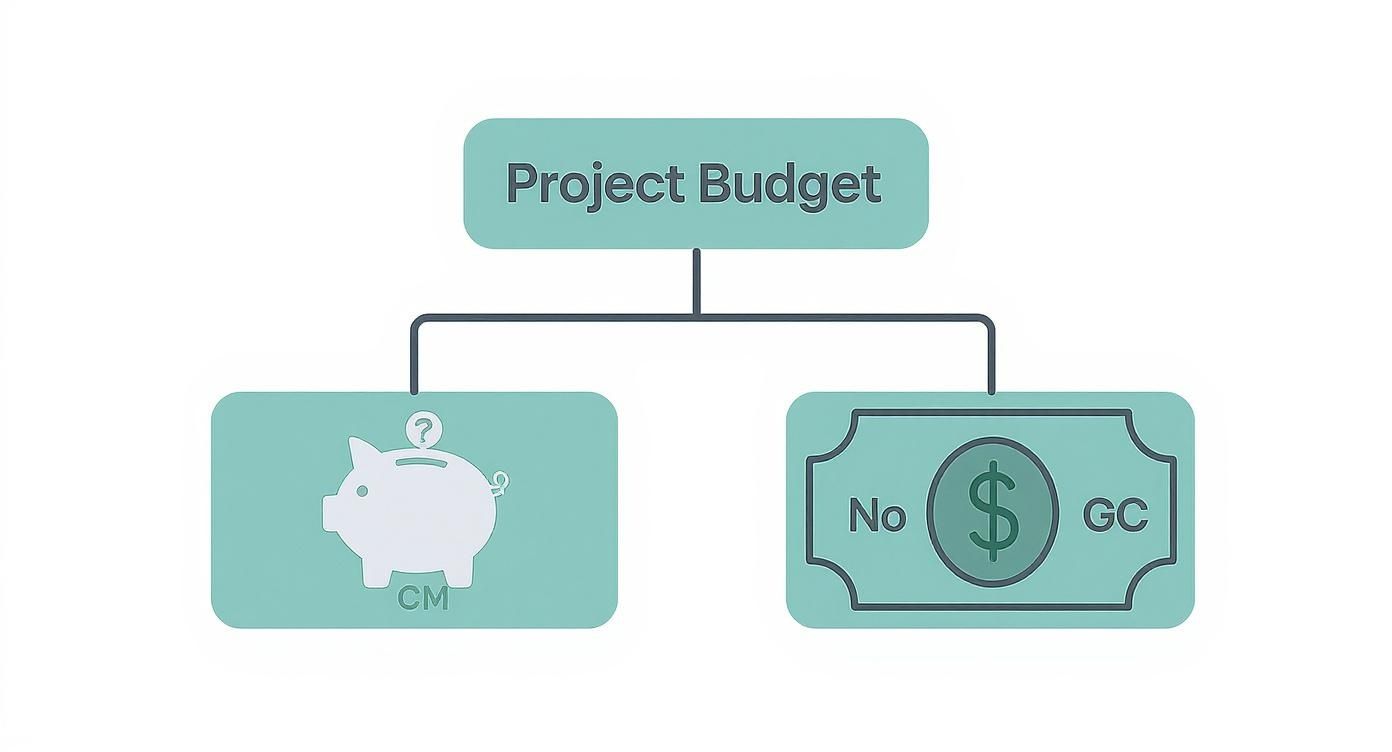
As you can see, if knowing your costs upfront is non-negotiable, a CM is your guy. If you've got a locked-in budget after the design is done, a GC is a fantastic choice.
Your Decision Checklist
Getting confident in your choice means asking the right questions. We put together this checklist to help you cut through the noise and figure out who you really need in your corner.
-
How much budget certainty do you need upfront?
- A lot: You want a Guaranteed Maximum Price (GMP) before the first shovel hits the dirt. A Construction Manager (in a CMAR role) is your best bet.
- Some: You have a hard budget based on a fully completed design. A General Contractor is built for this.
-
Do you want a collaborator during the design phase?
- Yes: You want an expert weighing in on costs, materials, and schedules from day one. You need a Construction Manager.
- No: Your design is finalized and you just need someone to build it. A General Contractor will execute that vision perfectly.
-
How complex is your project?
- High Complexity: We’re talking multiple phases, new technology, or a lot of unknowns. A Construction Manager will be your guide through the maze.
- Low Complexity: It's a straightforward build with a clear, predictable path. A General Contractor is a perfect match.
-
How involved do you want to be in picking subcontractors?
- Very Involved: You want to be in the room, vetting and selecting the trades. A Construction Manager makes that a collaborative process.
- Not at All: You’d rather trust your builder to handle it. A General Contractor takes care of all that for you.
Answering these questions honestly will give you a pretty clear direction. Here at SEGC, we don’t do "one-size-fits-all." We’re here to listen to your answers and help you build a legacy, not just another building.
Build Your Legacy with a Trusted Partner
Deciding between a general contractor and a construction manager isn't just a line item on a contract—it's about finding the right champion for your vision. There’s no magic formula here. The right choice always comes down to the nitty-gritty of your project: its complexity, your budget, and frankly, how hands-on you want to be.
At SEGC, we see ourselves as your project partner, ready to step in as your GC, your CM, or your Design-Builder, whatever makes the most sense. With over 21+ years of proven results right here in the Fayetteville and Lumberton communities, we’ve built our reputation on earning trust and delivering quality. It’s the bedrock of everything we do.

Being a Native American-owned, 8(a), and HUBZone certified firm means something to us. It’s more than a few stamps of approval; it’s our promise of integrity and an absolute commitment to excellence on every single job site, whether it's a complex government facility or a custom family home. Our mission is to build legacies, not just structures.
Your project deserves more than just a builder who checks the boxes. It deserves a partner who’s invested in your success. You’re not just putting up a structure; you’re building a legacy.
Ready to find the right partner? Contact SEGC today and let’s talk about how our team can bring your vision to life, from the first sketch to the final walkthrough.
Got Questions? We've Got Answers
Digging into the differences between a general contractor and a construction manager can kick up a lot of questions. Let's clear the air with some straight-to-the-point answers, backed by the 21+ years of hands-on experience we have serving the Fayetteville and Lumberton communities.
Can a Single Company Wear Both Hats—GC and CM?
You bet. It’s actually a pretty common and effective way to run a project. A flexible firm like SEGC can easily operate as both, and the most popular way we do this is through a model called Construction Manager at Risk (CMAR).
Here's how it works: the firm starts out as your construction manager during the all-important pre-construction phase. They're your expert advisor on everything from cost and scheduling to materials. Once the plans are locked in and a Guaranteed Maximum Price is set, they switch gears and become the general contractor who physically builds the project. It’s a beautifully seamless process.
Does a Construction Manager Always Cost More Than a General Contractor?
Not when you look at the big picture. Think of a CM's fee as a smart, upfront investment that pays for itself by preventing costly mistakes later. They save you money by fine-tuning the design for maximum efficiency, which dramatically cuts down on expensive change orders and avoids budget-busting schedule delays.
That rock-bottom GC bid might look tempting on paper, but it often hides the true cost of problems that pop up later. A CM gets involved early to protect your total investment and deliver the best long-term value, shielding your budget from nasty surprises.
Why Do Government Projects Often Use CMAR and Design-Build?
It all comes down to accountability. Government and public works projects operate under a microscope, demanding absolute budget transparency and minimal risk. Both CMAR and Design-Build are perfectly structured to meet these high standards.
These models work so well because they establish a Guaranteed Maximum Price early in the game and force collaboration between all parties from the get-go. This integrated approach is a perfect match for public procurement, where having certified partners is non-negotiable. As a Native American-owned firm with 8(a) and HUBZone certifications, SEGC brings the rock-solid reliability that government agencies in Fayetteville and across the region count on.
The right partner doesn't just put up walls—they safeguard your vision and your investment from start to finish. At South Eastern General Contractors, we're in the business of building legacies, not just buildings. Contact us today and let's talk about how our expert team can make your project a resounding success.