Stick Built Home: A Local Builder’s Guide to Lasting Quality
When you hear someone talk about a stick-built home, they’re talking about the classic, time-honored way of building a house. It’s construction from the ground up, piece by piece, right there on your own plot of land. Think of it like a master tailor crafting a bespoke suit—every single piece of lumber (the "sticks") is cut and fitted on-site by skilled hands to create a structure that's uniquely yours.
Building a Legacy, Not Just a House
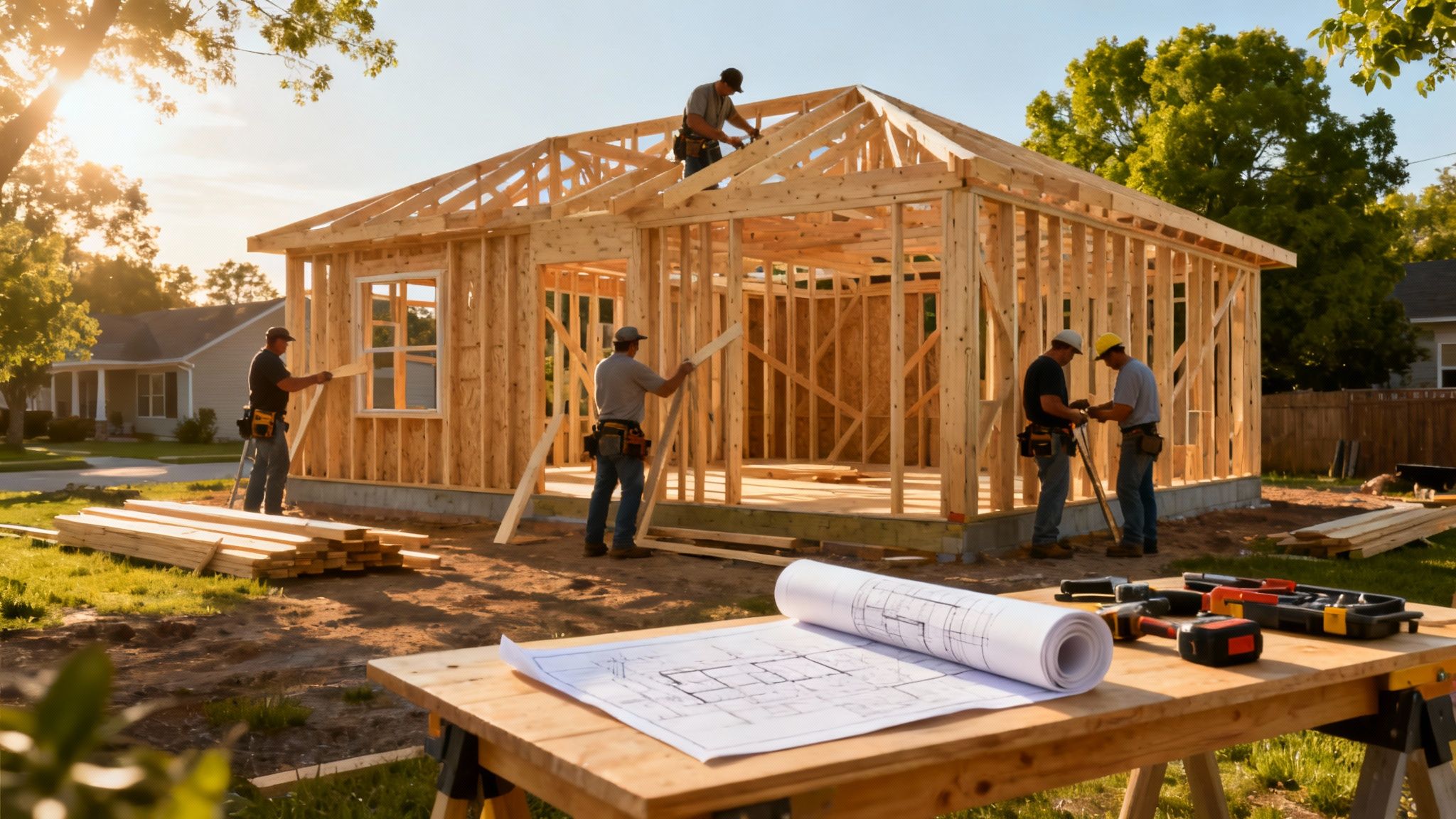
This is the method most of us picture when we imagine a home being built. A skilled crew shows up, pours the foundation, and then starts framing the skeleton of your future home, stud by stud. It’s a process that unfolds right before your eyes.
Unlike homes that are built in sections in a factory and then trucked to the site, the on-site process gives you an incredible amount of control over every last detail. Every wall, every window, every angle is put together with care on your property.
What Makes This Method So Enduring?
At its core, stick-building is all about personalization and quality. Since every component is measured, cut, and installed on the homesite, your builder can make real-time adjustments and ensure everything is just right. It’s this hands-on, high-touch approach that has kept it the gold standard for anyone wanting a truly custom home.
Here’s what really makes it stand out from the crowd:
- Complete Design Freedom: Want an oddly shaped room or a one-of-a-kind architectural flourish? No problem. You can dream up a floor plan from scratch and bring it to life without the constraints of pre-set factory modules.
- Boots-on-the-Ground Quality Control: A good builder is on-site constantly, inspecting materials as they arrive and watching over the craftsmanship every single day. This guarantees a higher level of structural integrity from the foundation up.
- Perfect Harmony with Your Land: A stick-built home is designed to perfectly complement the unique shape, views, and quirks of your specific property, not the other way around.
For over 21 years, we at South Eastern General Contractors have been proud to use this time-honored method to build homes for families in communities like Fayetteville and Lumberton. As a Native American-owned, 8(a), and HUBZone certified firm, building with integrity isn't just a business model—it's a commitment to our neighbors.
Actionable Insight: When interviewing potential builders, ask about their on-site supervision protocol. A builder who is present daily, like our team at SEGC, can catch potential issues before they become problems, ensuring the quality you deserve. This hands-on approach is a hallmark of our 21+ years of proven results.
In this guide, we'll pull back the curtain on this classic construction style. We’ll walk you through the entire process, break down the costs, and explore the benefits. Let’s dive in and see why a stick-built home is so much more than just a house—it's a sanctuary crafted just for you.
The On-Site Construction Journey Step by Step
There's nothing quite like watching your home spring to life on a patch of bare earth. It’s more than just a construction site; it’s the tangible story of your future, taking shape one two-by-four at a time. This process is a meticulously planned dance, where each step perfectly sets up the next, culminating in a home built to last for generations.
It all starts with getting the land ready. Our crews in Fayetteville and Lumberton get to work clearing the site, sculpting the ground, and prepping it for the single most important part of any building: the foundation. Whether you’ve chosen a slab, a crawl space, or a full basement, this concrete footprint is the bedrock for everything else. This is where our 21+ years of local experience really comes into play, because we know the North Carolina soil like the back of our hand.
From Skeleton to Shelter
Once that foundation has cured, the real show begins. We call it the framing stage. This is where the “sticks”—the individual boards and timbers—are pieced together right there on your property to form the walls, floors, and roof. It’s an exciting time, because for the first time, you can actually walk through the outline of your kitchen or stand in what will be your living room.
With the wooden skeleton up, it starts to look less like a project and more like a house. Next, we start layering on the things that make it a true shelter.
- Mechanical, Electrical, and Plumbing (MEP): This is the guts of the home. We run all the ductwork for your heating and air, pull wires for every light switch and outlet, and lay the pipes that will bring you water.
- Exterior Finishes: The house gets its skin. We install windows and doors, wrap the exterior to create a weatherproof barrier, and then apply your chosen siding, brick, or stone. This is where the home’s personality really starts to shine through.
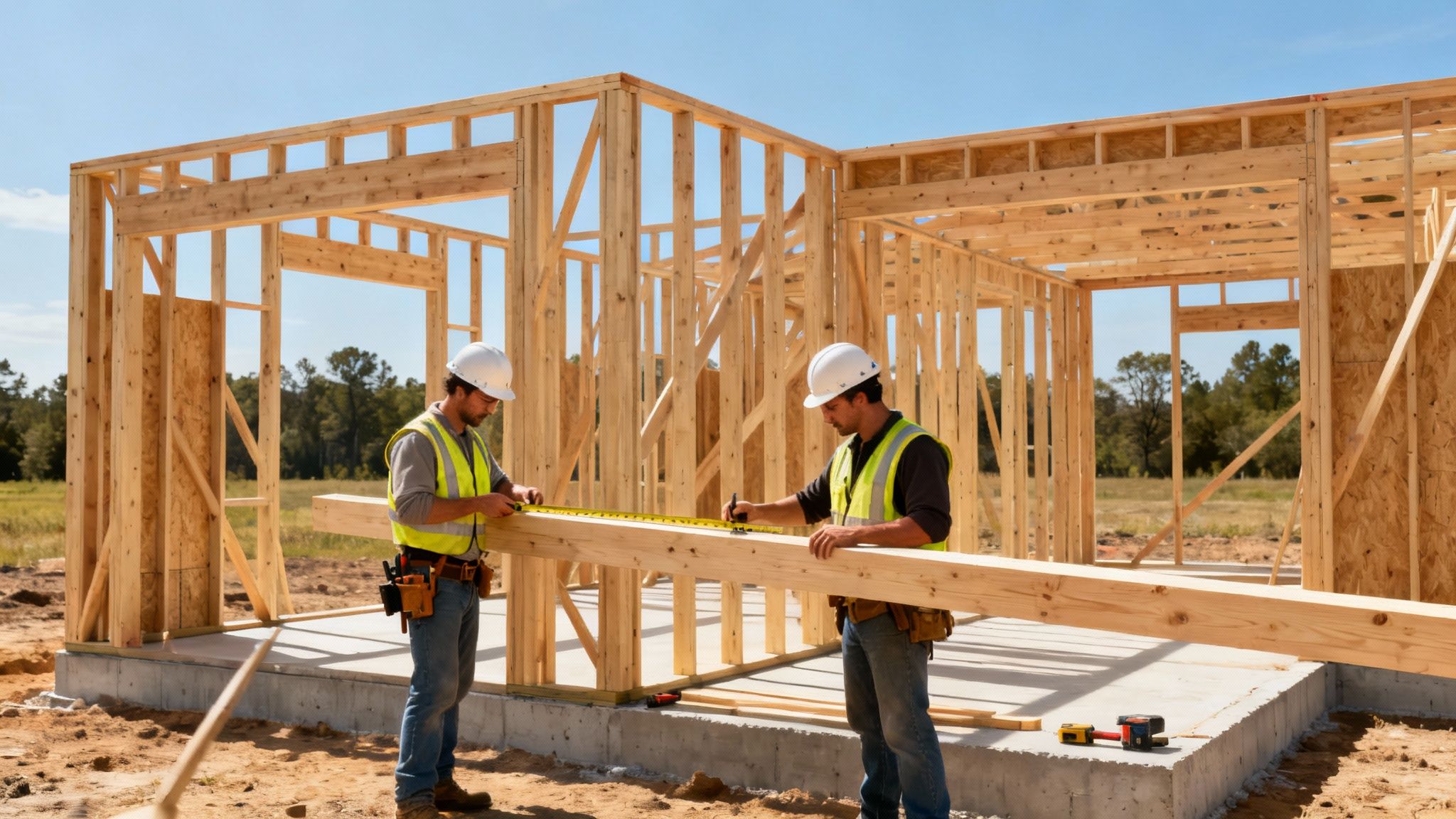
This visual gives you a great sense of how we get from raw timber to a fully-framed home.
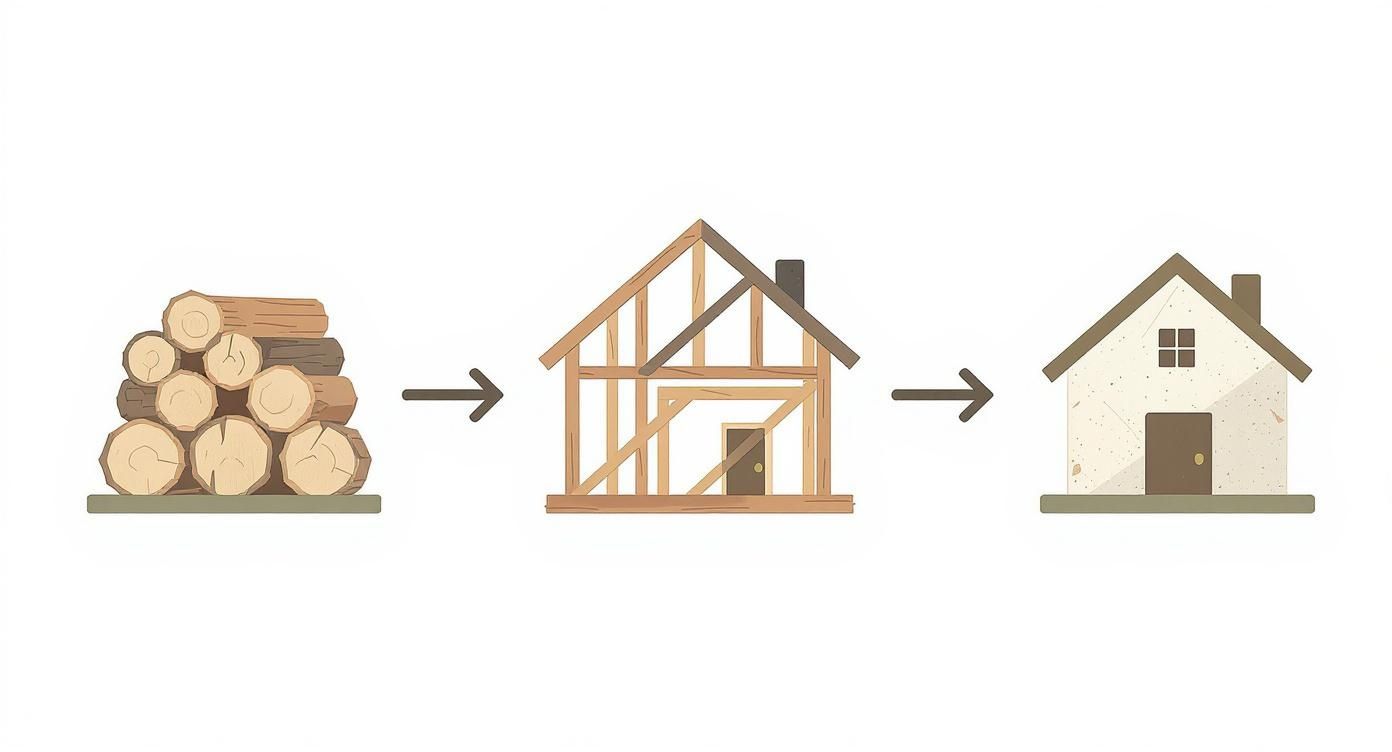
It’s a perfect illustration of why starting with high-quality materials is non-negotiable for a strong, sturdy structure.
Bringing the Interior to Life
With the outside buttoned up, our attention moves indoors. We fill the walls and ceilings with insulation for a comfortable, energy-efficient home. Then comes the drywall, which our teams hang, tape, and sand until the surfaces are perfectly smooth and ready for paint. It’s a job that requires a ton of precision and patience, but it lays the groundwork for a flawless finish.
"We're not just building to code; we're building to a higher standard—yours. Our on-site supervision, a cornerstone of our HUBZone and 8(a) certified promise, ensures every detail is executed with care, from the first survey stake to the final coat of paint."
Finally, we arrive at the fun part: the finishes. This is where the house truly becomes your home. Our craftsmen get to work installing beautiful cabinetry, laying down flooring, and adding all the trim and fixtures that bring your vision to life. The walls get their color, the countertops are set, and the appliances are moved into place. Along the way, you'll be making key choices, like choosing a garage door that pulls the whole exterior look together.
Want a deeper dive into these stages? Check out our complete guide on the custom home building process. Every step is a showcase of the hands-on quality you only get with a SEGC stick-built home.
Stick-Built Homes vs. Other Ways to Build
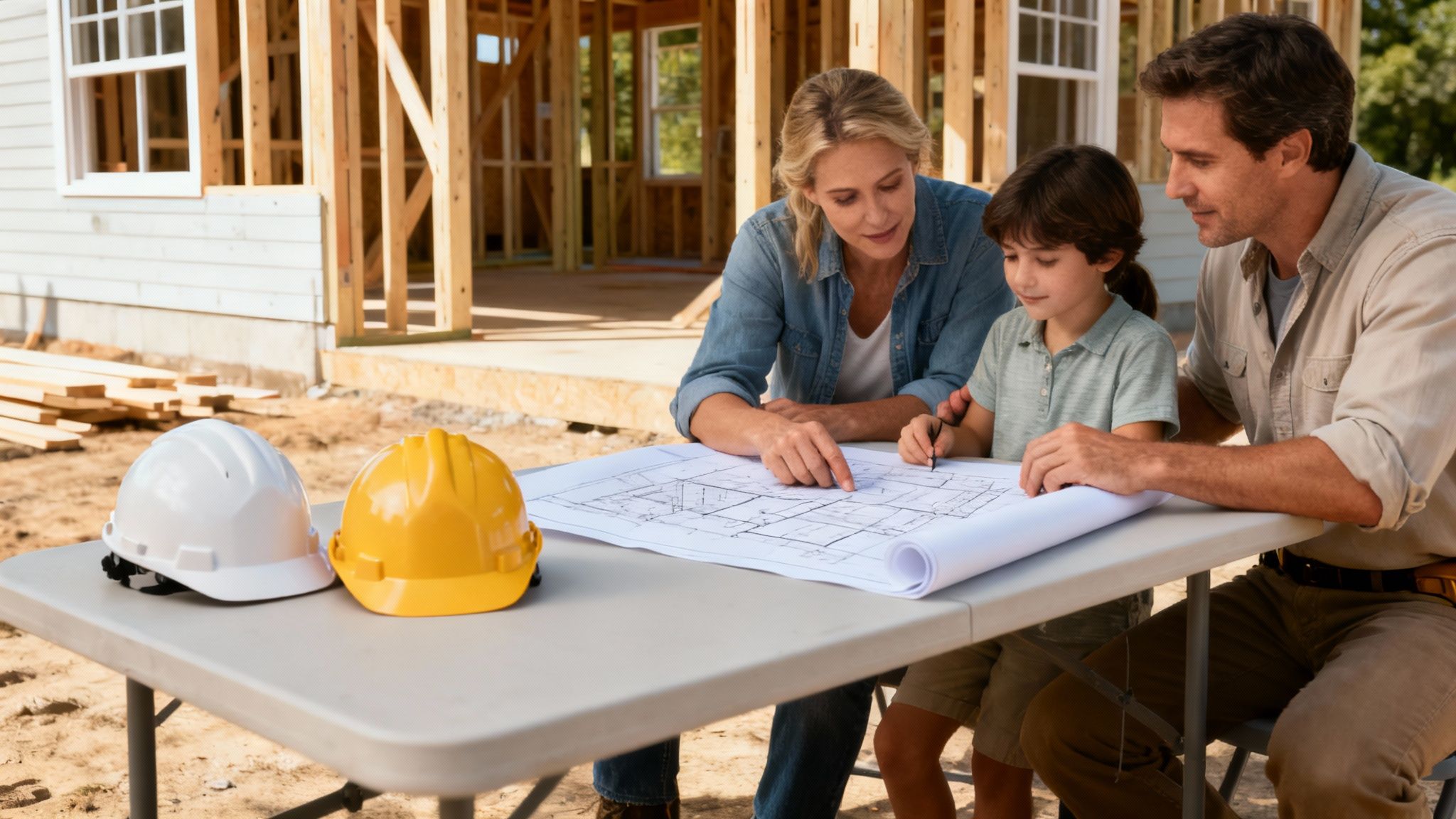
Deciding how your home gets built is just as critical as picking the perfect plot of land. While the good old-fashioned stick-built home is the go-to for its rock-solid quality and design freedom, other players like modular and manufactured homes have entered the ring. Figuring out the pros and cons is the first step to making a smart choice for your family's future in Fayetteville, Lumberton, or anywhere in between.
Let's quickly get to know the contenders. A stick-built home is the classic method—built piece by piece, right on your property. Think of a modular home as building with giant, high-tech LEGOs; large sections are built in a factory, trucked to your site, and then pieced together. Then you have manufactured homes (what many used to call mobile homes), which are constructed entirely in a factory on a permanent steel frame and simply delivered to their final destination.
Each of these paths tells a very different story about design, timing, and ultimately, the value of your finished home.
So, What's the Real Difference?
It really boils down to two things most people care about: getting the exact home you want and how long that home will last.
On one hand, the biggest win for a stick-built home is the endless potential for customization. Since every board is cut and every nail is hammered right there on your lot, you’re in the driver’s seat. Want to move a wall, add a quirky reading nook, or install a one-of-a-kind vaulted ceiling? No problem. This hands-on process, guided by your builder, means you're watching over every detail from the foundation pour to the final coat of paint.
Modular homes give you some design choices, but you’re ultimately working with the puzzle pieces the factory offers. Manufactured homes are the most rigid, usually offering a handful of pre-set floor plans and finish packages.
At SEGC, we’re firm believers that a home should be a direct reflection of the people living in it. As a Native American-owned and HUBZone-certified builder, our promise is to deliver the kind of masterful craftsmanship that can only come from the on-site control of stick building.
On the other hand, factory construction can often be faster. With modular homes, the crew can be laying your foundation on-site while the home itself is being assembled indoors, safe from rain delays. A stick-built project takes a bit more patience, as each step happens one after the other, right out in the elements.
But that extra time is an investment that often pays off big time. Stick-built homes are almost universally seen as the gold standard in real estate. They tend to appraise higher and hold their value better over the long haul. Why? Because they're built on a permanent foundation and are considered "real property" from day one, which can also make financing simpler.
To give you a clearer look, we've put together a simple table comparing the three main construction types.
Comparing Home Construction Methods
| Feature | Stick-Built Home | Modular Home | Manufactured Home |
|---|---|---|---|
| Customization | Virtually limitless; fully unique designs. | High, but limited to factory-set modules. | Limited to standard floor plans and options. |
| Construction Time | Longer; built sequentially on-site. | Faster; factory and site work happen at once. | Fastest; built completely in-factory. |
| Build Quality | Excellent; high on-site quality control. | Generally high quality; factory-controlled. | Varies; must meet federal HUD code. |
| Resale Value | Highest appreciation; considered traditional real estate. | Good appreciation, similar to stick-built. | Lower appreciation; often seen as personal property. |
| Foundation | Permanent, custom foundation (e.g., slab, crawlspace). | Permanent foundation required for assembly. | Placed on piers or a slab; chassis remains. |
| Financing | Standard home mortgage. | Standard home mortgage. | Can be challenging; often chattel loans. |
While the traditional stick-built method has its challenges, like finding skilled labor, it’s still the most trusted and dominant way to build a home. That said, factory methods are getting more popular, with the global prefabricated housing market expected to hit nearly $198.3 billion by 2030.
If you're looking for a legacy home in North Carolina—a place built not just for you, but for generations to come—the lasting quality and personal touch of a stick-built home is a truly solid investment.
For an even deeper comparison, check out our guide on modular vs. stick-built construction.
So, What Are the Real Perks of Stick-Built Construction?
Choosing how your home gets built is a massive decision. When you boil it all down, the real "why" behind going stick-built comes down to two things people dream of: total freedom and quality that lasts. This is where your wildest ideas can actually take shape, creating a home that’s as unique as your family.
The biggest showstopper, without a doubt, is the endless customization. Unlike other building methods that lock you into pre-set boxes, a stick-built home starts as a completely blank slate.
Want a gigantic kitchen island in your Fayetteville home that’s the hub for every family party? Done. Dreaming of a wall of windows perfectly placed to catch the sunrise over your property in Lumberton? You got it. That’s the kind of creative control stick-building gives you.
Quality You Can See and a Value That Endures
When a home is built on-site, every single two-by-four, every nail, and every shingle is hand-picked and checked by the crew. This kind of obsessive oversight—something we've prided ourselves on at SEGC for over 21 years—results in a home that’s just plain stronger.
We’re not just snapping together pieces from a factory. We’re building a fortress for your family, one that’s made to handle everything from rowdy kids to the wild Carolina weather. This hands-on approach naturally leads to a more durable structure, which often translates to a higher appraisal value down the road. You're not just buying a house; you're making a rock-solid investment in your family's future.
At SEGC, our dedication to quality is part of who we are—a Native American-owned, 8(a), and HUBZone certified company. We know we're not just putting up houses in our community; we're building legacies designed to last for generations to come.
Built for Today, Ready for Tomorrow
The advantages don't just stop when you get the keys. A stick-built home is incredibly adaptable to new ideas and technologies.
For example, it's much easier to integrate features like solar panels for new construction right into the design from the get-go, setting you up for major energy savings. This built-in flexibility means your home can grow and change right along with your family and the latest tech.
This method is the backbone of American homebuilding for a reason. After World War II, the nation needed homes, and fast. The flexible and reliable nature of stick-built construction met that demand, with housing starts jumping to over 1.2 million units in 1950 alone. This tradition has stuck around because it works, consistently delivering on the promise of a personalized, top-quality home. You can dive deeper into these historical home-building trends to see for yourself.
So, What's This Going to Cost Me? (And When Can I Move In?)
Let's get right to it. When you're dreaming up a new home, the two questions that really matter are always "How much?" and "How long?" For a custom stick-built home here in the Fayetteville or Lumberton area, the honest answer is: it depends entirely on your vision.
We believe in shooting straight with our clients. Our job is to give you a crystal-clear, realistic picture so you can plan your finances without any nasty surprises down the road.
Think of it less like buying something off-the-shelf and more like commissioning a piece of art. The final price tag isn't one single number; it’s a mosaic of all the choices you make. The size of the canvas, the quality of the paints, the complexity of the design—it all adds up. The same goes for your home.
The Big Things That Shape Your Budget
A few key players will determine the final investment in your home. Having an experienced local builder in your corner to navigate these is the secret to keeping your project on time and, more importantly, on budget.
- Size & Complexity: It’s simple math—a bigger, more complex home with intricate rooflines and unique layouts will require more materials and more man-hours.
- Your Land: What's the property like? We've seen it all. Clearing a heavily wooded lot, grading a steep slope, or running utilities a long way from the road all become part of the initial cost.
- Your Style (Materials & Finishes): This is where your personality shines through, and it’s also a huge factor in the budget. The choice between standard shingles and a metal roof, or laminate countertops versus granite, will make a real difference.
For a much deeper dive into the numbers, we've put together a comprehensive guide on the cost to build a house in North Carolina. It’s a great resource for understanding regional pricing.
A Realistic Timeline for True Craftsmanship
Patience is a virtue, especially in custom home building. A typical stick-built home in our part of North Carolina takes about 9-14 months from the day we pour the foundation to the day we hand you the keys.
That might sound like a long time, but it’s the hallmark of quality work. We’re not rushing. We’re building your forever home, piece by piece. This traditional method, with timber as its backbone, is still the gold standard and dominates the massive $4.3 trillion global residential construction market. If you're curious about how building is changing elsewhere, you can explore global prefabricated housing market trends.
Here at SEGC, our 21+ years building right here in Fayetteville and Lumberton gives us a home-field advantage. We know the suppliers, we know the best subcontractors, and we know how to sidestep the delays that can plague a project—from frustrating supply chain hiccups to a sudden hurricane warning. We keep things moving.
As a HUBZone-certified firm, we're not just some faceless company; we're part of this community. We’re invested in its success. We don't just build houses; we build relationships, and that starts with clear, honest communication every single step of the way.
So, Why Pick Us? A Little About SEGC
Choosing a builder is a lot like choosing a co-pilot for the most important journey you'll ever take. You need someone who knows the route by heart, anticipates the turbulence, and, most importantly, someone you genuinely trust to get you home safely. That’s where we come in.
Here at South Eastern General Contractors (SEGC), we don’t just see blueprints and 2x4s. We see family dinners, first steps, and front porches made for watching thunderstorms. For over 21 years, we’ve been the trusted partner for families across Fayetteville, Lumberton, and the surrounding areas, building homes with a reputation for rock-solid quality.
This isn’t just a business for us; it’s our life’s work.
More Than a Builder—We’re Your Neighbors
We're proud to be a Native American-owned, SBA 8(a), and HUBZone certified company. Now, that might sound like a bunch of industry jargon, but what it really means is that our commitment to this community is baked into the very foundation of our business. Our roots here are deep.
When you build with SEGC, you’re not just hiring a contractor; you’re investing back into the local economy and partnering with a team that’s dedicated to making our corner of North Carolina an even better place to live.
"We’ve always believed you build the relationship first, then you build the house. The trust our clients give us is the most valuable tool in our belt, and we bring it to every single job, every single day."
Our entire approach is built on straight talk and expert guidance. We want you to feel completely in the loop and confident at every stage. From wrestling with building permits to helping you pick out the perfect faucet, think of us as your go-to advisors for everything home-related.
Ready to stop dreaming and start digging? Let's talk about the home your family will cherish for generations. Get in touch with the SEGC team today and let’s start building your legacy.
Got Questions? We’ve Got Answers.
When you're thinking about building a custom home from the ground up, a million questions probably pop into your head. It's totally normal! Here are the straight-up, no-fluff answers to the questions we hear most often from folks right here in Fayetteville and Lumberton.
"Unlimited Customization" Sounds Great, But What Does It Really Mean?
It means exactly what it sounds like. With a stick-built home, there are no pre-set floor plans or factory limitations telling you what you can't do.
Want to move a wall six inches to the left to fit your grandmother's antique armoire? Done. Dreaming of a giant picture window overlooking the backyard that’s not a standard size? We can frame it. If you can sketch it on a napkin, we can build it on your property. Your imagination is genuinely the only blueprint we need to start with.
Are Stick-Built Homes Actually Energy Efficient?
You bet they are. Forget the stereotype of the drafty old house; a modern stick-built home is a fortress of efficiency.
We're talking about advanced insulation that wraps your home in a cozy blanket, high-performance windows that keep the summer heat out, and an air-tight seal on the entire structure. The result is a home that's not just comfortable year-round but also light on your utility bills. In many cases, our custom builds outperform factory-built homes on energy savings, hands down.
Okay, So How Long Is This Actually Going to Take?
Patience is a virtue, especially in custom building! While every project has its own unique timeline, a good rule of thumb for a custom stick-built home in our neck of the woods is anywhere from 9 to 14 months.
That clock starts ticking when we pour the foundation and stops when we proudly hand you the keys. With over 21 years of experience building in North Carolina, we’ve gotten pretty good at keeping things on track and navigating the unexpected hiccups that can pop up.
How Does Financing a New Build Even Work?
It’s a bit different than buying an existing house, but it’s a well-traveled road. Most of our clients use a construction loan.
Think of it as a short-term loan that pays for the build in stages (or "draws") as work is completed. Once your home is finished and you’re ready to move in, that loan simply converts into a standard, long-term mortgage. It sounds complicated, but it's a standard process we can absolutely help you navigate.
At South Eastern General Contractors, we don’t just build houses; we build the place your family will call home for generations. If you’re ready to stop dreaming and start planning, we’re here to listen. Let’s talk about what’s possible.
Explore our work and see what makes us different at South Eastern General Contractors.