
Modular Home Versus Stick Built Home: Building Your North Carolina Legacy
So, you’re thinking about building a new home. It’s a huge decision, one of the biggest you’ll ever make. The first question that usually pops up is: should we go modular or stick-built?
The answer really boils down to one thing: how it’s built. A modular home is put together in sections inside a factory, like giant, high-tech LEGOs, and then assembled on your property. A stick-built home is the traditional method—built from the ground up, piece by piece, right on your land. It's a choice between speed and efficiency versus total creative freedom. Understanding which path aligns with your family’s vision is the first step toward building a legacy, not just a structure.
Understanding The Core Differences
Choosing how to build your home is a major milestone. For over 21+ years, South Eastern General Contractors (SEGC) has been right there with families, guiding them through this exciting process. We’ve built legacies all across North Carolina, from the heart of Fayetteville to the communities of Lumberton. As a Native American-owned, 8(a), and HUBZone certified firm, our mission is to provide clear, honest advice you can trust, empowering you to make the best choice for your family. This deep-rooted local leadership gives us a solid perspective on the whole "modular versus stick-built" conversation.
At the heart of it, the difference is simple: one is built inside, the other outside.
- Modular Homes: Think of these as homes built in a controlled environment. Sections, or "modules," are constructed in a factory, safe from rain, snow, and mud. This allows for precision and keeps materials in top condition. Techniques like advanced factory fabrication methods highlight just how efficient this process can be.
- Stick-Built Homes: This is what most people picture when they think of home construction. Trucks deliver lumber and materials to your property, and skilled craftspeople build your home from the foundation up, right there in the open air.
Actionable Insight: Before you fall in love with a building method, evaluate your priorities. Is a predictable timeline most important, or is a completely unique architectural design a non-negotiable? Answering this will guide your entire project. At SEGC, we believe in walking you through every option to ensure your home is a perfect fit for generations to come.
While modular homes are gaining traction, it's good to know where things stand. In 2023, they made up only about 1.2% of all new single-family homes in the U.S. This tells us that traditional stick-built construction is still the go-to choice for the vast majority of American families.
To make things even clearer, let's break down the main differences at a glance.
Quick Comparison Modular vs Stick Built At A Glance
Here’s a simple table to quickly see how these two methods stack up against each other.
| Factor | Modular Home | Stick-Built Home |
|---|---|---|
| Construction Location | Built in sections inside a factory | Constructed entirely on the final home site |
| Typical Timeline | Generally faster; 3-6 months | Generally longer; 6-12+ months |
| Weather Impact | Minimal; factory work is indoors | Significant; delays are common |
| Initial Cost | Often 10-20% lower per square foot | Typically higher due to on-site labor |
| Design Flexibility | Highly customizable, but within factory limits | Virtually unlimited design freedom |
| Quality Control | Consistent due to factory standards | Dependent on individual contractor skill |
This chart gives you the thirty-thousand-foot view. Now, let’s dig into what these differences actually mean for your budget, timeline, and final home.
Unpacking The Construction Timeline And Speed
So, you're ready to build. One of the first, and biggest, questions on your mind is probably, "How long is this going to take?" When it comes to the modular home versus stick built home debate, the answer to that question is one of the clearest dividing lines. We're not just talking about getting the keys sooner; a shorter timeline means less stress, tighter budget control, and a much smoother transition into your new life.
The secret sauce for modular home construction is concurrent work. It’s a beautiful thing. While our SEGC crew is on your property getting the site prepped—clearing land, pouring the foundation, running utilities—your home is already taking shape in a state-of-the-art, climate-controlled factory. This parallel-path approach is what shaves weeks, and often months, off the total project time.
The Modular Advantage: Predictability and Precision
Let's be real: North Carolina weather doesn't always play nice. A week of solid rain in Fayetteville or a surprise storm in Lumberton can bring a traditional stick-built project to a dead stop. But inside a modular factory? It’s always sunny and 75. The work never stops, making the timeline incredibly reliable. That predictability is a huge win for both scheduling and your budget.
This factory setting also makes inspections a breeze. Instead of waiting for an on-site inspector to sign off on each phase, every module is inspected for quality and code compliance multiple times as it moves down the assembly line. That means fewer hiccups and delays once the home arrives at your property.
This timeline gives you a great visual of how the two processes stack up.
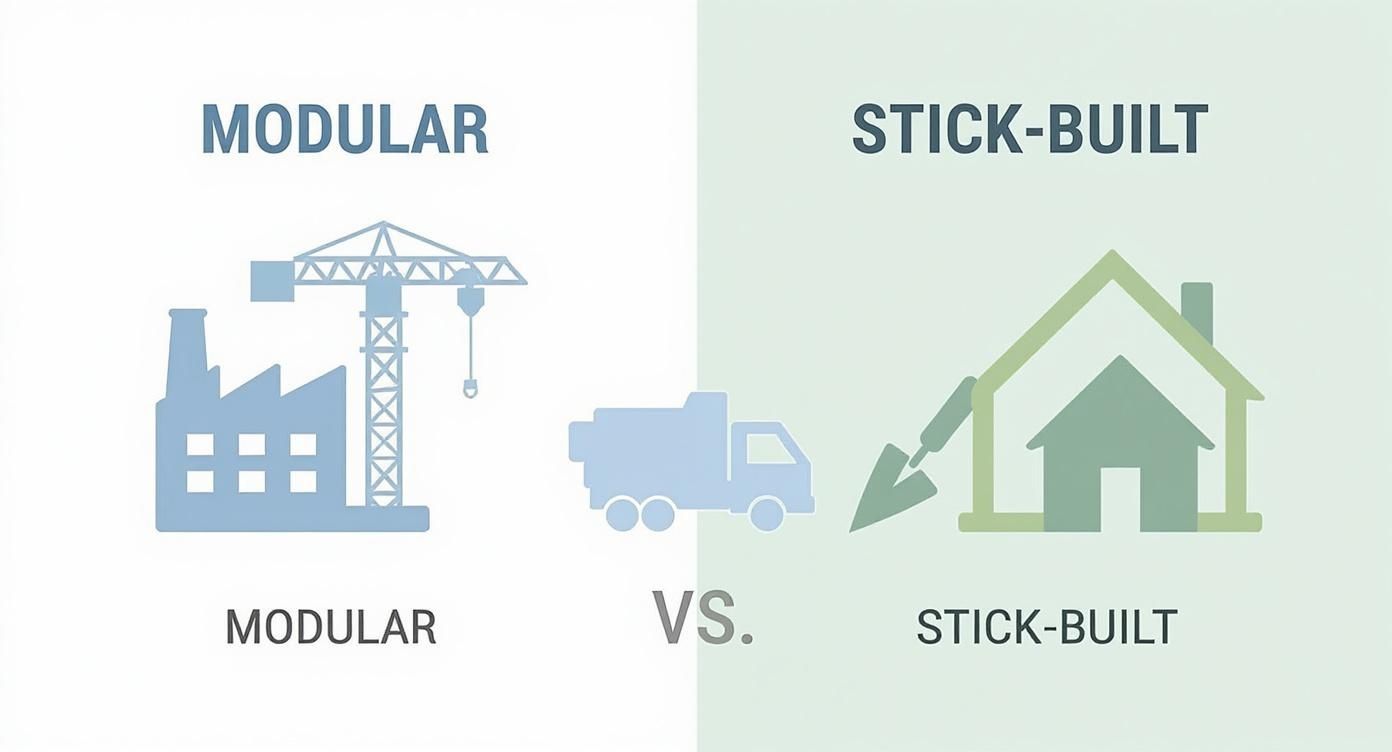
As you can see, the ability to build the house and prepare the site simultaneously is modular's killer app for saving time.
The numbers back this up. Industry data consistently shows that modular homes can be finished in 30% to 60% less time than a comparable stick-built house. A project that might take a year on-site could have you moving in within three to six months. It’s a massive difference.
Stick-Built Timelines: The On-Site Reality
Building a home the traditional way is a strictly linear, one-step-at-a-time process. You can't start framing until the foundation is poured, inspected, and cured. The roof can't go on until the walls are up. Everything has to happen in a specific, sequential order.
This traditional path is exposed to all sorts of potential speed bumps:
- Weather Delays: Rain, wind, snow, or extreme heat can shut a job site down for days on end.
- Subcontractor Logjams: If the plumber you need is booked solid for two weeks, everyone else has to wait. It creates a domino effect that can derail the whole schedule.
- Material Hold-Ups: A delay in a window or lumber delivery can leave a crew sitting idle, waiting for a truck to show up.
After 21+ years in this business, we at SEGC have become masters of juggling these variables. Our deep-rooted relationships with the best subcontractors and suppliers in North Carolina are what keep our stick-built projects humming along. We know that creating a solid schedule is half the battle, which is why we’ve broken down our entire process in our guide to effective construction scheduling.
SEGC In Action: We recently worked with a Fayetteville family who had a hard deadline: they needed to be in their new home before school started. We went the modular route. While the modules were being built in the factory, our crew had their foundation ready to go. The home was delivered and set in a single day. They were unpacking boxes weeks ahead of what a traditional build would have allowed—a perfect example of how our proven process delivers real results for local families.
Ultimately, your choice depends on what you value most. If a predictable, fast-tracked timeline is your number one priority, the modular approach is tough to beat. But if your dream home has a unique design that demands the hands-on flexibility of a stick-built process, partnering with an experienced builder like SEGC is your best bet for navigating the journey and keeping things on track.
A Realistic Look At Home Building Costs
Let's talk money. When you're trying to decide between a modular and a stick-built home, that final price tag often becomes the bottom line. But to get the real story, you must look past the simple price-per-square-foot and dig into the true, all-in cost. Here at SEGC, our commitment as a Native American-owned firm is to deliver total financial transparency, empowering families in Fayetteville, Lumberton, and beyond to build a legacy they can afford.
Right out of the gate, modular homes usually look like the more affordable option. Because they're built in a factory, the process is incredibly efficient—less material goes to waste, and you're not paying for as many expensive labor hours on-site. That efficiency often means you see some serious savings from the get-go.
The Upfront Numbers Modular vs Stick Built
On paper, the difference can be pretty stark. The data shows that modular homes can end up being 10% to 20% less expensive per square foot than a traditional stick-built home once everything is said and done. You’ll see advertised base prices for the factory-built sections of a modular home starting as low as $50 to $100 per square foot. That number looks mighty tempting next to the $100 to $150+ per square foot you’ll often hear quoted for stick-built. NewHomeSource.com actually has a great article that dives deeper into these stick-built vs. modular home costs.
But hold on—that initial modular price is just the first chapter of the story. It doesn't include some major expenses you'll need to turn those factory-built boxes into a place you can actually live.
Actionable Insight: The sticker price is never the final price. Our job at SEGC is to shine a light on the other costs—from crane rentals to utility hookups—so you have a complete financial picture from day one. That’s how you build trust, and it's a cornerstone of our 21+ years of proven results. Always ask for a detailed, all-in estimate.
To get a real, apples-to-apples comparison, you have to factor in what we call "soft costs" and all the expenses related to your specific piece of land. For a modular home, that means adding in transportation fees, the cost of renting a massive crane to set the modules, and paying the crew to "button up" the sections. For both types of homes, you absolutely have to account for buying the land, getting permits, pouring the foundation, and connecting all your utilities.
A Clearer Cost Comparison
Understanding the full financial picture is everything. In our experience building all over North Carolina, we've seen that stick-built homes tend to have more surprise costs tied to local labor rates and material prices that can swing wildly. A sudden jump in lumber prices can throw a real wrench in your budget.
Modular home prices, on the other hand, are a lot more predictable since the factory buys materials in huge quantities. The wild cards for modular construction are usually tied to the build site itself. For example, if you have a tricky lot to access out in the Sandhills, your delivery and crane costs might go up. If you want a detailed look at local expenses, you should check out our guide on the cost to build a house in North Carolina.
To make this all a bit more concrete, let's break down what the costs might look like for a hypothetical 2,000-square-foot home right here in our area.
Here’s a sample breakdown that shows how different expenses add up for each construction method. Keep in mind these are estimates, but they paint a pretty clear picture.
Sample Cost Breakdown For A 2,000 sq ft Home
| Cost Component | Estimated Modular Cost | Estimated Stick-Built Cost | Notes & Considerations |
|---|---|---|---|
| Base Construction | $160,000 ($80/sq ft) | $260,000 ($130/sq ft) | Modular is the factory cost; Stick-built includes on-site labor & materials. |
| Foundation | $25,000 | $25,000 | Costs are comparable for a similar foundation type (e.g., crawlspace). |
| Site Prep & Utilities | $20,000 | $20,000 | Includes grading, septic/sewer, water, and electrical hookups. |
| Delivery & Assembly | $15,000 | $0 | A unique modular cost for transport and crane rental/crew. |
| Finishing & On-Site Work | $30,000 | $50,000 | Includes porches, garages, final paint, and interior connections. |
| Permits & Fees | $5,000 | $5,000 | Local government fees are generally the same for both. |
| Total Estimated Cost | $255,000 | $360,000 | Illustrates the potential for significant savings with modular. |
As you can see, even after you tack on all the necessary on-site work, the modular home still comes out ahead by a healthy margin. When you combine that kind of financial savings with a much faster build time, it's easy to see why it's such a powerful option for so many families.
Comparing Design Freedom And Customization
Let's be honest, your home is more than just four walls and a roof—it's a reflection of you. One of the biggest myths I hear all the time in the modular home versus stick built home debate is that going modular means getting a "cookie-cutter" house. It's time to put that old idea to bed for good.
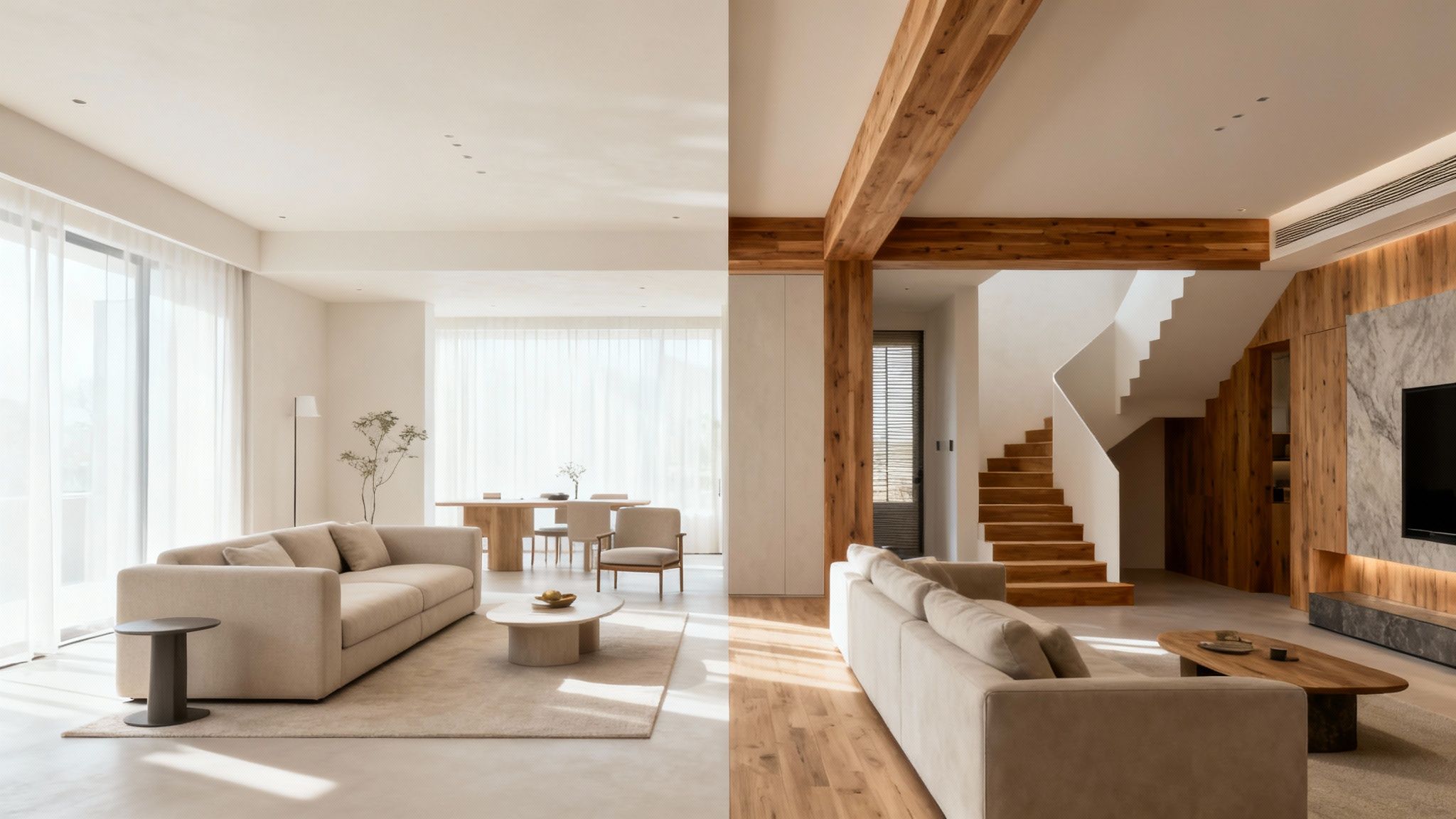
While stick-built homes have always been the king of unlimited design, you’d be shocked at the level of personalization you can get with modern modular homes today. The real difference isn't if you can customize, but how the customization happens.
Think of it this way: Stick-built construction is like sculpting from a fresh block of clay. The only limits are your imagination, your budget, and maybe the laws of physics. Modular, on the other hand, is like building with an incredibly sophisticated set of architectural LEGOs. You have a massive collection of high-quality pieces to combine and arrange into something that is absolutely yours.
The Unmatched Freedom of Stick-Built Homes
With a traditional stick-built home, every single detail is on the table. If you've spent years sketching a one-of-a-kind curved staircase, dreaming of an asymmetrical roofline, or picturing a sprawling open-concept living room that melts into an outdoor kitchen—it can be built. This route offers total architectural freedom.
Here at SEGC, we’ve helped bring some truly incredible visions to life for families around Fayetteville. I remember one project where the homeowner wanted to use reclaimed timber from an old family barn as the great room's ceiling beams. That’s the kind of deeply personal touch and on-the-fly creativity that really defines a stick-built project. The whole process is more fluid, which means you can make changes and inspired decisions even after the work has started.
Modular Homes Are Anything But "Boxy" Anymore
Now for modular. Forget everything you think you know. The days of identical, boxy modular homes are ancient history. Today’s modular builders have catalogs overflowing with fantastic options. You start with a great floor plan and then layer on all the personal touches that make it feel like home.
You can customize far more than you think:
- Architectural Styles: Whether you love a classic Colonial, a cozy Craftsman, or a sharp modern design, you can get the exact exterior look you want.
- Finishes and Fixtures: You’re still the one picking out the cabinets, countertops, flooring, lighting, and faucets—just like you would in any custom home.
- Layout Changes: Many manufacturers are flexible, letting you move interior walls, add extra windows, or build in features like vaulted ceilings and unique built-ins.
Our Local Expertise: We recently worked with a family in Lumberton who needed the speed of modular but didn’t want to compromise on style. They chose a gorgeous farmhouse plan and then went to town customizing it with a gourmet kitchen, a spa-like master bath, and a huge wrap-around porch that we added on-site. When it was all done, you’d never in a million years guess their stunning home came from a factory. It was the perfect marriage of factory precision and their personal taste.
If you’re the type who wants to dream up a home from scratch and have complete control over every last angle and nail, then designing a fully custom home the stick-built way is probably your jam. But if you appreciate a more streamlined design process that still delivers a beautiful, personalized home much faster, modern modular is a phenomenal choice.
With over 21+ years of experience, we've learned the best path is simply the one that fits your creative vision and practical needs. We're here to help you figure out which one that is.
Quality, Durability, and What Your Home is Worth Down the Road
When you're building a home, you're not just thinking about paint colors and floor plans; you're creating a cornerstone for your family's future. That's why the conversation about quality, long-term durability, and what it'll all be worth someday is so crucial in the modular home versus stick-built home debate. As an 8(a) and HUBZone certified firm, our reputation is built on quality, ensuring your home isn't just a place to live, but a rock-solid investment for generations.
Let's bust a myth right off the bat: quality isn't about where a home is built. It's about how it's built. Whether it comes together in a factory or piece-by-piece on your land, a home constructed by a skilled, reputable builder will be strong, durable, and valuable. The real difference is in the process.
Precision Engineering vs. On-Site Craftsmanship
Modular construction is a bit like a high-tech assembly line for homes, and that controlled factory setting brings some serious perks.
- Protected Materials: Lumber and other components stay high and dry, never getting hit by rain, snow, or humidity. This means no warping, no mold, and no weather damage before the walls are even up.
- Built-in Quality Control: Every single step is standardized and checked by inspectors. This ensures each module is built to precise engineering specs, every single time.
- Tougher Than it Needs to Be: Modular sections have to be strong enough to be shipped down a highway and lifted by a crane. To handle that stress, they’re often built with up to 20% more lumber than a comparable site-built house, making the final structure incredibly rigid.
On the flip side, the soul of a stick-built home is the on-site craftsmanship. This is where a master carpenter can really shine, adapting to unique designs and adding that human touch. The quality of a stick-built home hinges entirely on the skill of the builder and their crew. A truly great one is a work of art, with every joint and finish telling a story of expertise.
The SEGC Commitment to Quality: "A home's true quality isn't about factory versus field; it's about the builder's commitment. For over 21 years, whether in Fayetteville or Lumberton, we've built our reputation on a promise—every home, modular or stick-built, receives the same unwavering dedication to excellence. That’s how you build trust that lasts a lifetime."
Durability and Building Codes: A Level Playing Field
This is a big one, so let’s be crystal clear: a modular home is not a mobile home. It’s not even in the same ballpark. Once a modular home is set on its permanent foundation, it has to meet the exact same state and local building codes as any stick-built home next door. Period.
When it comes to safety, structural integrity, and energy efficiency, the rulebook is the same for both. From the footings to the final shingle, both types of homes are engineered to handle whatever North Carolina's weather decides to throw at them. The inherent strength of a modular home—born from its need to travel—often makes it a beast. In the same way, a well-built stick home constructed by an experienced crew is a fortress of traditional strength. The durability of your legacy really comes down to the builder you choose.
Let's Talk Resale Value
Alright, let's get to the bottom line: the long-term investment. How does a modular home's value hold up against a stick-built one? Simple. Once the construction is finished and the keys are in your hand, appraisers and lenders see them as one and the same.
They appreciate at similar rates, influenced by the exact same things: location, location, location… plus size, condition, and market trends. A beautiful, well-kept modular home in a great neighborhood will be just as valuable as its stick-built neighbor. The construction method becomes a footnote in its history. What matters is the quality of the finishes, the curb appeal, and the love it's been shown over the years. Your home's future value is tied to its quality and location, not its origin story.
Making The Right Choice For Your Family
So, modular or stick-built? It's a huge decision, but it doesn't have to be a stressful one. Honestly, the whole modular home versus stick built home debate comes down to what fits your family's life, your timeline, and your budget. There's no magic "best" choice—just the one that's best for you.

Let's cut through the noise. With over 21+ years building homes all over North Carolina, we've seen it all. Here are some real-world situations where one option clearly pulls ahead of the other.
When Modular Shines
Modular is the hero for families who need predictability. It's all about getting a high-quality home on a tight schedule without the budget spiraling out of control.
- You've Got a Hard Deadline: Maybe you're relocating to the Fayetteville area for a military assignment or you’re determined to be in your new home before the first school bell rings. The speedy, streamlined modular process is a lifesaver in these scenarios.
- You Need Cost Certainty: Let's face it, surprise costs are the worst. Because materials are bought in bulk and the construction happens in a controlled factory setting, the price you're quoted for a modular home is pretty much the price you'll pay.
When Stick-Built Is The Clear Winner
For those with a grand, unique vision, nothing beats the classic stick-built approach. It’s all about total creative freedom and the ability to adapt to anything the land throws at you.
- Your Design Is Truly One-of-a-Kind: If your dream home is something you’ve sketched out on a napkin—complete with dramatic rooflines, odd angles, or a crazy-cool open floor plan—you need the blank-canvas freedom of stick-built construction.
- Your Lot Is Tricky: Building on a steep hill or a hard-to-reach property in the Lumberton area? Trying to deliver massive factory-built modules can be a logistical nightmare. Building from the ground up on-site just makes more sense.
Actionable Insight: At SEGC, we’re not here to sell you on one method over the other. Our goal is to empower you with honest, straightforward guidance. As a Native American-owned, 8(a) certified firm, we're dedicated to building legacies, and that starts with being a partner you can trust. Our advice is always based on what's best for your family.
At the end of the day, both paths get you to a beautiful, well-built home. And more and more, families are thinking about the long-term picture—not just the initial build, but the home’s environmental impact. This often means aiming for top sustainable building certifications to ensure lasting value.
No matter which way you're leaning, the first step is always the same: find a builder who gets it. Give our team a call. We’d love to hear about your plans and figure out how we can help you build your family’s future, together.
Got Questions? We've Got Answers.
After weighing the pros and cons of modular and stick-built homes, a few common questions always seem to surface. With over 21+ years in the business of helping families figure this out, we've heard them all. As a proud, Native American-owned firm, we believe in giving you the straight scoop so you can make the right call with confidence.
How Does Financing a Modular Home Compare to a Stick-Built?
Believe it or not, they’re more alike than you'd think. Once the dust settles and your home is complete, both qualify for the same traditional mortgages. The real difference is how you get there.
A modular home typically needs a construction-to-permanent loan. This loan pays the factory in draws as your home's modules are built. Stick-built construction uses a similar loan structure, but the payments go to your on-site contractors as they hit various milestones.
The trick is finding a lender who gets it. Here at SEGC, we’ve spent years building solid connections in the Fayetteville and Lumberton communities. We can point you to local lenders who know the ins and outs of both financing paths, making sure your journey is a smooth one.
Do Modular Homes Appraise for the Same Value as Stick-Built Homes?
Yes, they absolutely do, and this is a big one. As soon as a modular home is set on its permanent foundation, it becomes real estate—end of story.
Appraisers use the same playbook for both: they look at the location, square footage, the quality of your finishes, and what similar homes are selling for in your neighborhood. There’s no “modular discount” in the appraisal. A quality modular home will gain value right alongside its stick-built counterparts. The key is not to confuse them with mobile homes, which are personal property and tend to depreciate.
Can I Build My Home on Just Any Plot of Land?
Not quite. Whether you go modular or stick-built, you’ll have to play by the rules—that means local zoning laws, building codes, and any pesky HOA covenants.
Modular homes have one extra hurdle: getting there. We have to make sure the roads to your property can handle the wide load of your home's modules. No low-hanging bridges, tight corners, or impassable roads allowed. Stick-built homes can face their own challenges, especially on remote or tricky sites.
Actionable Insight: That’s why the SEGC team always starts with a deep-dive site evaluation. We make sure the land you love is ready for the home you want, saving you from headaches and unexpected costs down the road. This is a critical first step to ensure you're building your legacy on solid ground.
At South Eastern General Contractors, we're not just putting up walls; we're building legacies for families. Our 21+ years of proven results, local leadership in Fayetteville and Lumberton, and commitment to quality make us the trusted choice for your new home. If you’re ready to start a conversation about your family’s future, let's talk. Find out more by visiting us at https://www.southeasterngc.com.